Deng Tong, Golden Finance
On November 6, 2025, the Ethereum Foundation announced the Fusaka upgrade. The Fusaka network upgrade is scheduled to activate on December 3, 2025, at 21:49:11 UTC, marking an important step forward in Ethereum's scaling roadmap. The core of Fusaka lies in: adding PeerDAS for scalable blob data availability, introducing a branch that contains only the Blob parameter (BPO) for flexible capacity increases, stabilizing the basic fees for blobs, and implementing new security restrictions to maintain network decentralization while accommodating throughput growth.
In short, Fusaka is an infrastructure adjustment for Ethereum that includes about a dozen EIPs, making the protocol faster, more streamlined, and cheaper, especially suitable for Layer-2 networks like Arbitrum, Optimism, and Base, which now handle most of the Ethereum activity.
According to the information shared on the official Ethereum page, the name “Fusaka” is a combination derived from the upgrades of the Ethereum core layer, which includes Fulu and Osaka.
1. Fusaka Upgrade Overview
The main feature of Fusaka is PeerDAS (Peer Data Availability Sampling), which can significantly increase blob throughput. Fusaka has also optimized the execution layer and consensus layer to enhance L1 layer performance and improve user experience.
Scale Blobs
PeerDASEIP-7594 introduces PeerDAS, a new network protocol that allows nodes to verify the availability of data blocks by sampling rather than downloading the entire data block. This is a key step in enhancing data block throughput while maintaining the security and decentralization of Ethereum.
Since the Dencun upgrade, the usage of layer 2 data has significantly increased, often reaching the current limit of 9 blobs per block. PeerDAS allows Ethereum to raise this limit without compromising security. It achieves this by using erasure coding, which enables nodes to sample part of the blob data while ensuring that the entire network has access to the complete data through encryption technology. This paves the way for achieving the higher blob targets outlined in Ethereum's scalability roadmap.
This sampling method directly benefits layer 2 rollups because it supports higher data block throughput without proportionally increasing the bandwidth demands on individual nodes. As data block capacity expands beyond current limits, layer 2 transaction fees can be further reduced while maintaining the security guarantees of Ethereum layer 1 data availability.
After PeerDAS activation, Ethereum will utilize a fork with only Blob parameters (BPO) to securely increase blob throughput, rather than bundling blob parameter adjustments with naming forks. The Fusaka plan is to conduct two BPO parameter adjustments on the mainnet starting from December 9, 2025. These two BPO adjustments will increase the blob target and maximum values for each block from 6 and 9 to 10 and 15 in BPO1, and 14 and 21 in BPO2.
Scale L1
ModExp optimizes EIP-7883 and EIP-7823 to work together, optimizing the ModExp precompiled contract. EIP-7883 increases the gas cost to more accurately reflect the computational complexity, including raising the minimum gas cost and tripling the general cost calculation. EIP-7823 sets a cap on the ModExp operation. These changes together ensure reasonable pricing for resource-intensive cryptographic operations and support potential increases in future block gas limits.
The transaction gas limit EIP-7825 implements a protocol-level transaction gas limit of 16,777,216 gas, preventing a single transaction from consuming too much block gas and guarding against DoS attacks. This lays the foundation for parallel transaction processing in the EVM.
The network protocol optimization EIP-7642 introduced eth/69, removing the pre-merge fields and receipt Bloom from the network protocol. This cleanup reduced synchronization bandwidth requirements, provided a clear historical service window for nodes to broadcast, and simplified the codebase by removing old components that are no longer needed after the merge.
Gas Limit Increase EIP-7935 raises Ethereum's default Gas limit to 60M, reflecting the core developers' belief that Ethereum L1 can safely scale to this Gas limit at present. This increase enhances L1's execution capacity and has been thoroughly tested across different client combinations to ensure network stability and security.
Improve user experience
secp256r1 Precompiled EIP-7951 adds native support for the secp256r1 elliptic curve through a new precompiled contract. This enables the blockchain to directly integrate with modern security hardware such as Apple Secure Enclave, Android Keystore, and FIDO2/WebAuthn devices, lowering the barrier to mainstream blockchain adoption through familiar authentication processes.
The leading zero counting opcode EIP-7939 introduces the CLZ (Count Leading Zeros) opcode, providing a native and gas-efficient way to perform basic counting operations. This new feature supports mathematical operations, compression algorithms, and post-quantum signature schemes, while reducing the cost of zero-knowledge proofs.
Fusaka Version Core EIP
- EIP-7594: PeerDAS - Peer Data Availability Sampling
- EIP-7823: Set the upper limit for MODEXP
- EIP-7825: Transaction Gas Limit Cap
- EIP-7883: ModExp Gas cost increase
- EIP-7917: Deterministic Proposer Front
- EIP-7918: The basic cost of Blob is limited by execution costs.
- EIP-7934: RLP Execution Block Size Limit
- EIP-7939: Count Leading Zeros (CLZ) opcode
- EIP-7951: Precompiled support for secp256r1 curve
Other supportive EIPs:
- EIP-7642: eth/69 - Remove pre-merge field
- EIP-7892: Hard fork with only Blob parameters
- EIP-7910: eth_config JSON-RPC method
- EIP-7935: Set the default Gas limit to 60M
2. The Significance of the Fusaka Upgrade
The core of the Fusaka upgrade lies in the expansion of “blob” data storage, a technology that was introduced earlier this year in the Dencun upgrade. These blobs are not just technical terms; they represent specialized data units designed to optimize Layer 2 data aggregation, significantly reducing transaction costs and accelerating processing speeds. The initial capacity of this Ethereum upgrade will double—up to 21 times—enhancing efficiency and repositioning it to meet the growing demands of its large user base.
The increase in Blob capacity this time reflects Ethereum's emphasis on stability and security.
For Web3 startups that are deeply entangled in regulatory challenges and complex payment issues, the Fusaka upgrade can serve as a forward-looking strategic blueprint. By reducing reliance on traditional centralized compliance models (such as traditional banking APIs), these innovative enterprises can move forward with greater agility while maintaining compliance. The transition to a decentralized framework can significantly lower costs, especially in cross-border transactions, thereby consolidating Ethereum's position as a cornerstone of contemporary entrepreneurship.
Fusaka brings not only an improvement in efficiency, but also consolidates Ethereum's position as the preferred platform for decentralized applications. With a simplified transaction process and continuously decreasing costs, users can expect a higher quality experience, encouraging both businesses and individual users to actively participate in the blockchain world. As layer two scaling solutions become increasingly popular, we may see both enterprises and individual users eager to connect to future-oriented blockchain infrastructure.
Fusaka may become a turning point for Ethereum's scalability to address the next wave of Layer 2 applications.
3. What Fusaka Means for Developers, Node Operators, and Users
For developers and L2 teams: Fusaka provides more convenient data and new tools, such as support for passkeys and the new CLZ opcode, enabling more efficient complex on-chain computations. These updates collectively reduce gas costs and simplify the development of applications using advanced logic or cryptographic proofs.
For Institutions and Validators: Fusaka provides validators with more predictable operations through a deterministic proposer foresight mechanism and an improved blob fee mechanism. This stability helps institutional stakers plan workloads, manage risks, and maintain stable returns, while fee adjustments contribute to building a more sustainable and transparent staking economy. Additionally, EIP-7935 raises the default block gas limit to around 60 million, expanding block capacity, which means more transactions can be processed, yielding higher potential priority fees (tips), and more MEV opportunities during high demand periods. However, the downside is that processing larger blocks increases the hardware, storage, and bandwidth requirements for nodes.
For users: No action is required. However, the benefits will be indirectly felt through faster and cheaper transactions on L2 nodes. Soon, new applications will also be seen, allowing the use of biometric information from mobile phones instead of mnemonic phrases, making cryptocurrency simpler and safer.
4. The Controversy of Fusaka
One of the main controversies surrounding Fusaka is the proposal to incorporate the Ethereum Virtual Machine Object Format (EOF), which amounts to a significant restructuring of the storage and execution methods of smart contracts. EOF was once considered for inclusion in Pectra and was later included in the initial plans for Fusaka. However, after intense discussions (involving issues such as complexity, compatibility, and upgrade risks), in order to ensure project progress and stability, Fusaka ultimately removed EOF.
This decision highlights the dilemma Ethereum faces in advancing EVM modernization while providing stable and timely upgrades. Although EOF may return in future forks such as Glamsterdam, its exclusion from Fusaka indicates how Ethereum has made prudent trade-offs to address community and technical constraints.
5. Will the price of ETH rise as a result?
If we refer to the impact of previous Ethereum network upgrades on ETH prices, ETH may be preparing for a new round of strong upward movement. The Pectra upgrade on May 7th this year triggered a significant increase in ETH within just a few days.
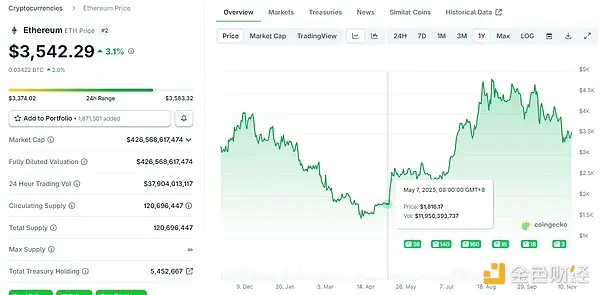
The Fusaka upgrade will further transform Ethereum into a more efficient and future-oriented network, thus, ETH may also see a rise in market trends again.
Six, the Next Upgrade of Ethereum: Glamsterdam
Ethereum developers are working hard to advance the next hard fork, named Glamsterdam. It is expected to be launched in 2026. The name of this upgrade is a combination of “Glamour” and the city where Devcon is held, “Amsterdam”, and will further promote the development of Ethereum in terms of scalability, security, and sustainability.


