The pre-storage event of MegaETH has been declared a failure, as a series of technical failures disrupted the originally planned open process for verified users. The team stated on the X forum that configuration errors and rate limit issues led to the failure of the platform's KYC (Know Your Customer) system. MegaETH ultimately froze deposits at $500 million and canceled the plan to expand the fundraising scale to $1 billion.
Technical Failure Erupts Completely: From KYC Collapse to Early Execution of Multi-Signature
The MegaETH pre-storage phase experienced multiple technical failures that caused fundraising to exceed the limit, forcing the team to stop sales. Pre-storage is an opportunity for verified users to lock in their MEGA token allocation in advance, but this event has been chaotic from the beginning. Configuration errors and rate-limiting issues led to the platform's KYC system failing, which meant that many users who had been verified could not smoothly access the pre-storage page, while some users who had not completed KYC unexpectedly gained deposit privileges.
The collapse of the KYC system exposed MegaETH's inadequate preparation in user management and process control. KYC is the foundation of compliance for cryptocurrency projects, especially for large projects raising hundreds of millions of dollars. The system failure not only violated the commitment of “verified users only” but also laid hidden dangers at the legal compliance level. If unverified users participate in deposits, the project may face investigations from regulatory authorities.
A more serious issue is the premature execution of Safe multi-signature transactions. Safe (formerly Gnosis Safe) is the most commonly used multi-signature wallet solution in the Ethereum ecosystem, used to manage high-value assets and execute transactions that require multi-party authorization. The MegaETH team had prepared a multi-signature transaction in advance, planning to increase the limit to 1 billion USD after reaching the 250 million USD cap. However, this transaction was accidentally executed without meeting the triggering conditions, resulting in the deposit channel remaining open and a large influx of funds.
The agreement states: “The cap of $250 million is filled by those who continuously refresh the pre-deposit website and seize random opening times.” This description reveals another technical issue: the unstable opening times of the pre-deposit page require users to refresh frequently to capture the brief deposit window. This poorly designed experience has sparked dissatisfaction within the community, with many genuine early supporters excluded due to their inability to access it in time.
MegaETH Technical Downtime Timeline
KYC system crash: Verified users cannot enter, unverified users unexpectedly gain access.
Deposit page is unstable: Random open times drive users to refresh crazily.
Multisig transaction misexecution: A transaction prepared to increase the limit is triggered prematurely.
Financing exceeds standards: Soaring from an expected $250 million to $500 million
Emergency Freeze: Halt all deposits and cancel the $1 billion fundraising plan.
From 250 million to 500 million: Out-of-control fundraising and forced cancellations of expansion
MegaETH will ultimately freeze deposits at $500 million and has canceled plans to expand the fundraising scale to $1 billion. This figure is double the original cap, indicating that the team has completely lost control over the fundraising process. Options for retroactive deposits and withdrawals will be launched soon, meaning the team will need to review all deposits one by one to distinguish which are compliant verified user deposits and which need to be returned.
“Assets have never faced risks, but that doesn't matter; we hold ourselves to a higher standard, with no excuses,” the team added. This statement attempts to reassure investors, emphasizing that the safety of funds is not threatened, but also acknowledges failures in process management and technical execution. For a project backed by Vitalik Buterin and Joe Lubin, aiming to become a high-performance Ethereum L2, such levels of technical errors are unacceptable.
Cancelling the $1 billion expansion plan was a passive decision made by the team under pressure. The original plan was to first complete a $250 million pre-sale, and after assessing the market response, decide whether to expand to $1 billion. However, technical failures led to the fundraising being completed in an uncontrolled manner, forcing the team to urgently halt and freeze the funds. This passive handling exposes the project's deficiencies in risk management and emergency response plans.
The community's reaction to this is divided. Some users praise MegaETH for its transparency in explaining the events, believing that the team deserves recognition for promptly disclosing the issues and taking responsibility. However, there are also users who hold a critical attitude. Developer and DAO founder AzFlin argues that these mistakes could have been avoided if the engineers had been more cautious. He points out that the erroneous execution of multi-signature transactions should not have occurred, as Safe's operating procedures are already quite mature; strictly adhering to best practices can prevent such blunders.
Comparison between 1.3 Billion Dollar Auction and Pre-stored Disaster
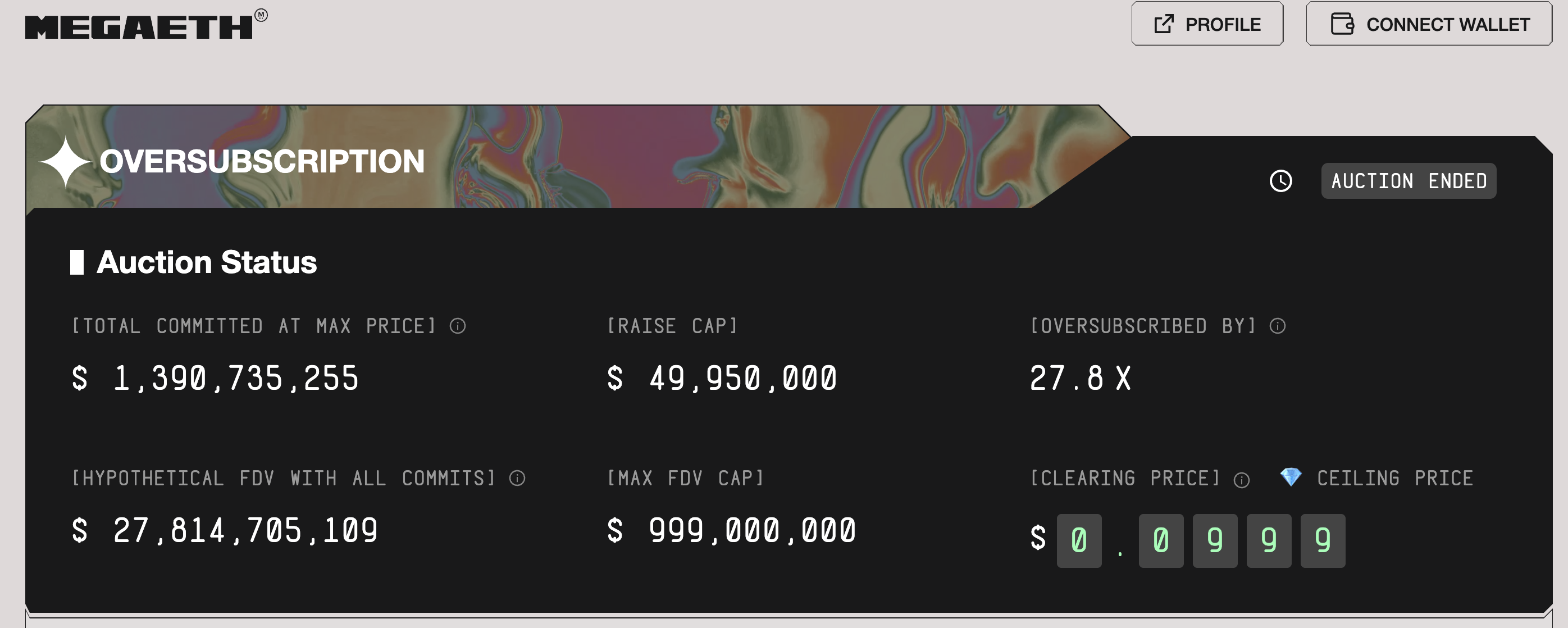
(Source: MegaETH)
The deposit window closely followed the MEGA token auction of MegaETH, which started on October 27 and was fully subscribed within minutes. That sale offered 5% of a total supply of 10 billion tokens, with bids ranging from $2,650 to $186,282, and an option to lock for one year, which provided a 10% discount for the one-year lock. The auction ended on October 30, ultimately attracting over $1.3 billion in subscription commitments, making it one of the hottest fundraising events of the year.
Due to the donation amount far exceeding the limit, MegaETH stated that it will rely on a “special allocation mechanism” to determine the final amount received by each participant. The success of the auction sharply contrasts with the failure of the pre-sale. The former showcases the strong demand for MegaETH in the market and confidence in its technological vision, while the latter exposes the team's serious shortcomings in execution and technical readiness.
This contrast raises a key question: if MegaETH cannot avoid technical failures even in a simple pre-storage process, how can it convince investors that it can achieve a technical target of processing 100,000 transactions per second with latency below the millisecond level? The core competitiveness of L2 scaling solutions lies in technical reliability and system stability, and this pre-storage disaster has precisely sounded the alarm in these two areas.
Vitalik Buterin Endorsement and High-Performance Vision
MegaETH is built by MegaLabs, and the team has received support from key industry figures including Ethereum co-founders Vitalik Buterin and Joe Lubin. Vitalik Buterin's endorsement carries significant weight in the Ethereum ecosystem, and his support often brings substantial attention and capital inflow to projects. Joe Lubin, as the founder of ConsenSys, also holds a prestigious position within the Ethereum developer community.
After the test network went live in March, the current goal of the project is to process 100,000 transactions per second with a latency of less than a millisecond. This performance target is highly ambitious, far exceeding most current L2 solutions. The TPS (transactions per second) of Arbitrum and Optimism typically ranges from thousands to tens of thousands, while MegaETH's commitment of 100,000 TPS would place it in a performance tier comparable to or even higher than Solana (theoretical TPS 65,000).
MegaETH is a Layer 2 protocol on Ethereum designed to provide ultra-low latency block processing and throughput, comparable to real-time Web2 applications. This positioning targets latency-sensitive application scenarios such as high-frequency trading, on-chain gaming, and instant payments. If it can fulfill its technological promises, MegaETH will bring a qualitative leap to the Ethereum ecosystem. The MEGA token is expected to be issued in early 2026.
However, this pre-storage disaster has cast a shadow over the project's technical reputation. Investors and developers cannot help but question: does a team that cannot even execute the pre-storage process smoothly really have the ability to build and maintain a high-performance blockchain capable of handling 100,000 TPS?
Disclaimer: The information on this page may come from third parties and does not represent the views or opinions of Gate. The content displayed on this page is for reference only and does not constitute any financial, investment, or legal advice. Gate does not guarantee the accuracy or completeness of the information and shall not be liable for any losses arising from the use of this information. Virtual asset investments carry high risks and are subject to significant price volatility. You may lose all of your invested principal. Please fully understand the relevant risks and make prudent decisions based on your own financial situation and risk tolerance. For details, please refer to
Disclaimer.


