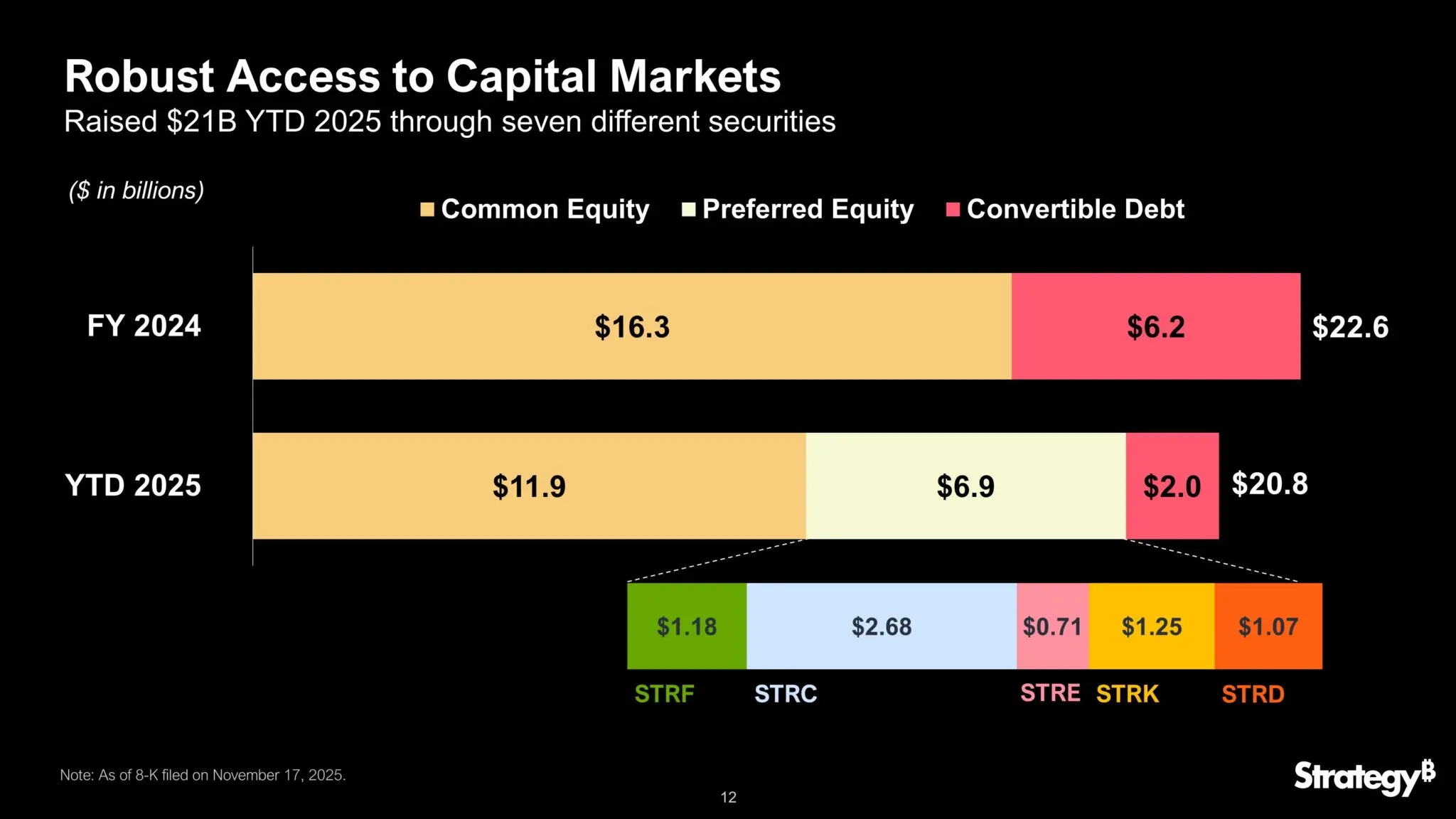
MicroStrategy (MSTR) holds approximately 641,000 Bitcoins, worth $56 billion. However, why is Wall Street preventing MicroStrategy from entering the S&P 500 index? The core reason lies in the company's inability to meet the index requirements of positive earnings for four consecutive quarters, with its stock price falling 68% from its peak, institutional investors reducing their holdings by $5.38 billion, and severe equity dilution caused by raising $21 billion through seven securities issuances within a year.
Radical expansion strategy evolves into structural contradictions
(Source: MicroStrategy)
MicroStrategy raised $21 billion through seven securities issuances within a year, expanding its holdings of Bitcoin to approximately 641,000 coins. The company issued $11.9 billion in common stock, $6.9 billion in preferred stock, and $2 billion in convertible bonds, using the proceeds to continuously purchase Bitcoin throughout the year. This sequential arrangement of financing not only expanded the company's cash reserves but also reshaped the company's image.
However, as the balance sheet grew to historic proportions, the equity story began to unravel. Each new round of financing increased the number of outstanding shares, diluting the interests of existing shareholders and indicating that management prioritized the expansion of cash reserves over stable profits or stock performance. The company initially adopted an aggressive expansion strategy, relying on leverage and diluting existing shareholder interests, but this strategy ultimately evolved into a structural contradiction, which has now become emblematic of the company.
This company no longer operates like a software developer or technology platform; its trends almost sync with Bitcoin itself, but its capital structure resembles an experiment in perpetual leverage. Investors are faced with an entity that generates billions in profits when Bitcoin rises and incurs billions in losses when it falls. For many, this volatility is acceptable, but the added equity dilution on top of this is unbearable.
Three Major Consequences of Capital Operations Over One Year
Equity Dilution: The issuance of 11.9 billion dollars of common stock significantly increases the number of shares outstanding, continuously weakening the rights of existing shareholders.
Identity Transformation: Completely transformed from a software company to a Bitcoin agent, losing traditional business support.
Institutional Exodus: Over the past two quarters, institutional holdings have decreased from 36.32 billion USD to 30.94 billion USD, a reduction of 5.38 billion USD.
Why did Wall Street prevent MicroStrategy from entering the S&P 500? Profitability stability is the Achilles' heel
Why is Wall Street blocking MicroStrategy from entering the S&P 500 index? The most direct answer lies in the index rules. The strategy meets the market capitalization and liquidity thresholds of the S&P 500 index, but the index requires positive returns for four consecutive quarters. Since MicroStrategy's profits are directly linked to the price fluctuations of Bitcoin, the company finds it difficult to generate sustained returns under the accounting framework used by the S&P for determining eligibility.
In the quarters where Bitcoin prices rise, MicroStrategy's profits also soar. Conversely, in the quarters where Bitcoin prices fall, its losses are equally massive. This volatility has effectively prevented the company from being included in indices and has eliminated substantial passive demand that could have supported its stock price. The 68% drop from its peak is a direct reflection of this structural issue.
This exclusion is crucial because MicroStrategy has sufficient liquidity and a large number of outstanding shares, making it a logical next step for a company of this size to be included in the index. However, the company still relies on active investors who must assess the comprehensive risks associated with leverage, equity dilution, and the profit volatility related to Bitcoin.
The cautious stance of the S&P 500 Index Committee reflects broader institutional concerns. Over the past two quarters, institutional investors have reduced their holdings from $36.32 billion to $30.94 billion, a decrease of $5.38 billion, which not only reflects the overall risk rotation in the market but also their genuine concerns about the MicroStrategy financing model. In a market that rewards asymmetric exposure to Bitcoin price increases, this approach may be sustainable. However, in an environment where investors are increasingly seeking predictable cash flows and balanced operating models, the structure of MicroStrategy makes it difficult for large portfolios to justify the rationale for continuing to hold this strategy.
Custody Restructuring and Transparency Trade-offs
(Source: Arkham)
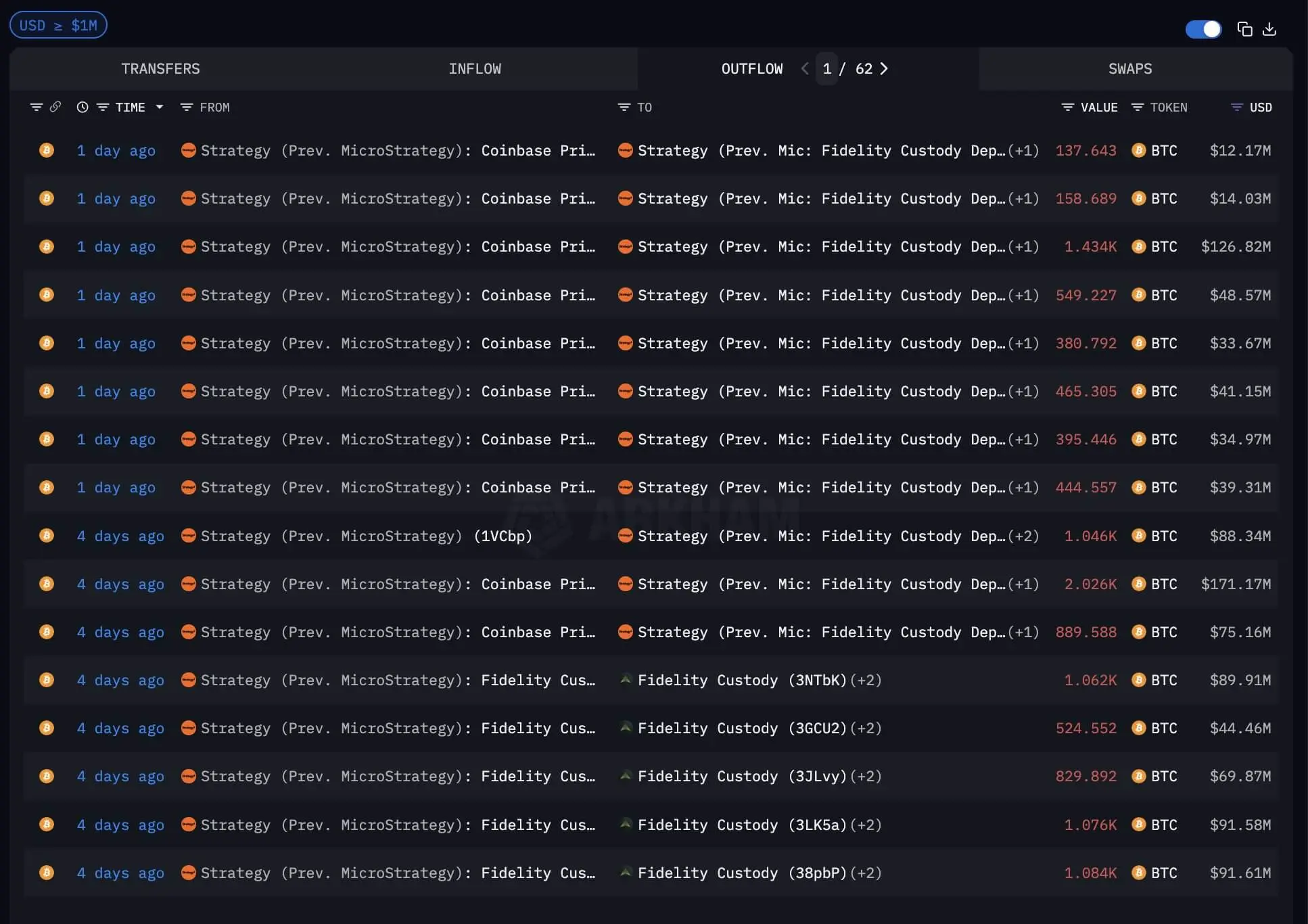
Blockchain analysis platform Arkham Intelligence reported that MicroStrategy transferred approximately 58,000 Bitcoins (about 5.1 billion USD) to Fidelity Digital Assets within two months. It also added: “MicroStrategy holds a total of 641,692 Bitcoins (worth 56.14 billion USD), of which 165,709 Bitcoins (worth 14.5 billion USD) have been sent to Fidelity Custody.”
This decision reflects the company's broader reassessment of operational risks. For many years, the company primarily relied on Coinbase as its custodian, but it has now adopted a multi-custodial service provider model, which aligns more with the expectations of lending institutions and credit analysts who prefer diversified custodial arrangements. This change also comes with some trade-offs. Fidelity has adopted an integrated custodial structure that aggregates client assets on-chain.
The model has increased redundancy, meeting the expectations of institutional trading counterparties, but it has eliminated the direct visibility that analysts once had in tracking MicroStrategy's holdings through identifiable wallet clusters. In the previous setup, the company's solvency status could be monitored by cross-referencing public addresses with company disclosures. The comprehensive framework has replaced this immediate transparency with custodian statements and internal audit controls, which, while providing security and operational strength, has diminished the external interpretability that retail traders and on-chain researchers once relied on.
The Duality of BTC Rating Indicators
(Source: MicroStrategy)
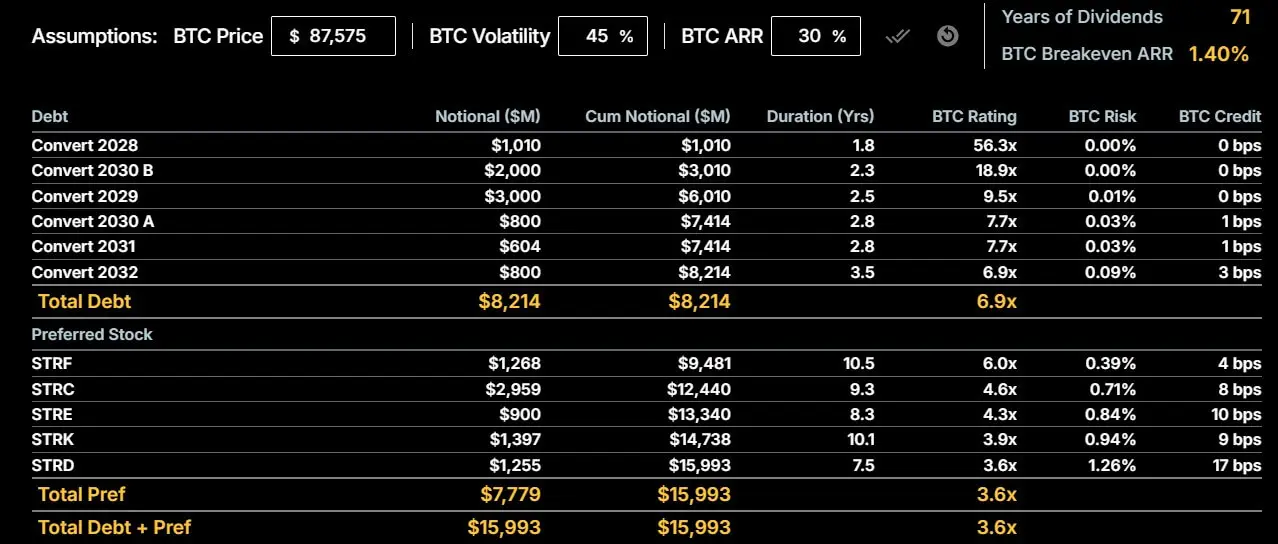
As the company's debt scale expands, management has introduced an unconventional metric. The “Bitcoin (BTC) rating” strategy measures the coverage of convertible bonds by comparing the market value of the Bitcoin treasury with the face value of the debt. This ratio aims to simplify credit discussions by focusing on asset coverage rather than revenue volatility.
Assuming the price of Bitcoin is $74,000 (consistent with the total cost basis of the strategy), its coverage ratio is 5.9 times. It is worth noting that even if the price falls significantly to $25,000, the coverage ratio only decreases to 2.0 times, which is still above the face value of the bonds. This presentation is reassuring for creditors. Data shows that even under adverse circumstances, the strategy can maintain substantial collateral protection.
However, the shareholders have a different view. The BTC rating does not take into account the equity dilution required to maintain treasury expansion, nor does it mitigate the volatility that directly affects quarterly performance. Essentially, this indicates that the company's creditors can clearly understand the risk exposure, while the shareholders bear the structural consequences of the ongoing issuance of shares.
Divided Company Identity and Future Challenges
MicroStrategy has achieved a scale that no other publicly traded company has attempted. It has built an unprecedented corporate Bitcoin reserve, diversified its custodians, and designed a new debt coverage ratio metric to stabilize its credit situation. The company has demonstrated that the public market can fund a billion-dollar Bitcoin accumulation model.
It has yet to establish a stable equity structure. Investors who once viewed this stock as a leveraged alternative to Bitcoin now face a capital structure that requires constant dilution of equity to maintain growth rates. The result is an increasingly fractured identity for the company: a company that has built a large digital asset reserve through public market financing, but whose equity value reflects market skepticism regarding the strategic sustainability used to build that reserve.
The company has realized its ambition to dominate the Bitcoin treasury space, but the strategy that enabled this has continuously weakened the equity engine that funds it. The market's repricing reflects this tension, and the reason why Wall Street blocked MicroStrategy from entering the S&P 500 index is also tied to this: an entity that cannot generate stable profits and continuously dilutes shareholder equity, no matter how large its asset scale, struggles to meet the index's requirements for long-term stability.


