Deng Tong, Jinse Finance
On December 2, 2025, according to Nikkei News, gaming and technology giant Sony Group plans to issue a US dollar-denominated stablecoin next year, to be used for purchasing games and anime within its digital ecosystem.
Japan also has a regulatory framework for stablecoins, but why did Sony choose to issue its stablecoin in the US instead of Japan?
1. Where is Sony issuing its stablecoin?
Due to the passage of the GENIUS Act in the US earlier this year, the US is a strong option. Previously, Sony’s banking division, Sony Bank, submitted an application in October to obtain a US national banking license. This license will allow its trust bank subsidiary to engage in “certain specific activities involving cryptocurrencies.”
According to reports in October, this bank will operate as a trust company in the US and provide cryptocurrency services, including issuing US dollar-backed stablecoins, holding digital assets for clients, and managing assets for affiliated companies.
The target customers for this stablecoin are US clients, who account for about 30% of Sony Group’s overseas sales. The stablecoin is designed to work alongside existing payment methods such as credit cards and help reduce processing fees paid to card organizations.
Currently, when a player buys a $60 game on PlayStation (owned by Sony Interactive Entertainment), Sony must pay fees to credit card companies. By using its own stablecoin, these fees would be eliminated. The savings could result in lower prices for players or higher profits for Sony.
For PlayStation users, these changes will initially have little impact. The stablecoin will operate in parallel with existing payment methods, rather than replacing them entirely. Players might notice slightly lower prices or faster transaction processing, but the basic purchasing experience will remain the same.
Over time, Sony may develop more advanced features. For example, players could earn stablecoin rewards for completing games, or traditional currency could be automatically converted to digital currency at checkout. The company might also create cross-platform loyalty programs covering games, movies, and music services.
Sony Bank has partnered with stablecoin company Bastion, which will provide infrastructure for Sony’s stablecoin. Bastion is backed by major cryptocurrency exchange Coinbase. Sony’s investment division also participated in Bastion’s $14.6 million funding round, indicating that their cooperation extends beyond just technical support.
2. Why choose a US dollar stablecoin?
From a business perspective, Sony’s core digital businesses like gaming and anime heavily depend on US dollar markets. Besides the US, key markets in Europe and Southeast Asia also use the US dollar as the main settlement currency. Issuing a US dollar stablecoin best meets business needs and avoids cross-border currency exchange costs that a yen stablecoin would incur.
From a regulatory perspective, the US Stablecoin Act clearly requires reserve assets to be cash or short-term government bonds, and issuers must be licensed, with clear regulatory standards. Although Japan amended its Payment Services Act in 2023 to allow stablecoin issuance, it mandates a yen peg and restricts use cases, making it far less flexible than the US market.
Specifically, under the Stablecoin Act’s regulatory framework, stablecoins must be 100% backed by cash or short-term US Treasuries; only “qualified institutions” such as banks or federally or state-licensed non-bank payment institutions may issue them; and there’s no requirement for stablecoins to be pegged to the US dollar.
Although the Payment Services Act made Japan one of the first countries globally with a clear legal framework for stablecoins, it has its own regulatory logic. Japanese law requires stablecoins to be pegged 1:1 to the yen and only issued by a limited group such as banks, funds transfer institutions, and trust companies. Japanese regulators believe stablecoins should mainly be used for domestic small payments, settlements, and regulated financial services, and do not encourage DeFi, cross-border payments, crypto trading, or globalized circulation.
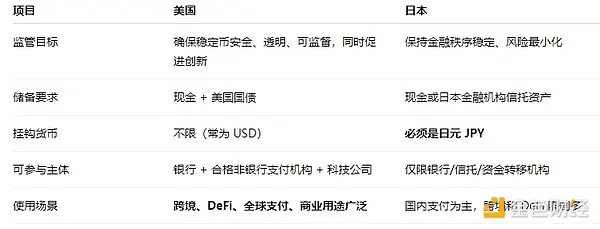
Therefore, under Japan’s stablecoin regulatory rules, stablecoin use is more conservative and not suitable for large enterprises like Sony. US dollar stablecoins, with broader participation and more use cases, are thus more attractive to Sony.
3. Opposition arises
Sony’s plan has faced strong opposition from traditional banks. The Independent Community Bankers of America (ICBA) has formally complained to federal regulators, requesting that Sony’s application be rejected.
The banking group argues that Sony’s stablecoin is similar to bank deposits but does not have to follow the same rules. Traditional banks must purchase federal insurance and invest in local communities, while Sony’s digital currency bypasses these requirements and directly competes with bank services.
The ICBA is also concerned about the consequences if Sony’s cryptocurrency business fails. Since 1933, federal regulators have never closed a non-insured national bank. Dealing with a failed crypto company involves many technical challenges and could result in customers being unable to retrieve their funds.
The regulatory review process could take 12 to 18 months. Public opposition from banking groups may prolong this even further.
4. Conclusion
The stablecoin market is rapidly expanding, and Sony’s first-mover advantage puts it in a strong position to shape digital payments in the gaming sector. Whether other major players will follow suit may depend on whether Sony can successfully navigate regulatory approval and win consumer acceptance in 2026.
Appendix: Other Sony Blockchain Initiatives
In 2021, Sony Music participated in a $30 million Series A funding round for NFT marketplace MakersPlace, marking its early exploration of NFT technology in the music industry.
In April 2022, Sony subsidiary Sony Network Communications and software development company Sun Asterisk established a joint NFT business in Singapore, with Sony holding a 70% stake and providing NFT issuance, game development, and other support services. That year, Sony officially launched the NFT platform SNFT; Sony Music partnered with Solana ecosystem NFT platform Snowcrash to issue a series of NFTs for artists such as Bob Dylan, and filed NFT-related trademarks for Columbia Records’ logo.
In August 2023, Sony Group’s wholly-owned subsidiary Quetta Web acquired Amber Japan, operator of the crypto trading platform WhaleFin, laying the foundation for future crypto asset business. In September, Sony invested $3.5 million in blockchain technology company Startale Labs, and the two jointly established a subsidiary focused on blockchain technology R&D and early-stage core blockchain network development.
In March 2024, Sony Bank announced plans to launch the NFT management app “Sony Bank CONNECT” in the summer, which will connect to the SNFT platform and offer users NFT privileges and access services. In April, Sony Bank conducted a stablecoin proof-of-concept pegged to fiat currency on the Polygon blockchain to evaluate legal issues and application feasibility. On July 1, the previously acquired Amber Japan was officially renamed S.BLOX, serving as Sony’s crypto exchange and bridging traditional and Web3 assets. In September, Sony officially launched the public blockchain Soneium’s testnet “Soneium Minato” and the “Soneium Spark” incubation project. Samsung’s venture fund Samsung Next announced an investment in Startale Labs and participation in the incubation program, signaling a joint effort between Japanese and Korean tech giants in the blockchain field. Additionally, the company responsible for Sony’s blockchain business was officially renamed Sony Blockchain Solutions Lab.
In January 2025, Sony’s Blockchain Solutions Lab launched the Soneium mainnet, an Ethereum Layer 2 blockchain network, continuing the testnet’s technical specifications and supporting seamless application migration and real crypto asset payments; on launch day, Sony banned several meme coin projects citing “intellectual property protection.”
Sony’s various business lines are deeply integrated with Soneium: Sony Pictures Entertainment offers exclusive access for users purchasing content on designated platforms, Sony Music Entertainment (France) issues limited edition NFTs, and Sony Music Publishing (Japan) launched NFT campaigns linked to girl group performances. Sony has also deepened cooperation with Astar Network, leveraging its technology and operational experience to expand the Web3 ecosystem, with the ASTR token becoming a core asset of Soneium.
Sony fans once hoped Soneium would attract large numbers of PlayStation games. However, so far, none of Sony’s mainstream game series have released crypto games on Soneium. It has, however, become a network with NFT music compilations and a growing small game library, and it once collaborated with Square Enix’s now-closed crypto game “Symbiogenesis.”


