Analysis of the altcoin season shows that altcoins appear to be closer to their bottom than their peak. This is the main message from the latest macro signals, and the charts also confirm this.
The Russell 2000 Index (IWM) has just recorded its strongest monthly close ever and is now approaching the upper end of its long-term range, nearing the highs of 2025. This is significant because this index often reflects liquidity fluctuations in the US.
Altcoin season accelerates as Russell 2000 hits record highs
When small-cap stocks break major resistance, it usually signals increased risk appetite. In previous market cycles, similar market activity pushed Bitcoin higher, with altcoin rallies typically following.
A similar scenario played out in 2007, 2015, 2018, and 2021. Once again, the Russell 2000 is retesting its peak, while Bitcoin and the broader altcoin group continue to trade below their all-time highs.
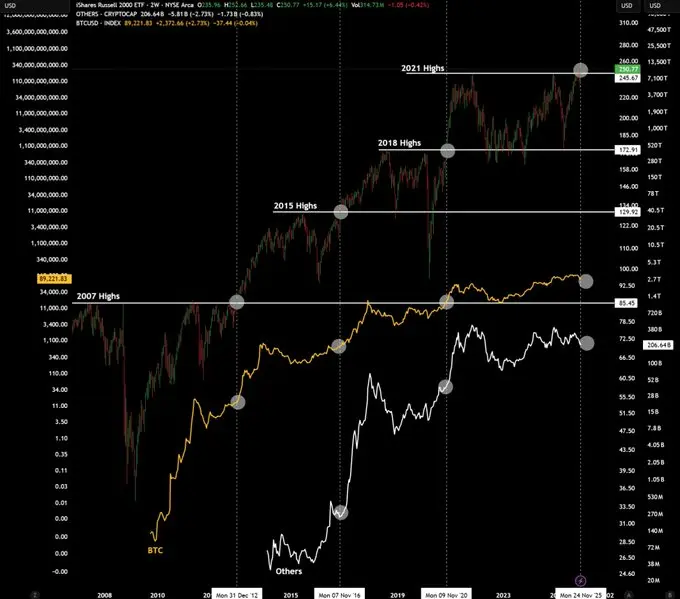 Altcoin season analysis | Source: Bull TheoryHistory shows this gap often leads to strong expansions for altcoins.
Bitcoin’s long-term uptrend supports a mid-cycle rally
Bitcoin’s long-term trend from the 2022 bottom is still intact, which also reinforces optimism for the altcoin season. Despite some corrections on the daily chart and the loss of a few short-term EMAs, the long-term structure remains bullish.
Price action resembles a mid-cycle dip rather than the start of a full-blown bear market. BTC is also showing signs of resynchronizing with the stock market after months of divergence. This is another positive signal.
When Bitcoin moves in tandem with other risk assets rather than in opposition, it often signals a more favorable environment for trend continuation. Bitcoin has never entered a prolonged bear market at the same time US small-cap stocks are making new highs.
In every major downturn—2014, 2018, and 2022—the Russell 2000 reversed sharply lower before Bitcoin started to weaken. That is not happening now.
Macro factors support an extended bull cycle for BTC and altcoins through 2026
The macro picture is also shifting in a way that typically supports Bitcoin and altcoin growth. The Fed has started cutting interest rates, easing pressure on risk assets after the tough periods of 2022 and 2023.
Many major banks now believe policy could shift to a lighter version of QE in 2026 as government funding needs increase.
In Washington, fiscal discussions are once again turning toward stimulus ideas—from tax adjustments to tariff-related payments.
Nothing is set in stone yet, but policymakers’ attitudes have clearly changed, and markets often recognize this well before any official change occurs. That’s why many analysts now lean toward a cycle peak in 2026 instead of 2025.
When you combine these expectations with the Russell 2000’s strongest monthly close ever and Bitcoin’s preserved long-term trend, the message is clear: liquidity appears to be improving, not tightening.
That’s why Bitcoin and the broader altcoin market are not trading like assets about to enter a deep bear market.
Instead, the current structure resembles an extended cycle, where both BTC and altcoins still have room to reach new highs if the current environment holds. Under these conditions, a runway into 2026 is becoming increasingly realistic.
Ong Giao
Disclaimer: The information on this page may come from third parties and does not represent the views or opinions of Gate. The content displayed on this page is for reference only and does not constitute any financial, investment, or legal advice. Gate does not guarantee the accuracy or completeness of the information and shall not be liable for any losses arising from the use of this information. Virtual asset investments carry high risks and are subject to significant price volatility. You may lose all of your invested principal. Please fully understand the relevant risks and make prudent decisions based on your own financial situation and risk tolerance. For details, please refer to
Disclaimer.
Related Articles
Kaspa Tops CoinMarketCap Community Sentiment With 90% Bullish Votes – Here’s Why
Kaspa’s price hasn’t had the best year. The coin is currently trading around $0.03, and on the yearly chart it’s still down roughly 60%. That kind of drop usually hurts sentiment in most crypto
CaptainAltcoin49m ago
Will XRP Hold $1.33 or Extend Toward $1.30 Before Rebound?
XRP is currently trading at $1.35, experiencing a 1.3% decline. Key support is at $1.34, while resistance is at $1.40. The price is testing around the Fibonacci levels of $1.33 and $1.30, crucial for potential upward movement or deeper decline.
CryptoNewsLand5h ago
Dogecoin Monthly Breakdown Pattern Reappears as Price Tests $0.0918
Dogecoin is currently trading at $0.09205 at a gain of 2.3, with support of above $0.08878.
As can be seen in the monthly chart, there are recurring breakdown areas that have been followed by significant expansions in price.
The short-term trading range is narrow and the immediate point o
CryptoNewsLand5h ago
Solana Nears $95 Resistance With $17B Volume Surge
Solana approaches a key resistance level near $95, with increased trading volume and open interest signaling active trader interest. The token is currently at $90.20, facing potential upward movement if it surpasses $95, but may test $85 if rejected.
CryptoFrontNews5h ago
Bitcoin Slips to $68,000 as Middle East Conflict and US Jobs Data Trigger Sell-Off
Bitcoin surrendered its $70,000 support level, triggering a broader crypto market retreat that wiped out $329 million in leveraged positions. This downturn was fueled by a perfect storm of geopolitical and macroeconomic pressures.
Wiping out the ‘War Gains’
Bitcoin’s midweek resilience
Coinpedia5h ago
PEPE Hovers at Critical $0.053414 Support as $432M Volume Surge Tightens Breakout Watch
PEPE is trading at $0.053416, just above support at $0.053414, with significant trading volume up 22.14%. Resistance is at $0.053676. Despite a slight decrease in price, there’s increased market activity, suggesting potential volatility.
CryptoNewsLand5h ago


