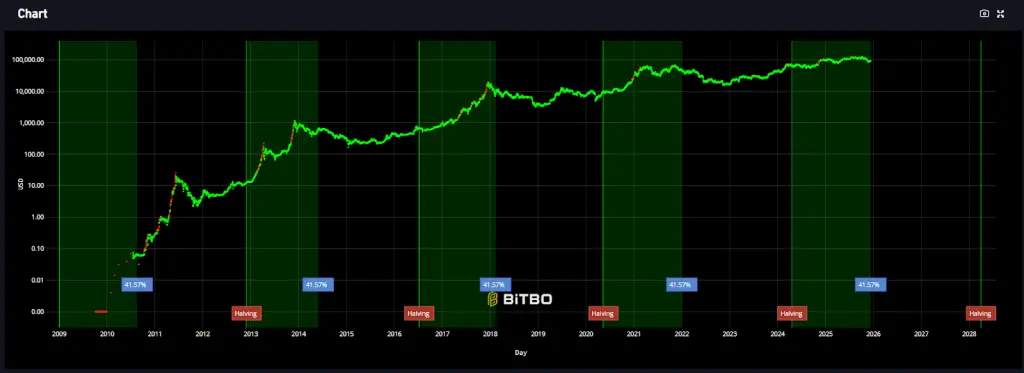
Ark Invest CEO “Wood姐” Cathie Wood stated that the four-year cycle of Bitcoin may no longer define the long-term behavior of the asset. She believes institutional adoption is reshaping volatility, making the early sharp downturn patterns of Bitcoin increasingly rare. Volatility is decreasing, and institutions will prevent larger declines. Wood姐 asserts that the market may have already seen the bottom weeks ago, and future pullbacks might only be 30% to 50%.
How Institutional Capital Is Rewriting Bitcoin Volatility
(Source: Bitbo)
Wood姐’s core argument is based on the fundamental differences between institutional behavior and retail investors. As large financial institutions continue to accumulate Bitcoin, the 75% to 90% drops seen in early years are becoming increasingly uncommon. These differences stem from the nature of the funds: retail investors use high leverage, trade emotionally, and sell collectively in panic; institutions adopt long-term allocation strategies, use low or zero leverage, and buy more during declines rather than exit.
The launch of Bitcoin spot ETFs marks a watershed moment in this transformation. Since being approved in January 2024, US Bitcoin spot ETFs have attracted over $60 billion in funds, with BlackRock’s IBIT nearing $100 billion in assets. These institutional-grade products provide compliant investment channels for traditional financial institutions, allowing pension funds, insurance companies, and family offices to enter the market.
Wood姐 points out that “institutions will prevent larger declines,” a judgment based on simple market logic: when prices fall, institutional investors often see it as a buying opportunity rather than panic selling. This “buy the dip” behavior creates strong buying support at key levels, preventing the price from collapsing uncontrollably. In contrast, the past 75% to 90% crashes were often chain reactions of leverage liquidations. Once leverage usage significantly decreased, such extreme volatility naturally diminished.
Three Ways Institutional Entry Is Changing Bitcoin Market Structure
Locking in Long-Term Supply: Institutions buy Bitcoin via ETFs, corporate bonds, and asset allocations, which are rarely quickly sold off, reducing market circulation.
Providing Liquidity Bottoms: Continuous buying during price declines prevents cascade liquidations and chain leverage liquidations.
Smoothing Price Volatility: Large-scale funds build and reduce positions in batches, avoiding single large orders from causing severe market shocks.
Ark Invest itself continues to increase its holdings, recently purchasing more shares of Coinbase, Circle, and its own Ark 21Shares Bitcoin ETF (ARKB). This consistency in action adds credibility to Wood姐’s judgment.
Weakening Halving Effect: Standard Chartered Downgrades Targets to Confirm Transition
Wood姐’s view is supported by some Wall Street institutions. Standard Chartered announced this week that ETF purchases have reduced the impact of halving on prices. Analyst Jeffrey Kendrick wrote that the pattern of prices reaching a peak 18 months after each halving “is no longer effective,” leading to a downgrade of the bank’s 2025 target from $200,000 to $100,000. While this significant cut appears pessimistic, the underlying logic supports Wood姐’s argument: explosive bull markets driven by halving may no longer occur.
The most recent halving occurred on April 20, 2024, reducing mining rewards to 3.125 BTC. According to traditional cycles, 12 to 18 months after halving should be the price peak, roughly mid-2025 to late 2025. Bitcoin did hit a historic high of $122,000 in January 2025 but then entered a prolonged consolidation, failing to sustain explosive growth. This pattern is markedly different from previous cycles.
Sentora senior Patrick Heusser pointed out that the daily supply reduction is only 450 Bitcoins, which is negligible compared to Bitcoin’s market cap of hundreds of billions of dollars and billions flowing into spot ETFs. This insight reveals a fundamental change in supply and demand dynamics: past halvings could significantly impact because new supply constituted a higher proportion of total trading volume; now, with institutional funds often in the tens of billions, a daily reduction of 450 Bitcoins is almost insignificant.
Bitcoin’s power law model views price growth as part of a long-term curve influenced by time, rather than a strict four-year window. Heusser stated that halving remains important but only as a disruption within a broader trend. This theoretical framework suggests Bitcoin’s price should follow a long-term logarithmic upward curve, with halving events causing short-term acceleration but not altering the overall trajectory.
Major Industry Divide: Is the Cycle Dead or Just Evolving?
(Source: Glassnode)
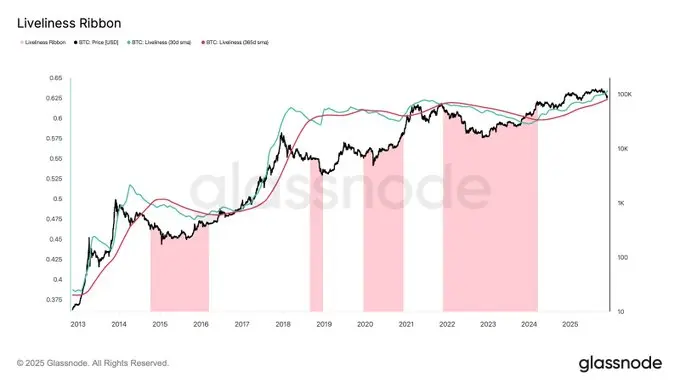
Wood姐’s comments come amid a broader industry debate. Since late July, discussions on social media have been intense. Matt Hougan, CIO of Bitwise, and Ki Young Ju, founder of CryptoQuant, both said that the influx of institutional funds has effectively eliminated the traditional cycle. “The cycle is over,” Ju asserts.
However, Glassnode holds an opposing view. Data released in August shows that the current cycle’s structure resembles previous cycles, including behaviors of long-term holders and weak demand at cycle ends. Despite institutional participation, Glassnode believes Bitcoin’s trend remains very consistent with past high points over the years. This divergence reflects different data interpretations: supporters of “cycle end” focus on institutional fund flows and decreased volatility; supporters of “cycle continuation” focus on on-chain holdings behaviors and historical price patterns.
Wood姐’s view also involves a change in Bitcoin’s correlation with other assets. She believes Bitcoin’s trading is now more like a risk asset, with trends aligning with stocks and real estate rather than acting as a hedge. “Now, gold is more like a safe-haven asset,” she notes, as investors use gold to hedge geopolitical shocks. This observation challenges the narrative of Bitcoin as “digital gold,” implying its role is changing.
Experts are debating whether market cycles are already broken or merely evolving, but most agree that investors should expect markets to follow long-term trends rather than sharp, rapid swings. Analysts suggest future crashes might be shallower, around 30% to 50%, rather than the 75% to 90% declines of past years, though rebounds may also be longer. Strategies based on precise halving timing may no longer work with the same accuracy.
Macro analyst Lynn Olden recently stated that Bitcoin’s current market conditions lack the euphoric sentiment needed to trigger a major crash, and added that broader economic forces now determine the asset’s trend. She predicts Bitcoin will return to $100,000 by 2026 but warns the path will not be smooth. Wood姐 remains more optimistic, asserting “we may have already seen the bottom weeks ago,” implying now is an ideal time to build positions.
Disclaimer: The information on this page may come from third parties and does not represent the views or opinions of Gate. The content displayed on this page is for reference only and does not constitute any financial, investment, or legal advice. Gate does not guarantee the accuracy or completeness of the information and shall not be liable for any losses arising from the use of this information. Virtual asset investments carry high risks and are subject to significant price volatility. You may lose all of your invested principal. Please fully understand the relevant risks and make prudent decisions based on your own financial situation and risk tolerance. For details, please refer to
Disclaimer.


