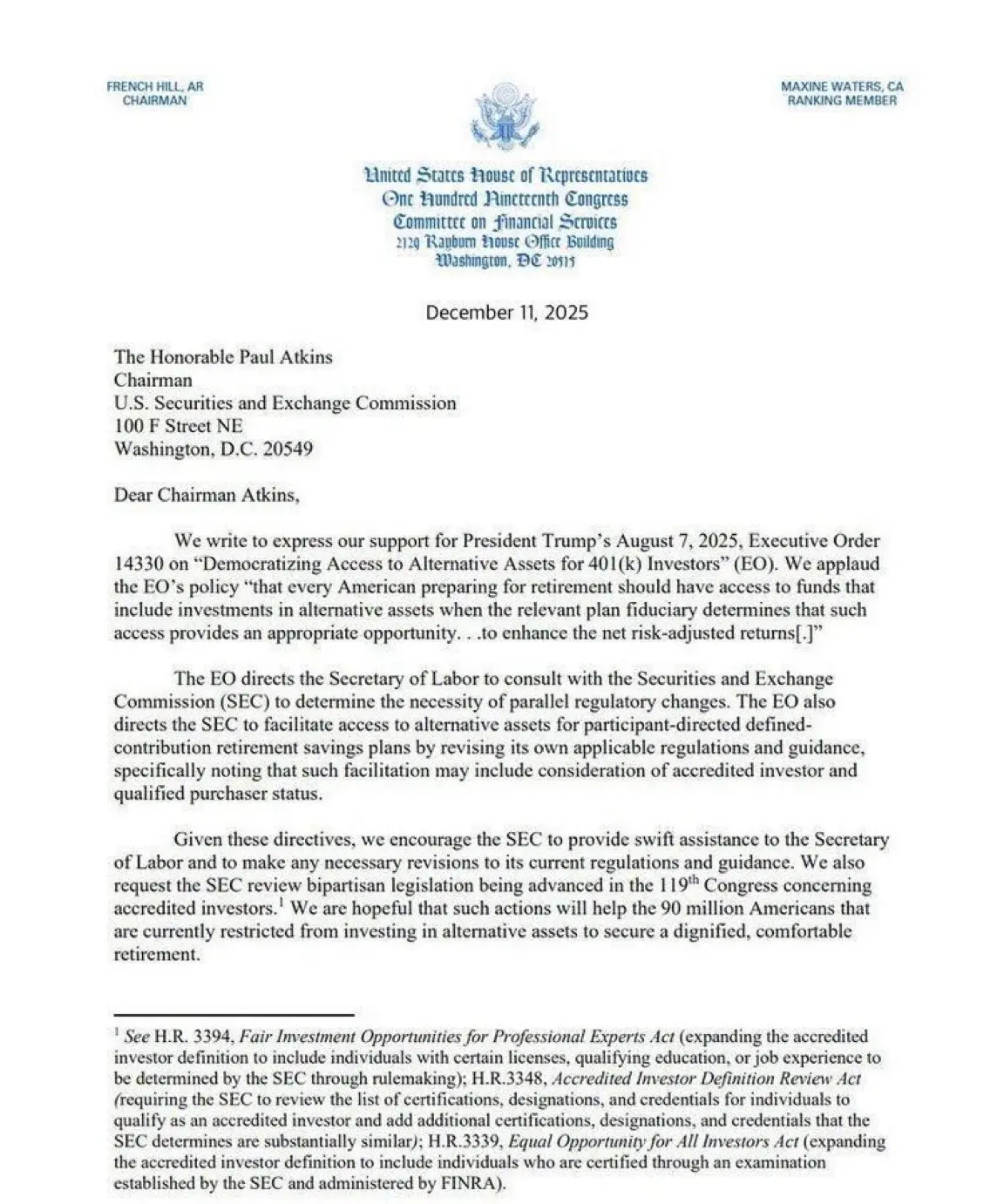
Bitcoin’s rise today is driven by favorable policies. The US Congress has sent a letter to the SEC urging the enforcement of allowing cryptocurrencies to be included in 401(k) retirement accounts. A moderate 1-3% allocation could generate $125 billion to $375 billion in buying pressure. Simultaneously, the Federal Reserve announced it will purchase $40 billion in short-term government bonds starting December 12. Under these dual catalysts, Bitcoin’s target points to $131,000.
The 1% Allocation Effect of the $12.5 Trillion Retirement Pool
(Source: SEC)
The core catalyst behind Bitcoin’s rise today is the legislative push for the 401(k) policy breakthrough. According to White House data, as of March 31, 2025, total American retirement assets reach $43.4 trillion, with about $12.5 trillion held in 401(k) plans. However, most savers still lack access to alternative investments, including cryptocurrencies. Lawmakers believe that allowing controlled allocations to these assets can improve risk-adjusted returns and modernize retirement investment strategies.
Industry experts see this policy evolution as a key moment for Bitcoin’s integration into traditional finance. Analysts estimate that even a 1% to 3% allocation from retirement funds could generate hundreds of billions of dollars in new buying pressure, potentially pushing Bitcoin prices to new all-time highs. The calculations are as follows: 1% of $12.5 trillion is $125 billion, and 3% is $375 billion. Considering Bitcoin’s current market cap of approximately $1.8 trillion, the additional demand of $125 billion to $375 billion represents about 7% to 21% of its market cap. Such a capital inflow could trigger a structural revaluation of prices.
Three-Stage Impact Projection of Bitcoin Inclusion in 401(k)
Stage 1 (Policy Implementation): The SEC officially amends regulations, allowing pension management companies to offer Bitcoin options, with an initial tentative allocation of $50 billion to $100 billion.
Stage 2 (Mainstream Adoption): Major pension fund managers like Vanguard and Fidelity promote widespread adoption, increasing allocation ratios to 2%, releasing $250 billion in capital.
Stage 3 (Standard Portfolio): Bitcoin becomes a standard component of retirement portfolios, with a 5% allocation, releasing a long-term demand of $625 billion.
This plan aims to provide ordinary workers with investment options similar to those of large pension funds. Currently, state pension funds and university endowments can allocate to alternative assets, including cryptocurrencies, but individual 401(k) accounts are heavily restricted. This inequality has raised concerns among legislators, who believe that ordinary workers should also have access to such investment opportunities.
In a formal letter sent to SEC Chair Gary Gensler on December 11, Congress expressed support for the executive order signed by President Trump in August 2025, which directs the Department of Labor and SEC to amend current restrictions on 401(k) investment choices. This congressional pressure has practical significance because, although the SEC is an independent regulator and not directly under the President’s command, it must respond to congressional oversight and budget control.
The Overlapping Effect of $55 Billion Liquidity Injection by the Federal Reserve
The second key factor behind Bitcoin’s rise today is the Federal Reserve’s announced liquidity injection plan. The Fed announced it will buy short-term government bonds starting December 12 to manage market liquidity, with an initial scale of about $40 billion. Additionally, this month, the Fed will reinvest $15 billion in mortgage-backed securities (MBS) as they mature, totaling a liquidity injection of $55 billion.
Increased liquidity generally benefits risk assets but is unfavorable for safe-haven assets like the US dollar. The Fed added that the scale of bond purchases will “remain at elevated levels for several months,” after which the scale will be “significantly reduced.” This clear timetable provides market predictability, allowing investors to calculate how long liquidity easing will last and adjust their positions accordingly.
Furthermore, on December 10, the Fed announced a 25 basis point rate cut to a range of 3.5% to 3.75%. Chair Jerome Powell emphasized risks in the labor market while downplaying concerns about inflation. The FOMC statement said: “Uncertainty regarding the economic outlook remains elevated. The Committee remains attentive to the risks to its dual mandate and judges that the downside risks to employment have increased over recent months.”
At the press conference following the rate decision, Powell stated that, after adjusting for potential overestimations in employment data, employment growth since April may have turned slightly negative. He said, “I think it’s fair to say that the labor market remains gradually cooling.” Powell also indicated that the Federal Reserve is unlikely to hike rates further and added that the latest projections from policymakers do not include rate hikes as a baseline scenario. This explicit stance against further rate increases provides strong support for risk assets.
Vassili Serebriakov, a UBS forex strategist, commented: “The market initially expected a more hawkish tone, but I don’t think Powell is particularly dovish; he just maintained the possibility of further rate cuts.” Serebriakov added, “Recently, expectations for non-US central banks have quickly shifted toward a more hawkish outlook, but the Fed’s tone was actually more dovish, which has pressured the dollar.” A weaker dollar usually boosts dollar-denominated Bitcoin prices.
Technical Breakout Targets 116,000, with a Longer-Term Goal of 131,000
(Source: Trading View)
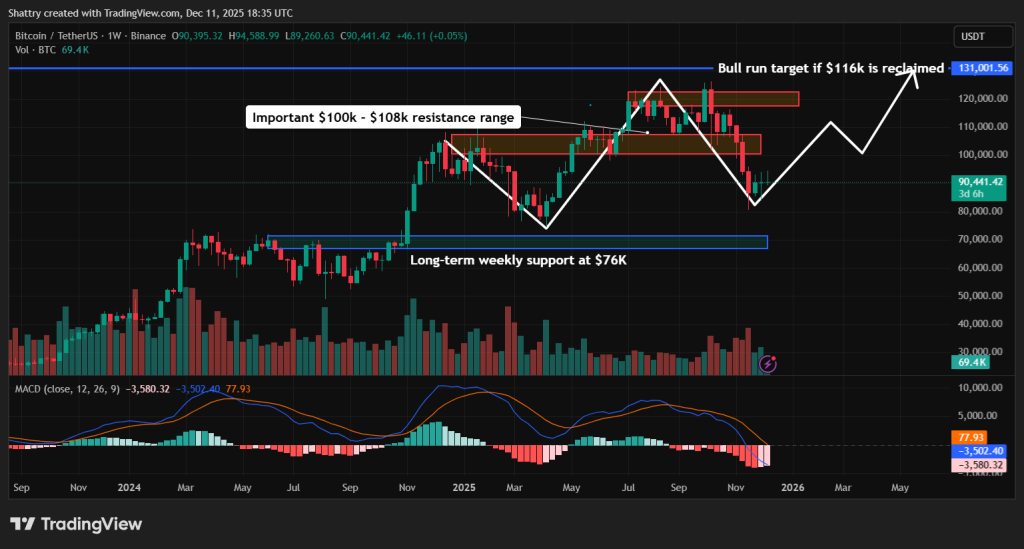
The weekly chart shows that Bitcoin has begun to decline after failing to hold support above the critical resistance zone of $100,000 to $108,000, forming a clear cyclical correction. Currently, the price hovers around $90,000, slightly above the key long-term weekly support at approximately $76,000, which is a crucial structural foundation for maintaining the overall bullish trend.
The MACD indicator remains deep in the bearish zone but has started to flatten, indicating that downward momentum may be waning after months of selling pressure. If Bitcoin can regain the $100,000 to $108,000 zone and then break through the next major resistance at $116,000, the chart structure supports the continuation of the bull market toward an estimated target of around $131,000.
The dual positive factors of 401(k) policy and Fed bond purchases provide fundamental support for Bitcoin’s breakout. If the $90,000 support level holds, combined with policy catalysts, returning to $100,000 is not far-fetched.
Disclaimer: The information on this page may come from third parties and does not represent the views or opinions of Gate. The content displayed on this page is for reference only and does not constitute any financial, investment, or legal advice. Gate does not guarantee the accuracy or completeness of the information and shall not be liable for any losses arising from the use of this information. Virtual asset investments carry high risks and are subject to significant price volatility. You may lose all of your invested principal. Please fully understand the relevant risks and make prudent decisions based on your own financial situation and risk tolerance. For details, please refer to
Disclaimer.


