In December, 33 Vietnamese investors filed a civil lawsuit with the Hanoi Hai Ba Trung District People’s Court, claiming approximately 258 billion VND (about 10 million USD) in damages. Many news headlines implied that the defendants were Pi Network itself or its founders, but influential crypto figure Crypto Chix revealed that the lawsuit targets only three individuals described as local community leaders or well-known community figures in Vietnam. The core allegations involve inducement to purchase and promises of Pi coins appreciating in value.
Three Vietnamese Volunteers Named Defendants: Promises of Price Guarantees Constitute Fraud
The main accusation in the lawsuit is that the three Vietnamese community leaders or well-known figures persuaded participants to spend money on goods, services, and recruit new members, while promising that Pi coins would soon appreciate on major exchanges. Such allegations are very common in the crypto community, especially in projects that have not yet officially launched or whose prices are unclear. Overenthusiastic promoters often make unrealistic price promises to attract new members.
The plaintiff claims damages of about 258 billion VND, roughly 10 million USD at current exchange rates. This amount indicates either a large number of involved individuals or significant losses suffered by a single victim. According to an announcement cited by Crypto Chix, Pi Network has publicly emphasized that no community members have the authority to guarantee token value or promise listings on exchanges. Any regional volunteers making such statements violate the network’s terms.
This explicit disclaimer provides legal protection for Pi Network. In decentralized communities, project teams find it difficult to control the speech and actions of every member, especially in a large global community with millions of users. Pi Network’s Terms of Service clearly prohibit members from making price guarantees or investment advice, thus fulfilling the obligation to inform. If community members violate these rules and commit fraud, legal responsibility should fall on the individuals, not the project.
Crypto Chix pointed out that although the case mentions the crime of “fraudulent appropriation of property” under Vietnamese criminal law, it is filed as a civil lawsuit rather than a criminal prosecution. This detail is extremely important; civil suits mainly involve economic compensation, while criminal cases involve deprivation of liberty. The plaintiffs’ choice of civil proceedings may stem from the higher threshold for criminal cases or their primary goal of seeking financial redress rather than punishing the defendants.
Three Key Facts of the Vietnam Lawsuit
Defendants’ identities: Three local community leaders in Vietnam, not Pi Network founders or corporate entities
Nature of the lawsuit: Civil claim for damages, not a criminal fraud prosecution
Geographical scope: Limited to Vietnam, does not affect Pi Network’s global operations
Media Misleading Headlines and Clickbait Traps
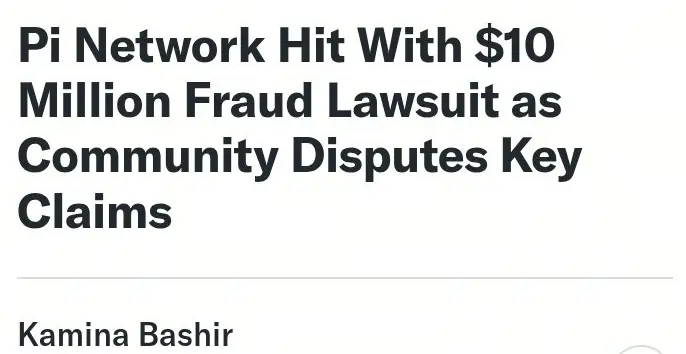
(Source: Yahoo Finance)
Reports claim Pi Network faces a $10 million fraud scandal, which may be technically accurate but is misleading. Most readers might mistakenly think the defendants are the global Pi Network project or its founders, whereas the lawsuit involves only a small subset of local community members. Such clickbait tactics are common in crypto news, where media outlets aim to attract clicks by amplifying negative headlines or obscuring key details.
This misleading reporting unfairly damages Pi Network’s brand image. Many investors unaware of the case details, upon seeing headlines like “Pi Network Fraud Scandal,” might immediately sell off or distance themselves from the project. However, a deeper understanding reveals this is primarily a local community mismanagement issue rather than a systemic fraud at the core of the project.
Crypto Chix explained that this case reflects the challenges Pi Network has faced over the years, as some overly enthusiastic pioneers made unrealistic financial promises. Exaggerated claims can cause confusion, especially for new members unfamiliar with the differences between global project operations and local community activities. The distinction is crucial: Pi Network, as a global project, sets the technology and rules, while local communities are responsible for promotion and user education, with separate responsibilities.
After the announcement, Pi Network’s token price drew market attention, but the price movement of PI is more closely related to overall cryptocurrency market trends rather than the lawsuit itself. The PI token and related metrics are largely unaffected by this localized dispute, indicating that the market is relatively rational and investors can distinguish between local legal issues and overall project value. If this lawsuit truly involved the Pi Network core team or revealed systemic fraud, the price reaction would be much more dramatic.
Deep Warning on Community Management Out of Control
The Vietnam lawsuit is small in scale and limited in scope, posing no overall threat to Pi Network. However, it highlights the importance of cautious communication and user expectation management in the rapidly growing crypto community. If Pi coins are eventually issued but trading prices are far below some local pioneers’ verbal promises, more similar cases could occur.
This lawsuit exposes structural issues in Pi Network’s community management. As a global project with hundreds of millions of users, Pi relies on local volunteers for promotion and support. While this decentralized model enables rapid expansion, it also presents quality control challenges. The project team finds it difficult to monitor every local promoter’s words and actions. When someone makes false promises for personal gain, victims often direct their anger at the entire project.
Crypto Chix emphasized that distinguishing between global project operations and local community activities helps maintain clarity about Pi Network’s development. For investors, the lesson from this case is: do not trust unofficial channels’ price promises or guarantees. Pi Network’s official stance has never promised specific listing timelines or price expectations; any such claims are made by unauthorized individuals and should not influence investment decisions.
For Pi Network’s team, this lawsuit should serve as a wake-up call to improve community management. Implementing stricter vetting of local promoters, conducting regular training for community leaders, and establishing quick-response mechanisms to handle improper statements are necessary measures. If similar incidents occur again, even if legal responsibility does not fall on the project, damage to its reputation will be difficult to repair.
If Pi coins are ultimately issued but trading prices remain far below some local pioneers’ oral promises, more similar cases may emerge. This represents the greatest potential risk for Pi Network. For example, if a Vietnamese promoter promises that Pi will reach $100 after listing, but the actual trading price is only $1, those investing based on the $100 expectation will suffer huge losses. They may file class-action lawsuits; even if they lose, the litigation process will consume Pi Network’s resources and damage its reputation.
Disclaimer: The information on this page may come from third parties and does not represent the views or opinions of Gate. The content displayed on this page is for reference only and does not constitute any financial, investment, or legal advice. Gate does not guarantee the accuracy or completeness of the information and shall not be liable for any losses arising from the use of this information. Virtual asset investments carry high risks and are subject to significant price volatility. You may lose all of your invested principal. Please fully understand the relevant risks and make prudent decisions based on your own financial situation and risk tolerance. For details, please refer to
Disclaimer.
Related Articles
Pi Network Explodes 50% – The Rebound Everyone Missed!
Pi Network has experienced a price rebound, rising from $0.128 to approximately $0.1819, approaching a key resistance at $0.20. Traders are optimistic, but liquidity remains low, leading to potential volatility in the market.
Coinfomania2h ago
Pi Network Confirms March 12 DEX Launch, Pi Coin Rallies Over 8% Amid Protocol Upgrades
Pi Network has scheduled the launch of its native decentralized exchange for March 12, 2026, integrated directly into the Pi Wallet, as the project completes mandatory protocol upgrades toward v20.2 ahead of the March 14 Pi Day milestone.
CryptopulseElite8h ago
Pi Network price hits two-week high, protocol upgrade drives 8.5% increase
Pi Network's native token PI rose about 8.5% on March 4th, reaching a nearly two-week high, following the successful upgrade to protocol v19.9. The upgrade aims to strengthen network capabilities and will introduce v20.2 before Pi Day 2026. Despite the short-term increase, the Pi Foundation transferred 60.99 million tokens, which could trigger supply pressure. Technically, PI faces a key resistance level at $0.173.
MarketWhisper10h ago
PI (Pi) increased by 7.51% in the past 24 hours
Gate News Bot Message, March 5th, according to CoinMarketCap data, as of press time, PI (Pi) is trading at $0.18, up 7.51% in the past 24 hours, reaching a high of $0.19 and a low of $0.16. The current market capitalization is approximately $1.748 billion, an increase of $122 million from yesterday.
Pi is the first digital currency that can be mined on a mobile phone, utilizing groundbreaking technology to achieve mining without battery loss on mobile devices. Pi Network aims to make cryptocurrency mining simple and accessible, with features such as decentralization, mobile-first design, user-friendliness, and environmental friendliness. Users can start mining for free by downloading the official mobile app and receiving an invitation from existing trusted members. The project aims to create a secure, tamper-proof, and interoperable digital currency ecosystem.
## Important recent news about PI:
1️
GateNews10h ago
Pi Network’s v19.9 Mainnet Upgrade Just Changed Everything
_Pi Network’s v19.9 mainnet migration is done. Node operators are already eyeing v20.2 before Pi Day 2026. What does this mean?_
Pi Network just crossed a line most projects talk about for years. Protocol v19.9 mainnet migration is done. Confirmed. The Pi Core Team announced the completion
LiveBTCNews20h ago


