Both BlackRock’s iShares Bitcoin Trust (IBIT) and MicroStrategy (now rebranded as Strategy, ticker MSTR) serve as prominent vehicles for Bitcoin exposure, but they cater to different investor profiles.
IBIT is a regulated spot Bitcoin ETF offering direct, low-cost access to BTC’s price performance, while MSTR is a publicly traded software company that has aggressively accumulated Bitcoin as its primary treasury asset, functioning as a leveraged proxy. Below, we break down their key differences across structure, performance, holdings, costs, and risks, based on the latest available data.
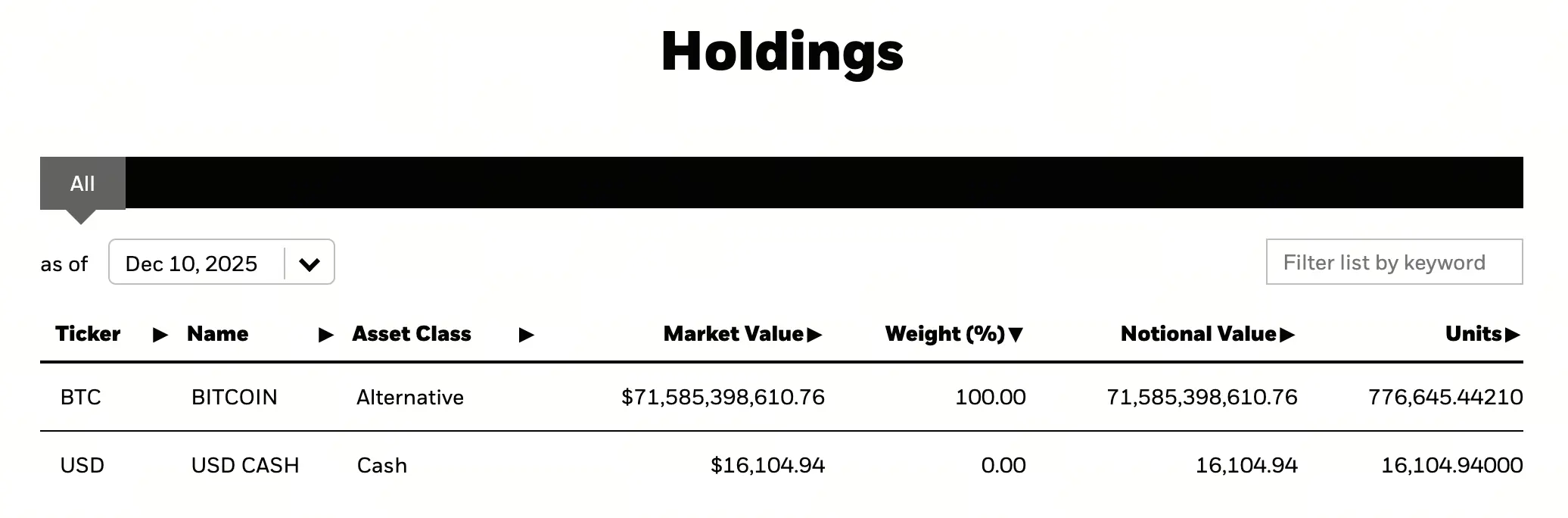
(Sources: iShares)
Overview and Structure
- IBIT: Launched January 5, 2024, by BlackRock, the world’s largest asset manager ($12.5 trillion AUM as of June 30, 2025). It’s a grantor trust holding physical Bitcoin, tracking the CME CF Bitcoin Reference Rate. Designed for retail and institutional investors seeking pure BTC exposure without custody hassles.
- MSTR: Originally a business intelligence software firm, rebranded to Strategy in February 2025. It holds Bitcoin as a core treasury reserve since August 2020, blending software revenue ($500 million annually) with BTC accumulation funded by debt and equity raises. Acts as an amplified BTC play due to its corporate leverage.
Both provide indirect BTC ownership, but IBIT is passive and compliant (no securities registration under the Investment Company Act), while MSTR involves operational risks and dilution from capital raises.
Holdings and Exposure
- IBIT: Holds approximately 802,198 BTC as of October 7, 2025 (3.8% of Bitcoin’s total supply), with ongoing inflows adding ~2,000 BTC daily in recent weeks. No direct corporate operations; pure BTC basket.
- MSTR: Owns 660,624 BTC as of December 8, 2025, acquired for $49.35 billion at an average cost of $74,702 per BTC (current value ~$61.02 billion, +23.64% unrealized gain). Represents ~3.1% of supply; funded by $21 billion in 2025 stock offerings.
MSTR’s holdings are more concentrated and actively managed, but IBIT’s scale grows faster via ETF inflows ($52 billion net since launch).
Assets Under Management (AUM) and Market Cap
- IBIT: $70.95 billion AUM as of December 11, 2025 (fastest ETF to $50 billion in 227 days; $70 billion in 341 days). Generates ~$187 million annual fees (0.25% expense ratio), surpassing BlackRock’s S&P 500 ETF revenue.
- MSTR: Market cap ~$53 billion as of December 2025 (down 35% YTD to ~$179/share). BTC holdings exceed market cap at times (e.g., $61B vs. $53B), trading at 1.1x-1.2x premium to BTC net asset value (NAV).
IBIT’s AUM dwarfs MSTR’s cap, reflecting ETF’s institutional appeal vs. MSTR’s volatility-driven trading.
| Metric |
IBIT (ETF) |
MSTR (Stock) |
| AUM/Market Cap |
$70.95B |
~$53B |
| BTC Holdings |
~802K BTC |
660K BTC |
| % of BTC Supply |
3.8% |
3.1% |
| YTD Change |
+159.52% (price return) |
-35% (stock price) |
Performance and Returns
- IBIT: YTD return +159.52% as of December 10, 2025 (tracks BTC closely; 1-year +4.39%, but since inception mirrors BTC’s +123% in 2024). Minimal tracking error (<0.5%); benefits from BTC’s 45% YTD gain in 2025.
- MSTR: Stock down 35% YTD to $179 (from ~$289 in January), despite BTC’s +45%. 1-year +4.37% decline; historical premium averaged 54% over 4 years but dipped below 1x NAV in December 2025 amid BTC dip to $85K. Amplifies BTC moves (beta ~2x) but adds dilution risk.
IBIT offers purer BTC beta; MSTR’s leverage boosts upside (370% in 2024) but magnifies downsides (66% drop from July highs).
Fees and Costs
- IBIT: 0.25% annual expense ratio (~$187M revenue for BlackRock). No performance fees; low trading costs via high liquidity (73M avg. daily volume).
- MSTR: No direct fees for BTC exposure, but indirect via corporate overhead (~$500M software revenue offsets costs). Debt financing adds interest (e.g., $8.2B debt at 0-1% rates); equity dilution from raises (e.g., $21B ATM in Q1 2025).
IBIT is cheaper for passive holders; MSTR’s “cost” embeds leverage risks.
Risks and Considerations
- IBIT: Custody risk (Coinbase Custody holds BTC; insured up to $320M); regulatory (SEC oversight); tracking error from fees/premiums (trades at market price, not NAV). Low operational risk.
- MSTR: High dilution (new shares for BTC buys); debt maturity (2028); software business decline (revenue flat); BTC concentration (96%+ of value). Trades at premium/discount to NAV, adding volatility.
Both face BTC price risk, but MSTR amplifies it via leverage (~2x beta).
Conclusion: Which Is Better for Bitcoin Exposure?
IBIT suits passive, diversified investors seeking clean BTC tracking with institutional backing—ideal for IRAs/401(k)s. MSTR appeals to aggressive traders betting on amplified returns and Saylor’s strategy, but with higher volatility and dilution risks. In 2025’s maturing market, IBIT’s $70B+ AUM edges MSTR’s $53B cap, reflecting ETF’s stability vs. stock’s leverage play. Always consider risk tolerance; neither is FDIC-insured.
Disclaimer: The information on this page may come from third parties and does not represent the views or opinions of Gate. The content displayed on this page is for reference only and does not constitute any financial, investment, or legal advice. Gate does not guarantee the accuracy or completeness of the information and shall not be liable for any losses arising from the use of this information. Virtual asset investments carry high risks and are subject to significant price volatility. You may lose all of your invested principal. Please fully understand the relevant risks and make prudent decisions based on your own financial situation and risk tolerance. For details, please refer to
Disclaimer.
Related Articles
The whale "pension-usdt.eth" has increased its Bitcoin long position to 1,000 coins, with a holding value of nearly $67 million.
Gate News Report, March 8 — According to HyperInsight monitoring, the swing whale "pension-usdt.eth" continued to increase its Bitcoin long positions this morning. As of press time, its Bitcoin long positions have increased to over 1,000 coins, with a holding value of nearly $67 million, currently with an unrealized loss of $460,000.
GateNews3m ago
Crude oil prices break through $90! A weekly surge of 35%. Middle Eastern energy supply chain disruption, UAE and Kuwait announce production cuts
Oil tanker flows through the Strait of Hormuz are nearly at a standstill, causing U.S. WTI crude oil prices to surge 35% within a week. Taiwan's CPC is about to raise gasoline prices by 1.5 yuan. Multiple oil-producing countries have initiated production cuts to respond to supply shocks. If the blockade continues, oil prices could reach $150, impacting the global economy and inflation pressures.
動區BlockTempo30m ago
BTC drops 0.71% in 15 minutes: Weak macro data and miner sell-off resonate, increasing selling pressure
2026-03-08 02:45 to 03:00 (UTC), Bitcoin (BTC) price candlestick data shows a 15-minute return of -0.71%, with the lowest at 66,837.0 USDT and the highest at 67,402.7 USDT, with an amplitude of 0.84%. Short-term volatility has attracted market attention, with on-chain risk signals rising to 0.84, above the historical average, indicating cautious investor sentiment and increased market fluctuations.
The main driver of this anomaly is the US February employment data, which significantly underperformed expectations, with a sharp decrease in new jobs and the unemployment rate rising to 4.4%, combined with the US
GateNews1h ago
The upcoming wave of $875 billion in US real estate debt maturities could put pressure on Bitcoin
A large amount of commercial real estate debt (Commercial Real Estate – CRE) in the US is approaching maturity amid a market that has changed significantly since these loans were issued.
The Mortgage Bankers Association (Mortgage Bankers Association) reports that approximately $875 billion in loans
TapChiBitcoin1h ago


