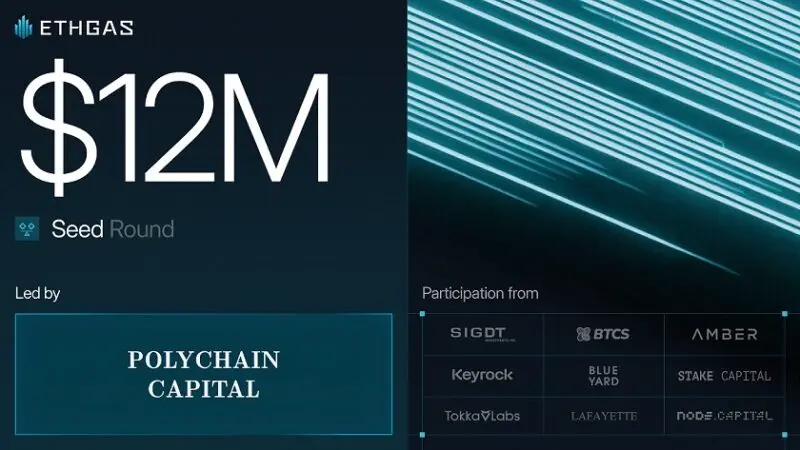
ETHGas announced it has raised $12 million in a seed round led by Polychain Capital, and launched what it claims to be the first Ethereum blockchain space futures market. ETHGas founder Kevin Lepsoe revealed that Ethereum validators and block builders have also committed approximately $800 million in liquidity to provide block space to the market.
How Block Space Futures Are Reshaping the Ethereum Economy
ETHGas has created a new financial instrument for Ethereum: the block space futures market. This concept draws on the logic of traditional commodity futures but applies it to the unique context of blockchain. Lepsoe explained, “You can think of this as energy or oil producers selling their capacity days, weeks, or even months in advance, while airlines or steel mills purchase this capacity to ensure delivery. The reasons for existing commodity futures markets include reducing risk for all participants, increasing transparency, eliminating cartels, and more.”
Traditionally, Ethereum blocks and their transactions are finalized every 12 seconds. ETHGas’s futures market allows validators to sell up to 64 blocks (about 12.8 minutes) of block space in advance. This mechanism is positioned upstream of Ethereum’s existing block production process (proposer-builder separation, PBS), and does not replace the current system but integrates with it.
Validators can sell various types of commitments to block space through ETHGas. These commitments include: pre-sale of full control over an entire block; guarantees ensuring specific transactions are included in a particular block; execution guarantees ensuring certain prices or predefined blockchain states are included; and multi-block commitments, such as purchasing multiple consecutive blocks or one minute of Ethereum time.
Three Major Innovations of ETHGas Futures Market
Maximizing Validator Revenue: Locking in block space sales in advance to achieve higher and more predictable MEV returns, with annualized yields potentially increasing by 20-30%
Controlling User Costs: Buying block space in advance to hedge against gas fee volatility, avoiding exorbitant transaction fees during network congestion
Enhancing Market Transparency: Futures pricing reveals expectations for future gas fees, providing a price discovery mechanism for the entire ecosystem
Lepsoe stated, “This enables them to capture more MEV (Maximum Extractable Value), significantly increasing ETH validators/stakers’ earnings—that’s why validators want to join ETHGas.”
From a user perspective, this market allows traders, applications, and institutions to hedge gas costs, prepay transaction fees, and completely avoid gas price spikes. This feature is especially important for enterprise applications requiring cost certainty. Traditional financial institutions and sovereign wealth funds have shown strong interest in understanding and accessing block space performance. As many institutions and real-world assets (RWA) migrate to Ethereum, demand for mechanisms to operate block space is exploding.
The True Meaning of the $800 Million Liquidity Commitment
ETHGas claims an $800 million liquidity commitment, which needs to be understood correctly. Lepsoe clarified that these commitments are not cash investments but rather the provision of liquidity to the ETHGas market in the form of Ethereum block space, in exchange for higher and more predictable returns.
This means validators and block builders commit to placing their controlled block space on the ETHGas market for trading, rather than selling via traditional MEV auctions. The $800 million is an estimate of the value of these block spaces at current market prices, not actual cash inflow. This business model is similar to traditional futures exchanges, which do not hold the underlying assets but provide a trading platform and charge fees.
ETHGas profits by charging a 5% fee on block space futures trading. In the future, it also plans to charge applications requiring instant settlement. While a 5% fee is high compared to traditional futures markets, considering this is a new market with no competitors, this pricing is reasonable in the early stages. As the market matures and competition increases, fee rates may decrease.
Lepsoe mentioned that ETHGas has “more large-scale projects from digital asset management firms in preparation,” adding, “We are already supporting some projects, but cannot disclose details yet. More information will be announced in January.” This hints at ETHGas’s ambitions beyond just a futures market, potentially including a broader ecosystem of blockchain financial derivatives.
Toward the Technical Vision of “Real-Time Ethereum”
In addition to the futures market, ETHGas is also working to significantly improve Ethereum’s operational speed. Lepsoe said, “Unlike extracting MEV by merging multiple blocks, ETHGas has added a feature to split a single block into hundreds of consecutive segments, each lasting 50-100 milliseconds, effectively increasing Ethereum’s speed by 100-200 times. Although this essentially eliminates MEV, it can generate additional transaction fees.”
If this technological breakthrough can be realized, it will fundamentally change the user experience on Ethereum. Currently, Ethereum’s 12-second block time makes it unsuitable for applications requiring instant confirmation. Shortening confirmation times to 50-100 milliseconds would enable Ethereum to support high-frequency trading, real-time payments, and other latency-sensitive applications.
Ethereum researcher Justin Drake has publicly stated that pre-confirmation and real-time execution are crucial for improving Ethereum’s user experience. Ethereum co-founder Vitalik Buterin has also called for establishing a “trustless on-chain gas futures market,” which ETHGas aligns with. The endorsement from top researchers provides strong theoretical support for ETHGas’s technical direction.
Lepsoe pointed out that ETHGas has created a competitive system with two parallel modes. One mode allows traditional MEV participants to continue operating but at higher costs to acquire block space, thereby increasing validator income. The other mode offers an instant ordering model aimed at completely eliminating MEV and redistributing that value to applications, liquidity providers, and end users.
ETHGas’s 18 contributors are distributed across Asia, Europe, and the US, with about half based in Hong Kong. The project originated from Lepsoe’s other project, Infinity Exchange, a fixed-income protocol that has since been suspended. Lepsoe said ETHGas was developed to address MEV and liquidation risks, which have long hindered institutional capital from trading on-chain.
Disclaimer: The information on this page may come from third parties and does not represent the views or opinions of Gate. The content displayed on this page is for reference only and does not constitute any financial, investment, or legal advice. Gate does not guarantee the accuracy or completeness of the information and shall not be liable for any losses arising from the use of this information. Virtual asset investments carry high risks and are subject to significant price volatility. You may lose all of your invested principal. Please fully understand the relevant risks and make prudent decisions based on your own financial situation and risk tolerance. For details, please refer to
Disclaimer.
Related Articles
Ripple Expands Institutional Trading With Coinbase Derivatives BTC, ETH, SOL, and XRP Futures
Ripple added Coinbase BTC, ETH, XRP and SOL futures to Ripple Prime, its platform that cleared more than $3 trillion in 2025.
Trades are processed through Nodal Clear, giving institutions 24/7 access to CFTC-regulated crypto futures in the U.S.
Ripple has added Coinbase Derivatives’
CryptoNewsFlash2h ago
Ethereum Price Prediction 2026: Pepeto Exchange Targets 100x Over ETH and Mutuum Finance as CLARITY Act Faces Bank Resistance
Reuters just reported the long anticipated CLARITY Act may be at risk after banks declined a White House compromise, intensifying the fight over whether stablecoin issuers can offer yield bearing products that compete with traditional deposits.
The ethereum price prediction holds
CaptainAltcoin2h ago
Bitcoin and Ethereum ETFs Record Daily Outflows While Maintaining Weekly Gains
Gate News bot message, according to the March 6 update, Bitcoin ETFs recorded a daily net outflow of 1,697 BTC (valued at $116.94 million), while maintaining a 7-day net inflow of 13,014 BTC (valued at $896.69 million). Ethereum ETFs showed a daily net outflow of 3,185 ETH (valued at $6.34 million),
GateNews6h ago
"Brother Maqi" deposits $210,000 into HyperLiquid to increase ETH long position by more than 25 times
Gate News Report, March 6, according to Onchain Lens monitoring, "Big Brother MaJie" deposited $210,000 USDC into HyperLiquid to increase his ETH 25x long position. Previously, as the market declined, "Big Brother MaJie" had closed most of his positions at a loss, and his unrealized loss has now exceeded $29.7 million.
GateNews6h ago
ETH drops below 2000 USDT, 24H decline of 5.68%
Gate News Report, March 6th, according to data from a certain CEX market, ETH dropped below 2000 USDT, currently at 1999.87 USDT, down 5.68% in the past 24 hours.
GateNews7h ago


