Cardano is signaling a fundamental shift, moving away from an academically focused research platform toward a “operating system” model oriented toward commerce.
On December 17, the Intersect Product Committee published the Vision 2030 report, establishing strict performance standards to redefine how the market evaluates networks. Intersect – a member-based organization responsible for maintaining the continuity of Cardano – aims to position the network not just as a crypto, but as essential digital infrastructure. This strategy decisively abandons vague commitments to “adoption,” replacing them with concrete measurement metrics.
Accordingly, the ecosystem commits to achieving KPIs by the end of the decade including 324 million transactions per year, 1 million active wallets monthly, and a total value locked (TVL) of approximately $3 billion USD.
This document marks a clear departure from the previous phase where Cardano prioritized formal verification and academic peer review. Vision 2030 shifts focus entirely to metrics valued by businesses and institutional investors: uptime, revenue, and capital efficiency.
These goals also expose the gap between Cardano’s cautious approach and the explosive growth of competitors, raising questions about whether “reliability” alone is enough to narrow the gap with leading networks like Ethereum or Solana.
Cardano’s “Operating System” Vision
The core argument of Vision 2030 is that Layer 1 blockchains must operate with the reliability of an operating system, rather than the volatility of a startup. The committee explicitly rejects the “speed at all costs” philosophy dominating competitors like Solana or Sui, and anchors the network’s success on a service reliability standard of 99.98% uptime.
This metric is defined very specifically, based on a Poisson model with an expected block time of 20 seconds. Any five-minute interval without a block is considered a “serious incident.” Cardano’s goal is to eliminate these gaps entirely within six epochs, providing statistical guarantees that infrastructure buyers such as banks or government agencies require before deploying capital.
This reliability approach drives the entire capacity plan. The roadmap targets a throughput of approximately 27 million transactions per month on the base layer. This limit is intentional, as the mainnet is positioned for high-value payments and traffic coordination. High-frequency activities like daily trading or gaming will be transferred to Layer 2 “top-tier” networks built on Cardano, handling computational loads and anchoring final security to the mainnet.
However, this choice also highlights a significant difference from the broader market. The 27 million transactions per month is considerably lower than high-performance networks like Solana, which often process up to 70 million transactions daily. Nonetheless, supporters argue that Cardano is best suited for high-value users willing to pay fees for certainty in settlement, even if competitors offer superior throughput for mass-market applications.
Governance and Treasury
Beyond technical specifications, Vision 2030 proposes a major overhaul of how funds are allocated within the ecosystem. The document introduces the “Treasury Seasons” model, a structured budgeting framework designed to impose fiscal discipline on the decentralized treasury.
Under this new model, the ecosystem will no longer allocate funds based on open-ended proposals. Instead, the treasury will operate through public funding rounds. Each project must demonstrate its budget based on three core utility metrics from the roadmap: impact on TVL, contribution to transaction volume, and growth in active wallets.
The committee describes these KPIs as “gatekeepers.” If a project does not improve adoption or reliability within a season, the community has the right to reduce or terminate funding in the next season. This mechanism aims to prevent “perpetual funding,” ensuring resources flow only into initiatives that deliver observable value.
Financial restructuring also extends to roles within the ecosystem, with specific incentive mechanisms for Delegated Representatives (DReps), Stake Pool Operators (SPOs), and the Constitution Committee. The plan proposes a “weighted voting threshold,” considering participation rates, to prevent small minority groups from making decisions without broad support. By standardizing these checks and balances, Intersect aims to provide an auditable governance record similar to corporate governance structures in public markets.
Revenue and Sustainability Challenges
Vision 2030 links operational goals with specific economic prospects. The strategy aims for financial self-sufficiency, where protocol revenue – transaction fees – covers security and development costs. The target is to generate at least 16 million ADA in annual revenue by 2030.
This projection assumes stable average transaction fees around 0.05 ADA at a volume of 324 million transactions per year. The report also presents scenario analyses using an “illustrative” ADA price of $5.00 to demonstrate revenue potential, roughly $81 million USD annually.
While this path toward sustainability is promising, these figures remain modest compared to the leading network’s economy. For instance, Ethereum generated approximately $600 million USD in transaction fees this year, nearly six times Cardano’s projected annual revenue by 2030. The reliance on a $5.00 ADA price – about 500% higher than current levels – also indicates that the business model remains heavily influenced by asset appreciation expectations rather than organic fee demand.
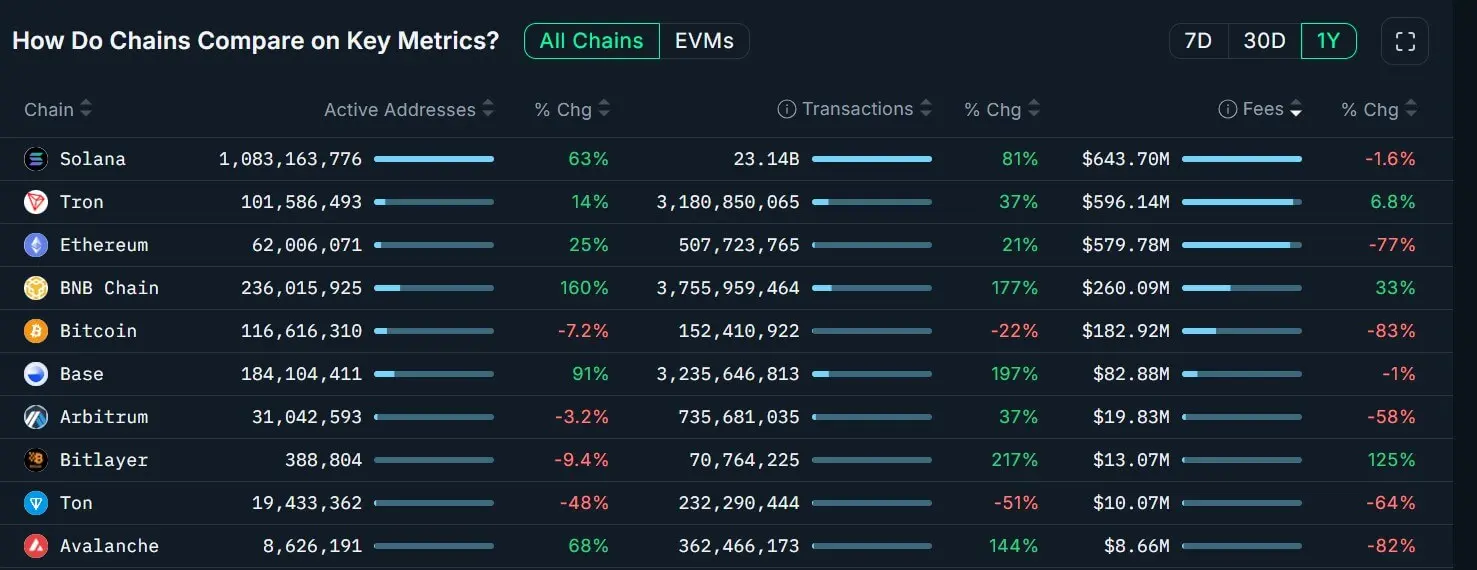 Top 10 Blockchain Networks by Key Metrics (Source: Nansen)## Deployment Risks and Layer 2 Dependency
The roadmap concludes with a frank assessment of risks. The drafting team emphasizes that “invisible” experience improvements such as fee abstraction or session keys are prerequisites to reaching 1 million active wallets. They acknowledge that current user journeys are still too complex for enterprise compliance use cases.
The strategy also highlights the inherent economic tension of Layer 2 models. The document warns of “value leakage”: as activity shifts to L2, Layer 1 may become a low-revenue settlement layer – a challenge Ethereum itself faces. To mitigate this, Intersect requires future bridge and tokenomics designs to “route value back” to Layer 1.
The draft calls for SPOs to expand their roles, operating infrastructure for L2s and auxiliary services to capture value across the entire tech stack.
Overall, Vision 2030 demonstrates a professional effort to formalize Cardano. By setting concrete uptime, adoption, and revenue targets, the ecosystem is inviting the market to evaluate it based on execution capacity rather than philosophy. The “operating system” model provides a clear roadmap for maintaining relevance, though financial projections show Cardano still has a long way to go to catch up with “big players” in revenue terms.
Disclaimer: The information on this page may come from third parties and does not represent the views or opinions of Gate. The content displayed on this page is for reference only and does not constitute any financial, investment, or legal advice. Gate does not guarantee the accuracy or completeness of the information and shall not be liable for any losses arising from the use of this information. Virtual asset investments carry high risks and are subject to significant price volatility. You may lose all of your invested principal. Please fully understand the relevant risks and make prudent decisions based on your own financial situation and risk tolerance. For details, please refer to
Disclaimer.
Related Articles
BlackRock Deposits Approximately $55.16 Million in Crypto Assets to a Certain CEX
Gate News reported that on March 12, according to Onchain Lens monitoring, BlackRock deposited 566.88 BTC to a certain CEX, valued at approximately $39.64 million, and simultaneously deposited 7,552 ETH, valued at approximately $15.52 million, with a total combined value of approximately $55.16 million. Monitoring data shows that BlackRock may continue to deposit more assets.
GateNews3m ago
BlackRock deposited 566.88 BTC and 7552 ETH to a certain CEX
Gate News reported that on March 12, Onchain Lens monitoring shows that BlackRock deposited 566.88 BTC (worth approximately $39.64 million) and 7,552 ETH (worth approximately $15.52 million) to a certain CEX 20 minutes ago, and may continue to deposit more assets.
GateNews3m ago
Vitalik Buterin Reveals Ethereum Foundation Is Staking 72K ETH Using DVT
Vitalik Buterin says the Ethereum Foundation is using a ‘lite’ version of the Distributed Validator Technology to stake 72,000 ETH.
He hopes it will eliminate the idea that institutions need complex infrastructure to participate in staking.
Two weeks ago, the Ethereum Foundation announced th
CryptoNewsFlash23m ago
ETH rises 1.00% in 15 minutes: On-chain capital inflows and 2.0 upgrade news drive market movement
March 12, 2026, 09:30 to 09:45 (UTC): During this period, ETH price range was 2039.29 to 2062.42 USDT, achieving a +1.00% return rate within 15 minutes, with volatility reaching 1.13%. Market fluctuations intensified, overall attention increased significantly, and on-chain activity strengthened synchronously, displaying typical characteristics of rapid capital flow and institutional pushing power.
The primary driver of this price movement stems from obvious on-chain capital inflow and direct stimulus from Ethereum 2.0 upgrade news. Within this time window, the number of on-chain ETH transactions
GateNews57m ago
"Maji Big Brother" Closes Partial ETH Long Positions During Rebound, Reduces Holdings by 118 ETH
Gate News report: On March 12, according to Hyperinsight monitoring, "麻吉大哥" closed part of its ETH long positions during the rebound market on March 12, reducing holdings by a total of 118 ETH. The address currently holds 5850 ETH long positions with 25x leverage, with the current position valued at 11.97 million USD, unrealized gains of 176,000 USD, average entry price of 2016 USD, and liquidation price of 1963 USD.
GateNews1h ago


