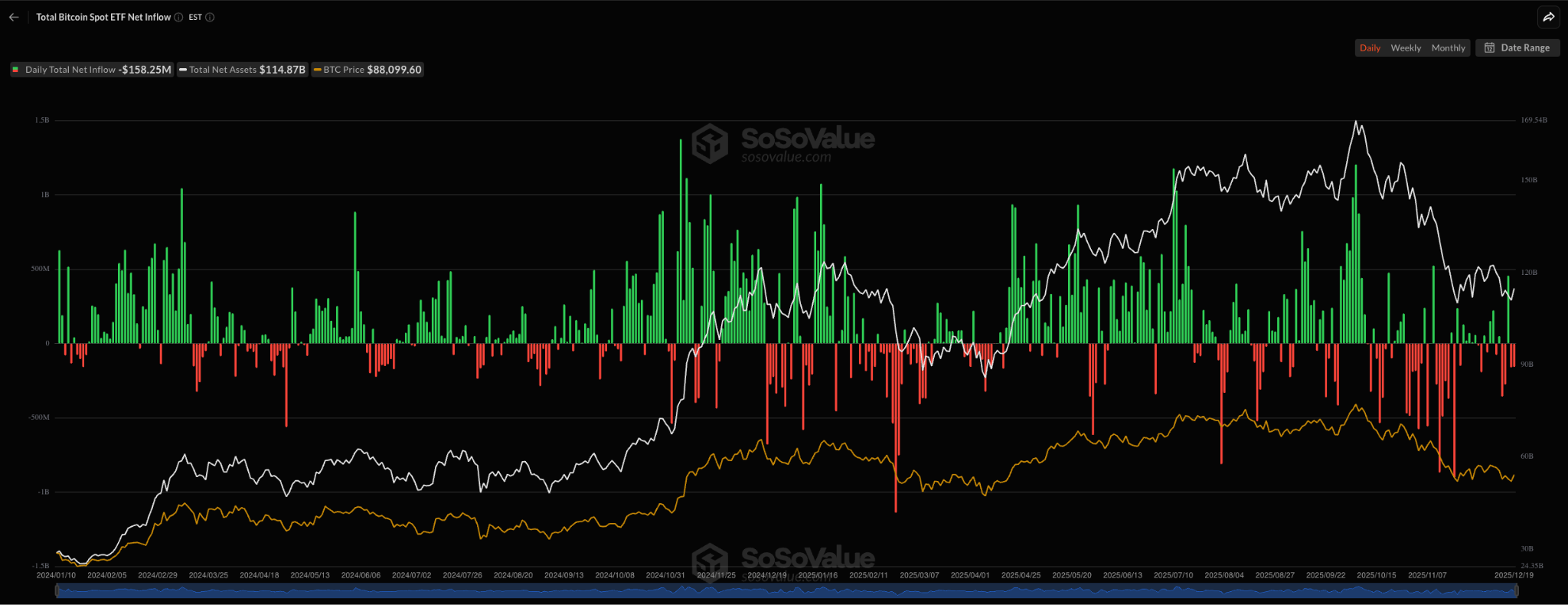
In 2025, the cumulative net inflow of Spot Bitcoin ETF reached 57 billion USD, but funds turned to outflows after October, with Bitcoin experiencing a 30% fall and Ethereum crashing by 50%. In 2026, the crypto market faces three major variables: The Federal Reserve (FED) cutting interest rates by 100 basis points, breakthroughs in U.S. legislation, and AI bubble risks. CoinTelegraph market chief Ray Salmond warned that the first quarter will determine whether the bull run continues or reverses.
Three Key Determining Factors for Q1 2026
(Source: SoSoValue)
By 2026, the crypto market will no longer be a casino driven purely by speculative sentiment, but a financial asset deeply tied to macroeconomic policies, regulatory frameworks, and the valuations of tech stocks. Salmond pointed out in an interview with Schwab Network that the market performance at the beginning of 2026 will depend on the interaction of a series of factors.
The most critical question is: Can the adoption rate at the institutional, corporate, and government levels continue to drive Bitcoin prices up in 2025? Topics such as artificial intelligence, The Federal Reserve (FED) interest rate cuts, Bitcoin strategic reserves, and ETF capital flows drove the market in 2025, but will these narratives still attract buyers back to the market in 2026, or will new catalysts need to emerge?
Three Major Variables in the Market for 2026
1. The Federal Reserve (FED) interest rate cut policy has a double-edged sword
· Expected interest rate cut of 100 basis points to stimulate risk assets
· The cooling of the job market and the rise in consumer debt
· Trump's tariffs have led to an increase in product costs, offsetting the effects of interest rate cuts.
· Loose monetary policy may delay the detonation of the debt bomb
2. Legislative Breakthrough of the CLARITY Act
· Clarify the jurisdiction of the SEC and CFTC over encryption assets
· Provide regulatory certainty for DeFi and altcoins
· Attract offshore crypto businesses to return to the United States
· Consumer protection framework enhances investment confidence
3. AI Industry Valuation Bubble Risk
· Can MAG7 and the expansion of super-large data centers be monetized?
· The decline in stock prices of Oracle, Meta, and Nvidia raises questions.
· Cash flow crisis of heavily indebted AI companies
· The collapse of tech stocks may drag down the crypto market.
These three major variables influence each other, and a drastic change in any direction could rewrite the trajectory of the crypto market in 2026.
Can the CLARITY Act Ignite a DeFi and Altcoin Frenzy?
The most noteworthy positive event to watch for in early 2026 is whether the CLARITY Act can ultimately become law. Cryptocurrency lobbying groups originally hoped the bill would be passed by the end of 2025, but the lengthy government shutdown has delayed the legislative process. If passed, this bill will provide structural support for the crypto market in 2026.
The core of the “CLARITY Act” lies in clarifying regulatory boundaries. It will clarify the jurisdiction of the SEC and CFTC over various types of encryption assets, depending on whether they are classified as securities or commodities. This regulatory certainty will provide the necessary environment for fintech innovators to conduct sandbox testing in the United States and is expected to encourage more offshore cryptocurrency companies to relocate their headquarters back to the U.S.
For DeFi protocols and altcoins, the passage of the CLARITY Act means a fundamental improvement in the space for survival. Over the past few years, the enforcement uncertainty from the SEC has forced many innovative projects to leave the U.S. market, with protocols like Uniswap and Aave facing litigation threats. Once the regulatory framework is clear, these protocols can legally operate in the U.S., attracting institutional funds and retail participation.
Moreover, the bill places a high emphasis on consumer protection, which will provide the transparency needed by businesses and consumers, allowing them to invest in crypto assets with greater confidence. Historical experience shows that a clear regulatory framework often serves as a turning point for an asset class to move from the margins to the mainstream. In the first quarter of 2026, the legislative progress of the CLARITY Act will become a key indicator for observing the sentiment in the crypto market.
The Federal Reserve (FED) cuts interest rates by 100 basis points hidden traps
The market generally expects that the Federal Reserve's policy will further evolve into an accommodative monetary policy, and the Federal Reserve Chair selected by President Trump in early 2026 is expected to bring about a cut of up to 100 basis points. Cryptocurrency investors believe that the Federal Reserve's rate cuts are beneficial for risk assets, but Salmond warns, “What we are facing now is a 'Tale of Two Cities' situation, where the data contradicts the most optimistic views.”
The job market is cooling down, and this cooling trend is expected to continue until 2026. The “temporary” impact of Trump's tariffs has led to rising costs of goods and services, healthcare premiums will increase, and with the announcement of layoffs, increasing consumer debt, and declining disposable income, retail investor confidence may decrease. In this macro context, whether interest rate cuts can truly stimulate consumption and investment, or merely delay the arrival of an economic recession, is the core question for 2026.
Investors expect that the Federal Reserve's interest rate cuts will lead to a decrease in mortgage rates, forcing banks to loosen lending and stimulating consumers to increase spending. However, the potential return of loose monetary policy and massive government spending actually confirms that the U.S. is further delaying the detonation of its debt bomb. The long-term consequences of this “kicking the can down the road” strategy may集中爆發 in the second half of 2026 or 2027.
For the crypto market, the short-term benefits of interest rate cuts may be offset by long-term risks. In the first quarter of 2026, the dilemma facing investors will be: Is the Federal Reserve's loose monetary policy being front-run and then sold off upon confirmation? Or will the ever-changing Federal Reserve policy revive the bull run in the stock market of 2025 and extend into the cryptocurrency space?
AI bubble and MAG7 crash chain risk
The biggest black swan facing the crypto market in 2026 is the burst of the AI industry valuation bubble. In addition to the ETF capital flows in the large CEX spot market in the United States, investors' views on the massive development scale of the artificial intelligence industry and the performance of the tech-heavy S&P 500 index may have a direct impact on the cryptocurrency market.
Salmond explained that the rapid expansion of the balance sheet is one of the strategies driving the surge in technology stocks in 2025, with hyperscale data center operators investing billions of dollars in data centers, computing power, Nvidia GPUs, and energy. As they enter 2026, these companies must prove that they can monetize their investments or at least leverage internal cash flow to fund their expansion.
In the second half of 2025, the stock prices of Oracle, Meta, and Nvidia fell due to market skepticism about whether these companies' free cash flow could turn negative. If investors sense risks associated with AI and quantum computing companies that are burdened with debt and have scarce cash flow in 2026, a negative reaction is likely to occur. How these shockwaves will affect the S&P 500 index, the Dow Jones index, and the crypto market is a matter that investors need to pay close attention to.
On paper, the overall outlook for 2026 is optimistic, especially considering Trump's economic policies, the Federal Reserve's policies, and friendly regulations towards cryptocurrencies. However, the unknown outcomes of AI development and the actual impact of interest rate cuts on consumers and the economy will determine the direction of the market in the first and second quarters. Investors who value options and flexible layouts should be able to avoid some market traps driven by narratives and speculation.


