The total stablecoin market capitalization has reached an all-time high of $310 billion as of late December 2025, marking a more than 50% increase from $205 billion at the start of the year.
This explosive growth underscores stablecoins’ evolution from niche trading tools to core infrastructure for payments, DeFi, and traditional finance integration. Led by Tether (USDT) at $187 billion and USD Coin (USDC) at $77 billion, the sector has also seen rapid gains from newer entrants like Ethena’s USDe and Sky’s USDS. With unique holders surpassing 200 million and on-chain transaction volume exceeding $40 trillion annually, stablecoins now rival major payment networks while holding massive U.S. Treasury exposure. Supportive regulations—such as the U.S. GENIUS Act and Europe’s MiCA framework—have encouraged bank participation, though rising issuer concentration raises questions about potential market shifts ahead.
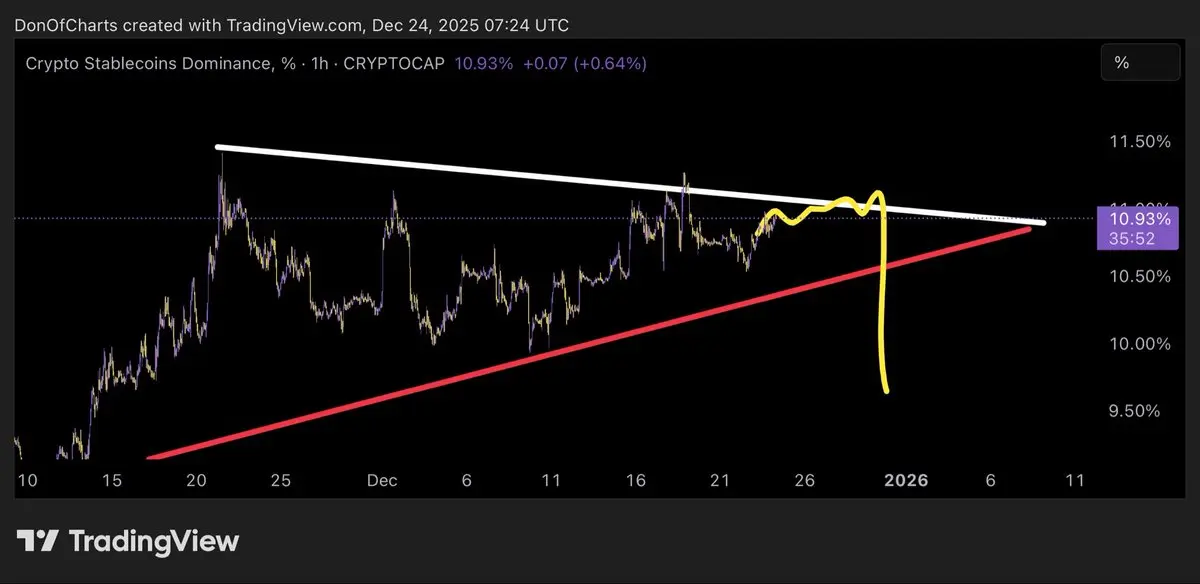
(Sources: TradingView)
Key Drivers Behind the $310 Billion Stablecoin Milestone
2025 has been a breakout year for stablecoins:
- Market Cap Growth: +$105 billion YTD (>50%).
- Dominance Breakdown:
- Tether (USDT): ~$187B (60%+ share).
- USD Coin (USDC): ~$77B.
- Emerging Players: USDe, USDS, and others gaining fast.
- User Adoption: 200 million+ unique holders worldwide.
- Transaction Volume: >$40 trillion annualized on-chain.
This expansion reflects stablecoins’ utility in trading, remittances, yield farming, and cross-border settlements.
How Stablecoins Bridge DeFi and Traditional Finance
Stablecoins have become indispensable infrastructure:
- Treasury Holdings: Billions in U.S. Treasuries as reserves, linking crypto to government debt markets.
- Payments & Remittances: Low-cost, instant global transfers challenging legacy rails.
- DeFi Backbone: Collateral for lending, borrowing, and perpetuals.
- Institutional On-Ramps: Banks exploring issuance under new frameworks.
The $40T transaction volume rivals Visa/Mastercard in certain corridors, highlighting real-world penetration.
Regulatory Tailwinds Fueling Growth
2025 regulations provided clarity and legitimacy:
- U.S. GENIUS Act: Framework for bank-issued stablecoins.
- Europe’s MiCA: Standardized rules boosting EU adoption.
- Global Ripple: Encouraged compliant issuers and institutional participation.
These developments reduced offshore dominance fears while attracting TradFi capital.
Risks and Concentration Concerns
Despite the rally, analysts note potential vulnerabilities:
- Issuer Dominance: USDT/USDC control ~85%+ of supply.
- Counterparty Risks: Reliance on reserve attestations.
- Market Shift Potential: Bank-issued alternatives could fragment liquidity.
- Regulatory Scrutiny: Ongoing debates over systemic importance.
Traders watch for signs of rotation if new entrants erode legacy shares.
In summary, the stablecoin market’s climb to a record $310 billion in 2025—up over 50% YTD with 200 million holders and $40 trillion in volume—cements its role as a bridge between DeFi and traditional finance. Led by Tether and USDC amid regulatory tailwinds like GENIUS Act and MiCA, the sector’s Treasury-backed growth signals mainstream maturation. Monitor issuer reports, regulatory updates, and on-chain metrics for evolving dynamics in this cornerstone of digital dollar infrastructure.
Disclaimer: The information on this page may come from third parties and does not represent the views or opinions of Gate. The content displayed on this page is for reference only and does not constitute any financial, investment, or legal advice. Gate does not guarantee the accuracy or completeness of the information and shall not be liable for any losses arising from the use of this information. Virtual asset investments carry high risks and are subject to significant price volatility. You may lose all of your invested principal. Please fully understand the relevant risks and make prudent decisions based on your own financial situation and risk tolerance. For details, please refer to
Disclaimer.


