![]() Trusted Editorial content, reviewed by leading industry experts and seasoned editors. Ad Disclosure
For the first time in nearly two years, the cryptocurrency market has experienced a turn in net capital flows, dropping below the $4.5 billion mark. This downturn comes as Bitcoin (BTC) has led a tumultuous fourth quarter, characterized by increased selling pressure and heightened volatility.
Trusted Editorial content, reviewed by leading industry experts and seasoned editors. Ad Disclosure
For the first time in nearly two years, the cryptocurrency market has experienced a turn in net capital flows, dropping below the $4.5 billion mark. This downturn comes as Bitcoin (BTC) has led a tumultuous fourth quarter, characterized by increased selling pressure and heightened volatility.
Cash Flow Crisis In Crypto
Notably, CoinShares recently reported that crypto products witnessed outflows totaling $446 million last week, contributing to a total of $3.2 billion in outflows since the sharp price decline on October 10th
Technical analyst Ali Martinez shared insights on social media platform X (formerly Twitter), indicating that, from a price-action perspective, a short-term bounce could be possible after such an extended downtrend, reminiscent of patterns observed following the market peak in 2021.
Related Reading: Free Bitcoin And Dogecoin: How Robinhood Users Are Claiming Crypto RewardsHowever, when analyzing on-chain data, the overall decline in capital inflows suggests that money is currently leaving the crypto space rather than entering it
This is further supported by Bitcoin exchange-traded fund (ETF) net flows, which have seen nearly $1 billion in outflows over the past two weeks, suggesting that institutional investors are currently reducing their exposure rather than increasing their risk assets.
Martinez cautioned that any potential rebound would likely be propelled by leverage rather than fresh demand, which can create scenarios where late buyers get trapped, ultimately leading to further price declines. He concluded that the risk of Bitcoin hitting lower lows remains significant as capital continues to exit the market.
Could Bitcoin Recover $100,000 In Q1 2026?
Despite the prevailing bearish sentiment, some optimistic forecasts have emerged for the first quarter of 2026. Crypto Rover highlighted that Q1 could be particularly bullish for both Bitcoin and altcoins for several reasons
First, fresh capital is typically deployed at the beginning of the year, as hedge funds, asset managers, and institutional players allocate new money to work
With traditional assets like gold, silver, and stock indices already nearing all-time highs, Rover believes that institutions may see crypto as an attractive opportunity, especially since Bitcoin and various altcoins still fall below their previous peaks
Second, end-of-year selling often transitions into buying come January. This behavior is frequently driven by tax-loss harvesting, where investors sell losing positions in December to lock in losses, only to re-enter those positions in January
Related Reading: Bitcoin Miners Brace For Another Difficulty Spike In January After 2025 RecordLastly, Bitcoin has been known to follow a four-year market cycle. The previous cycle saw Bitcoin drop from $69,000 to $32,000, before rebounding to around $48,000 and reclaiming its 50-week exponential moving average (EMA)
Currently, this EMA stands near $98,200, and if Bitcoin adheres to similar patterns in Q1 2026, a move toward the $100,000 to $102,000 range is entirely plausible, marking an 18% increase from current levels
Historically, a 20% increase in Bitcoin often correlates with a 35-40% rise in Ethereum (ETH) and large-cap altcoins, while smaller altcoins may see even more dramatic increases of 60-80% before momentum stabilizes.
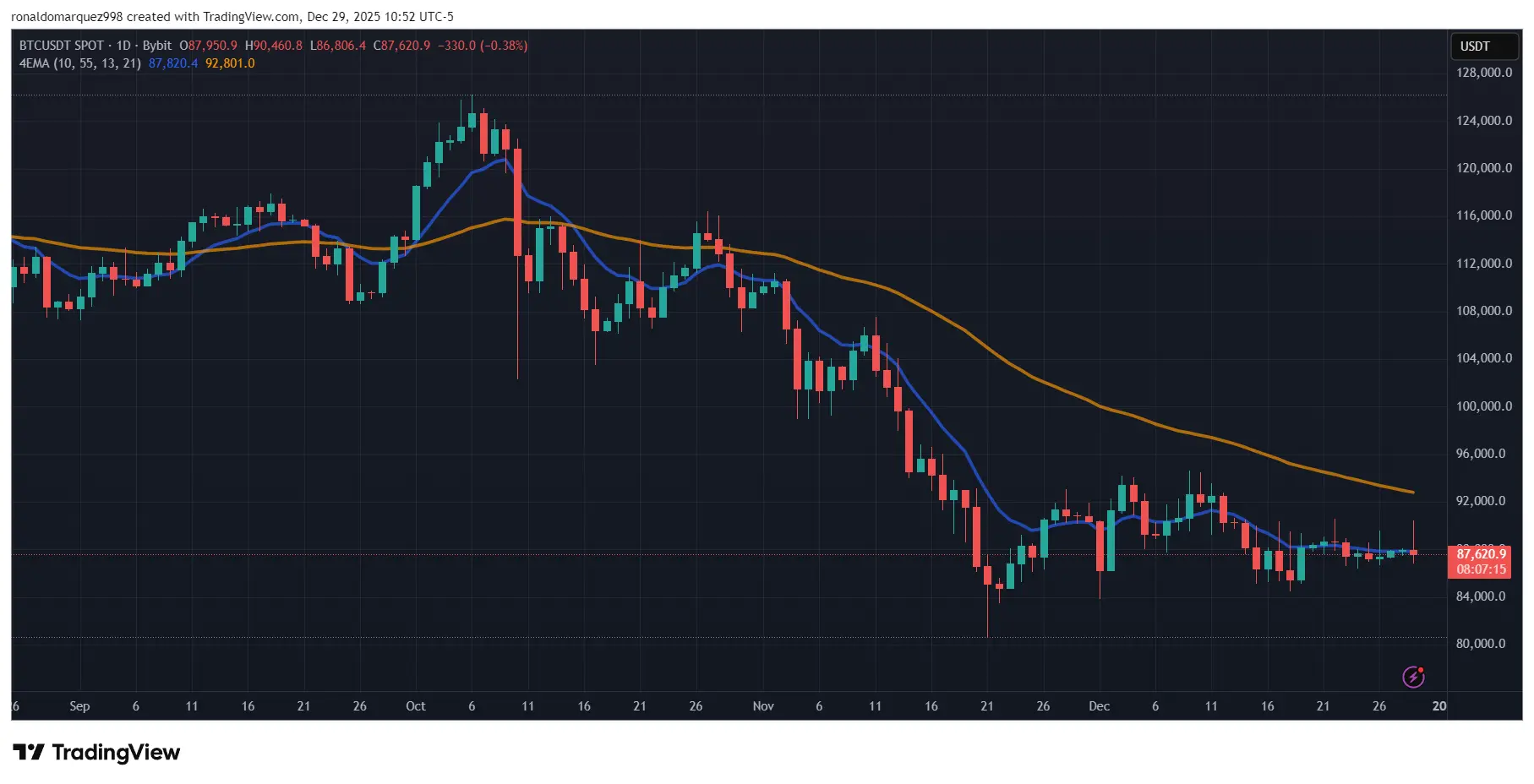 The 1-D chart shows BTC’s consolidation below the key $90,000 mark. Source: BTCUSDT on TradingView.comAt the time of writing, the market’s leading cryptocurrency is trading at $87,620 — a 30% drop from the all-time high of $126,000 reached in October
Featured image from DALL-E, chart from TradingView.com
![]() Editorial Process for bitcoinist is centered on delivering thoroughly researched, accurate, and unbiased content. We uphold strict sourcing standards, and each page undergoes diligent review by our team of top technology experts and seasoned editors. This process ensures the integrity, relevance, and value of our content for our readers.
Editorial Process for bitcoinist is centered on delivering thoroughly researched, accurate, and unbiased content. We uphold strict sourcing standards, and each page undergoes diligent review by our team of top technology experts and seasoned editors. This process ensures the integrity, relevance, and value of our content for our readers.
Disclaimer: The information on this page may come from third parties and does not represent the views or opinions of Gate. The content displayed on this page is for reference only and does not constitute any financial, investment, or legal advice. Gate does not guarantee the accuracy or completeness of the information and shall not be liable for any losses arising from the use of this information. Virtual asset investments carry high risks and are subject to significant price volatility. You may lose all of your invested principal. Please fully understand the relevant risks and make prudent decisions based on your own financial situation and risk tolerance. For details, please refer to
Disclaimer.
Related Articles
AVAX 15-minute increase of 0.76%: Ecosystem positive catalysts combined with on-chain capital inflows driving abnormal movements
From 00:00 to 00:15 (UTC) on March 9, 2026, the AVAX price experienced a rapid surge, with a return of +0.76%. The price ranged between 8.815 and 8.885 USDT, with an amplitude of 0.79%. At the same time, trading volume significantly increased during this period, market volatility intensified, short-term trading became active, and market attention was heightened.
The main driver of this anomaly was the ongoing fermentation of the news announced by Avalanche on March 8, about a liquidity staking partnership with a well-known DeFi protocol. The market
GateNews2m ago
Bloomberg: Hyperliquid is the only window to observe oil prices over the weekend, with a surge to $92 USD alert; now crude oil has skyrocketed to $112
The Iran conflict has entered its second week. After the reopening of traditional markets, crude oil prices have risen from the predicted $92 by Hyperliquid to $112, indicating the correct direction but underestimating the magnitude. Hyperliquid is currently driven by retail investors, and its lack of liquidity limits its value to an emotional indicator, preventing it from becoming an accurate pricing benchmark.
動區BlockTempo3m ago
NYDIG: 75% Bitcoin volatility does not depend on the stock market; diversification still proves effective
NYDIG's report indicates that while the correlation between Bitcoin and the stock market has risen to 0.5, only 25% of its volatility can be explained by the stock market, with 75% stemming from its own factors. This demonstrates Bitcoin's value for diversification in investment portfolios. Additionally, Bitcoin's long-term growth does not rely on central bank adoption, showcasing a bottom-up continuous expansion potential.
MarketWhisper5m ago
BTC 15-minute increase of 0.68%: Whales' capital inflow and geopolitical safe-haven funds resonate to drive a short-term rebound
2026-03-09 02:30 to 2026-03-09 02:45 (UTC), Bitcoin (BTC) achieved a +0.68% return within 15 minutes, with the price range between 66,095.6 and 66,585.0 USDT, and an amplitude of 0.74%. Amid geopolitical conflicts, market attention during this period significantly increased, volatility intensified compared to normal levels, and trading activity rapidly surged.
The main driver of this anomaly was the concentrated inflow of whale funds into a certain trading platform. On-chain data shows that recent whale transfers of BTC to exchanges have sharply increased.
GateNews16m ago
XRP Plunges in a Wave! Analysts Warn of Liquidity Traps, ETF Weekly Capital Reversal
XRP is currently facing multiple pressures. Analyst ChartNerd predicts that it may first rise to $1.80 before retracing to $1, forming a "liquidity hunt." At the same time, XRP ETF experienced its first weekly outflow, indicating cautious market sentiment. Nevertheless, on-chain data shows large holders returning, signaling bottom accumulation. Ripple's CEO also remains optimistic about the long-term outlook.
MarketWhisper22m ago
Solana Signals Weak Momentum After Failed Break Above $90.89
Key Insights
Solana failed to hold above the $90.89 resistance level as buyers lost strength, pushing the price back into the established range structure.
Price now trades around the point of control, where weakening momentum increases the likelihood of a rotation toward lower range
CryptoFrontNews23m ago


