 Bittensor (TAO) is sitting in a very different mood compared to the autumn pump. The Bittensor price has spent weeks sliding lower, and the chart now looks more like “acceptance” than “hype.” That matters, because it changes what the TAO price usually does next.
This take is coming from analyst CyrilXBT, who framed the move as a turning point. In his words, “This is no longer ‘distribution.’ This is acceptance at lower prices.” He also called the area a “high-conviction demand zone,” pointing to a long downtrend, fading seller momentum, and drying volume.
Bittensor (TAO) is sitting in a very different mood compared to the autumn pump. The Bittensor price has spent weeks sliding lower, and the chart now looks more like “acceptance” than “hype.” That matters, because it changes what the TAO price usually does next.
This take is coming from analyst CyrilXBT, who framed the move as a turning point. In his words, “This is no longer ‘distribution.’ This is acceptance at lower prices.” He also called the area a “high-conviction demand zone,” pointing to a long downtrend, fading seller momentum, and drying volume.
- What the TAO chart is actually showing
- Key TAO price zones to watch
- Does CyrilXBT’s take make sense?
- What TAO holders could expect post-halving in 2026
What the TAO chart is actually showing
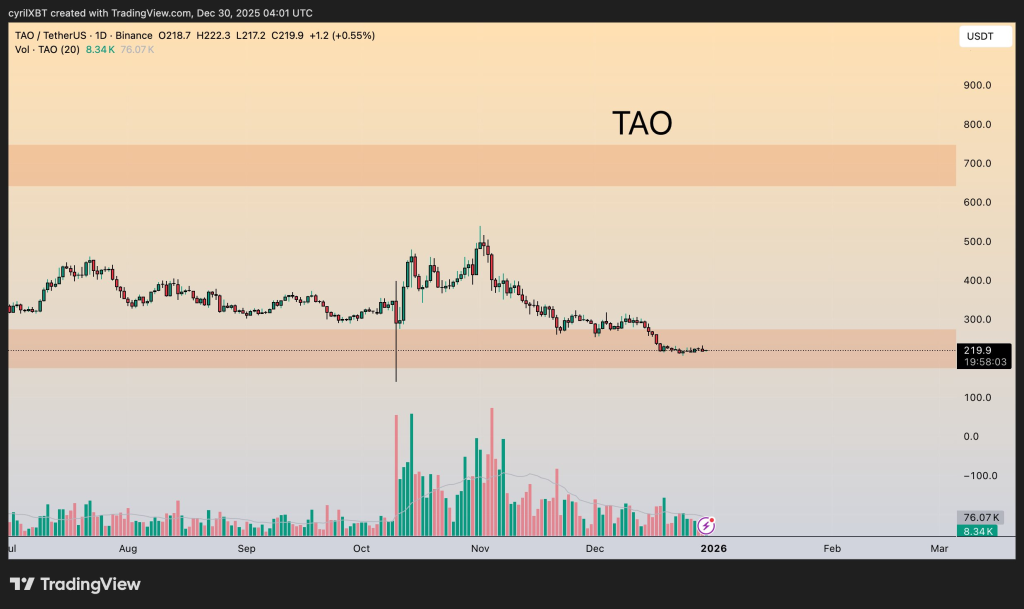
On the daily TAO/USDT chart, the TAO price is trading around the low-$200s, after a clear breakdown from the November peak near the low-$500s. The structure since that top is consistent: lower highs, weak bounces, and a slow grind downward rather than a clean V-shaped reversal. That usually signals steady sell pressure instead of one-off panic.
The most important detail is volume. The biggest volume burst shows up during the sharp move higher and the reversal zone in October–November, which is when the market was most emotional. Since then, volume has cooled as price has drifted down. That supports CyrilXBT’s point about exhaustion: the “urgent selling” phase appears to have already happened, and what’s left is a market that’s simply willing to transact at lower levels.
Source: X/@cyrilXBT
At the same time, calling it “capitulation” is only partly supported by this specific chart. Classic capitulation often comes with a violent flush and a large final volume spike. Here, the message is more like fatigue than maximum panic. It’s closer to “the crowd has stopped fighting the downtrend,” which is still a big psychological shift.
Key TAO price zones to watch
The chart highlights a broad demand region around the current area, roughly the $200–$260 band, where price is now compressing. If the TAO price continues to hold in this region, it can become a base. If it loses it cleanly, the chart opens room for a deeper sweep toward the high-$100s, especially if broader crypto risk turns off.
Overhead, the first area that matters is the prior breakdown region around $260–$300. That’s where a lot of failed bounces started. If TAO can reclaim and hold above that zone, it would be the first sign that the Bittensor price is shifting from “sell rallies” to “buy dips.” Above that, the next heavier resistance sits around the low-to-mid $300s, where price previously chopped before the leg down accelerated.
Does CyrilXBT’s take make sense?
Mostly, yes. The downtrend is obvious, and the volume trend does support the idea that forced selling has cooled. The chart also shows that TAO is no longer behaving like a “top distribution range” where sellers are unloading into strong demand. Instead, it looks like price has already been repriced lower and is now trying to stabilize.
The one tweak is the terminology. “Capitulation” can be real, but the evidence here points more to acceptance and exhaustion than a dramatic final flush. That difference matters because an “acceptance base” can still take time. It doesn’t guarantee an immediate bounce.
Read also: “The Timeline Was Wrong”: XRP Community Confronts Reality After 7 Years of Waiting
What TAO holders could expect post-halving in 2026
Post-halving narratives usually come down to one thing: reduced new supply hitting the market. If Bittensor’s emissions slow meaningfully after the halving, it can reduce the constant sell pressure that comes from ongoing rewards distribution. That can help the TAO price recover if demand returns at the same time.
But supply changes alone rarely do the whole job. The Bittensor price will still depend on whether the network stays relevant in the AI-crypto cycle. If subnet activity, real usage, and ecosystem growth stay strong, a lower emission rate can amplify upside during risk-on periods. If sentiment stays weak or AI narratives cool off, halving effects can take longer to show up and may only act as a “floor-builder,” not an instant catalyst.
Right now, the chart is basically saying this: the market has stopped paying premium prices for TAO, and it’s testing whether this lower range can hold without another wave of selling.
Read also: Bittensor (TAO) vs. Hedera (HBAR): Which Altcoin Could Perform Better in 2026?
Disclaimer: The information on this page may come from third parties and does not represent the views or opinions of Gate. The content displayed on this page is for reference only and does not constitute any financial, investment, or legal advice. Gate does not guarantee the accuracy or completeness of the information and shall not be liable for any losses arising from the use of this information. Virtual asset investments carry high risks and are subject to significant price volatility. You may lose all of your invested principal. Please fully understand the relevant risks and make prudent decisions based on your own financial situation and risk tolerance. For details, please refer to
Disclaimer.
Related Articles
Short-selling firm Culper releases bearish report on Ethereum: Fusaka upgrade disrupts ETH token economics
Aggressive short-selling firm Culper Research has released a report bearish on Ethereum (ETH), believing that the Fusaka upgrade in 2025 will cause structural damage to ETH's token economy. The report points out that a significant decrease in Gas fees has led to increased address pollution attacks and reduced validator rewards, and emphasizes that Ethereum is facing competitive pressure from Solana and L2 solutions. Culper believes that ETH's value capture ability is declining and has started shorting ETH.
ChainNewsAbmedia1h ago
Geopolitical Turmoil! Dalio Declares "Gold is the Only True God," but Its Safe-Haven Performance Trails Bitcoin
As geopolitical tensions in the Middle East escalate, Bridgewater founder Ray Dalio questions Bitcoin and reaffirms gold as the preferred safe haven. Nevertheless, gold prices fell accordingly, while Bitcoin only experienced a slight correction, indicating that the correlation between the two is weakening. Dalio doubts Bitcoin's transparency and future risks, but he still maintains a small allocation of Bitcoin for diversification.
区块客1h ago
Zcash (ZEC) at the important crossroads: What could happen in the next few weeks?
Zcash (ZEC) shows signs of stabilization after declining from over 700 USD, with price nearing critical support around 200 USD. Recent recovery indicates buyer strength, but momentum indicators suggest caution. A breakout above 250 USD could initiate further recovery.
TapChiBitcoin1h ago
ETH 15-minute sharp decline of 1.53%: Large investors' short-term profit-taking and ETF capital outflows resonate, triggering a significant drop
From 13:45 to 14:00 on March 6, 2026 (UTC), ETH experienced a significant fluctuation, with a short-term decline of 1.53%. The price fluctuated sharply between 2019.21 and 2051.26 USDT, with an amplitude of 1.56%. High-frequency sell orders surged, market attention spiked, trading volume increased, and the divergence between bulls and bears intensified. Market sentiment became more cautious.
The main driving force behind this fluctuation was large investors and whale accounts reducing their positions after a short-term rebound, leading to a rapid release of large sell orders and triggering short-term selling pressure in the market. On the ETF front, holdings
GateNews1h ago
BTC short-term decline of 1.23%: whale fund outflows and leveraged long liquidations trigger concentrated selling
On 2026-03-06 from 13:45 to 14:00 (UTC), the price of Bitcoin (BTC) experienced a -1.23% return over 15 minutes, with a price range of 69,219.0 to 70,086.3 USDT, and an amplitude of 1.24%. Trading activity significantly increased in a short period, with the market focusing on intense volatility and a resurgence of risk sentiment.
The main drivers of this anomaly are continuous outflows of on-chain whale funds and large-scale leveraged long liquidations in the derivatives market. According to on-chain data, whale withdrawals reached as high as 16,972 BTC in a single day, Whales O
GateNews1h ago
Samson Mow Objects to Michael Saylor's Bitcoin Insufficiency Post - U.Today
The debate over Bitcoin's supply scarcity is highlighted by Michael Saylor's claim that there isn't enough Bitcoin for everyone, which Samson Mow counters with calculations showing each person could receive around 259,259 satoshis if distributed globally. Mow's argument underscores the reality that large entities hold significant portions of Bitcoin, emphasizing its scarcity and potential value.
UToday3h ago


