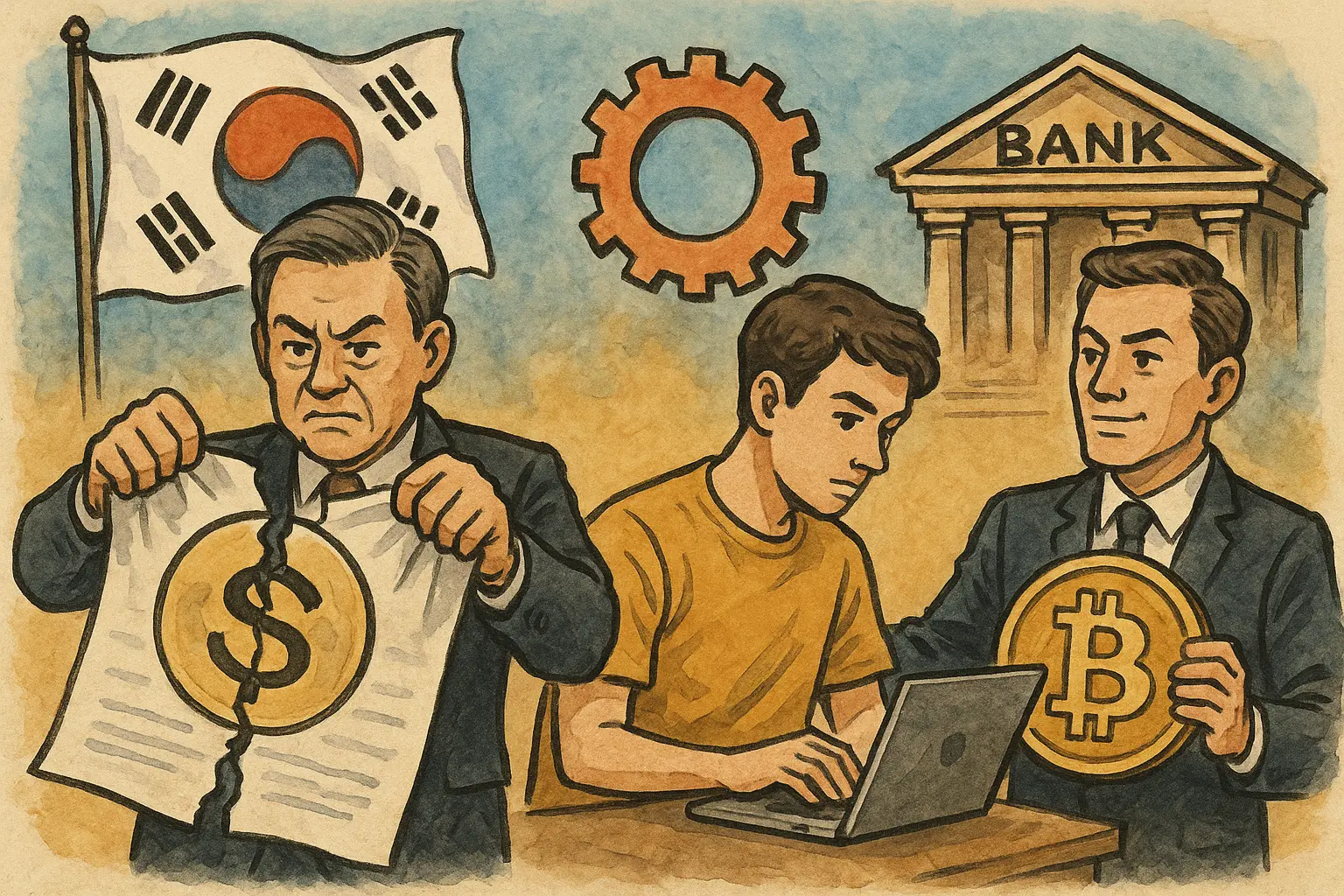
South Korea’s cryptocurrency industry faces a turning point. According to Yonhap News Agency, the originally scheduled Digital Asset Basic Law has been postponed to 2026 due to key regulatory disagreements. This stablecoin bill, promoted by President Lee Jae-myung, was once seen as a milestone for Korea’s crypto market, but now faces deadlock over “stablecoin issuer qualifications” and “reserve asset custody mechanisms.” The tug-of-war over regulatory authority between the Financial Services Commission and tech industry players has put the legalization process of stablecoins in Korea on hold.
Lee Jae-myung’s Crypto Vision and Political Betting
Before taking office in June, South Korean President Lee Jae-myung promised to promote the issuance of stablecoins pegged to the Korean won as a core policy to revitalize the country’s cryptocurrency market. This commitment is not isolated but part of Lee’s overall crypto-friendly policy. He also advocates for national pension funds to invest in digital assets and supports the issuance of Bitcoin-linked exchange-traded funds (ETFs).
There are clear strategic considerations behind these policies. Korea has one of the world’s most active cryptocurrency trading markets, with a high crypto holding rate globally, but has long been constrained by strict regulations and the lack of domestic stablecoins. Lee aims to legalize Korean won stablecoins to keep the massive trading demand within the country and open new avenues for Korea’s tech industry.
However, this political gamble is now facing technical setbacks. The bill proposed by the ruling Democratic Party in June explicitly allows the issuance of stablecoins pegged to the Korean won, but specific implementation details have triggered conflicts of interest. The bill requires stablecoin issuers to entrust all reserve assets to authorized custodial institutions like banks, a seemingly reasonable regulation that has become a trigger for legislative delays.
Regulatory Power Struggle: The Tug-of-War Between Banking System and Tech Innovation
The core contradiction delaying Korea’s stablecoin bill lies in who is qualified to issue and regulate stablecoins. Within the Financial Services Commission, two opposing factions exist, and this disagreement has directly hindered the bill’s progress.
Three Major Controversies
Issuer Qualification Threshold: Traditional finance advocates argue only licensed banks and large financial institutions should issue stablecoins, while tech innovators believe the field should be open to blockchain technology companies.
Reserve Asset Custody Rights: Banks demand all reserves be held by custodial banks and charge fees, whereas tech firms question this could create new monopolies and increase issuance costs.
Timing of Regulatory Authorization: Should a regulatory body be authorized before approving the bill to oversee stablecoin issuers, or should legislation be enacted first with a gradual development of the regulatory framework?
Reports indicate that the Financial Services Commission is reviewing the proposal but is also considering limiting the role of financial institutions in Korea’s stablecoin sector to encourage participation by tech companies. This conflicting stance reflects deep internal divisions within the Korean government: on one hand, ensuring financial stability through strict regulation; on the other, not wanting to miss out on blockchain technological innovation.
Concerns from traditional financial institutions are not unfounded. The collapse of the Terraform Labs ecosystem and the de-pegging of UST stablecoin caused significant impact in Korea, with tens of thousands of Korean investors suffering losses. The co-founder of this incident, Do Kwon, was recently sentenced to 15 years in prison in the US and may be extradited back to Korea facing up to 40 years in prison. This disaster has made Korean regulators extremely cautious about stablecoin risks.
Tech industry players argue that over-reliance on traditional banking systems will stifle innovation. They point out that major global stablecoins like USDT and USDC are issued not by banks but by specialized blockchain fintech companies. If Korea restricts issuance rights to banks, it could hinder innovation and ultimately reduce competitiveness internationally.
Delayed Legislation’s Far-reaching Impact on Korea’s Crypto Market
The postponement of the Digital Asset Basic Law until 2026 means Korea’s stablecoin legalization will have to wait at least two more years. This period is enough for significant changes in the market landscape. Currently, Korean crypto traders mainly rely on USD-pegged stablecoins like USDT and USDC, which flow out of the country and fail to generate value for the domestic economy.
More seriously, regulatory uncertainty may drive Korean crypto companies abroad. Singapore, Dubai, and Hong Kong are actively vying to become the regional hub for crypto, offering clear regulatory frameworks and tax incentives. Continued delays in legislation could cause Korea to fall behind in this regional competition.
From an investor’s perspective, the delay signals confusion. The gap between Lee Jae-myung’s campaign promises and actual legislative progress undermines confidence in the government’s crypto-friendly policies. This uncertainty suppresses institutional investment and dampens retail enthusiasm for domestic crypto projects.
However, delays may also have positive effects. The two-year buffer allows regulators to observe global stablecoin regulation practices, especially the EU’s MiCA regulations and US stablecoin legislation progress. Korea can learn from international experience to craft a more comprehensive regulatory framework and avoid regulatory gaps caused by rushed legislation.
The Shadow of Terraform Labs and Cautious Regulation
The Do Kwon case cannot be ignored in Korea’s stablecoin legislation. The Korean-born entrepreneur’s project collapse caused losses estimated at over $40 billion, with a significant proportion of Korean investors affected. This disaster has made the Korean public extremely cautious about algorithmic stablecoins and decentralized finance projects.
The current bill requires reserves to be entrusted to authorized custodial institutions, aiming to prevent a repeat of the UST disaster. However, this overly conservative approach may be excessive. Fully collateralized stablecoins like USDC and USDT have not experienced similar issues, and overly strict regulation could hinder normal financial innovation.
Disclaimer: The information on this page may come from third parties and does not represent the views or opinions of Gate. The content displayed on this page is for reference only and does not constitute any financial, investment, or legal advice. Gate does not guarantee the accuracy or completeness of the information and shall not be liable for any losses arising from the use of this information. Virtual asset investments carry high risks and are subject to significant price volatility. You may lose all of your invested principal. Please fully understand the relevant risks and make prudent decisions based on your own financial situation and risk tolerance. For details, please refer to
Disclaimer.
Related Articles
Rune Christensen-Linked Address Goes Long on Oil With $4M USDC
Rune Christensen's crypto wallet made waves by depositing $4M in $USDC into HyperLiquid, opening leveraged oil positions. This risky move amid geopolitical instability has sparked discussions on speculation versus calculated risk in the crypto community.
BlockChainReporter42m ago
Circle completes $68 million in internal settlements among 8 entities using USDC within the first month
Circle CEO Jeremy Allaire revealed that Circle has completed internal entity transfers using USDC through the Circle Mint platform, transferring over $68 million in the first month, with significantly higher efficiency than traditional bank wire transfers. The platform will launch a fund management update in March to optimize account transfers and integrate with accounting system APIs.
GateNews3h ago
USDC tops Tether as stablecoin transfers hit all-time high $1.8T
Stablecoins are delivering a liquidity surge unseen in recent cycles, with February marking a record on-chain transfer activity and signaling a shift in how capital moves through crypto markets. Allium’s data shows total stablecoin transfers climbed to $1.8 trillion in February, underscoring a
CryptoBreaking6h ago
February stablecoin trading volume hits a new monthly high of $1.8 trillion, with USDC accounting for 70%
Gate News reports that on March 7th, according to Allium data, the trading volume of stablecoins in February reached $1.8 trillion, setting a new monthly record. Among them, USDC accounted for approximately 70% of the total trading volume, reaching $1.26 trillion; USDT's trading volume in February was $514 billion.
GateNews7h ago
South Korea plans to ban corporate investments in stablecoins, and USDT and USDC may be excluded from the permitted scope.
Gate News Report, March 7 — According to Korean media, the Korea Financial Services Commission is drafting the "Corporate Virtual Currency Trading Guidelines," which may exclude stablecoins from the permitted investment scope. The guidelines will outline the standards for listed companies and registered professional investment firms to trade digital assets for investment or financial purposes. To prevent reckless investments in the early stages of the market, regulators have decided to exclude dollar-pegged stablecoins such as Tether (USDT( and USD Coin )USDC( from the allowable investment range.
GateNews8h ago
Circle Settles $68M in USDC Transfers Across 8 Entities
Circle used USD Coin to settle $68M across eight entities in under 30 minutes via its Circle Mint treasury platform.
The stablecoin workflow replaced bank wires that usually take one to three days, enabling faster intercompany treasury settlements.
Circle Mint maintained treasury
CryptoFrontNews10h ago


