


Dalio's Annual Review: Why Did the US Dollar Depreciate by 39% and Gold Surge?
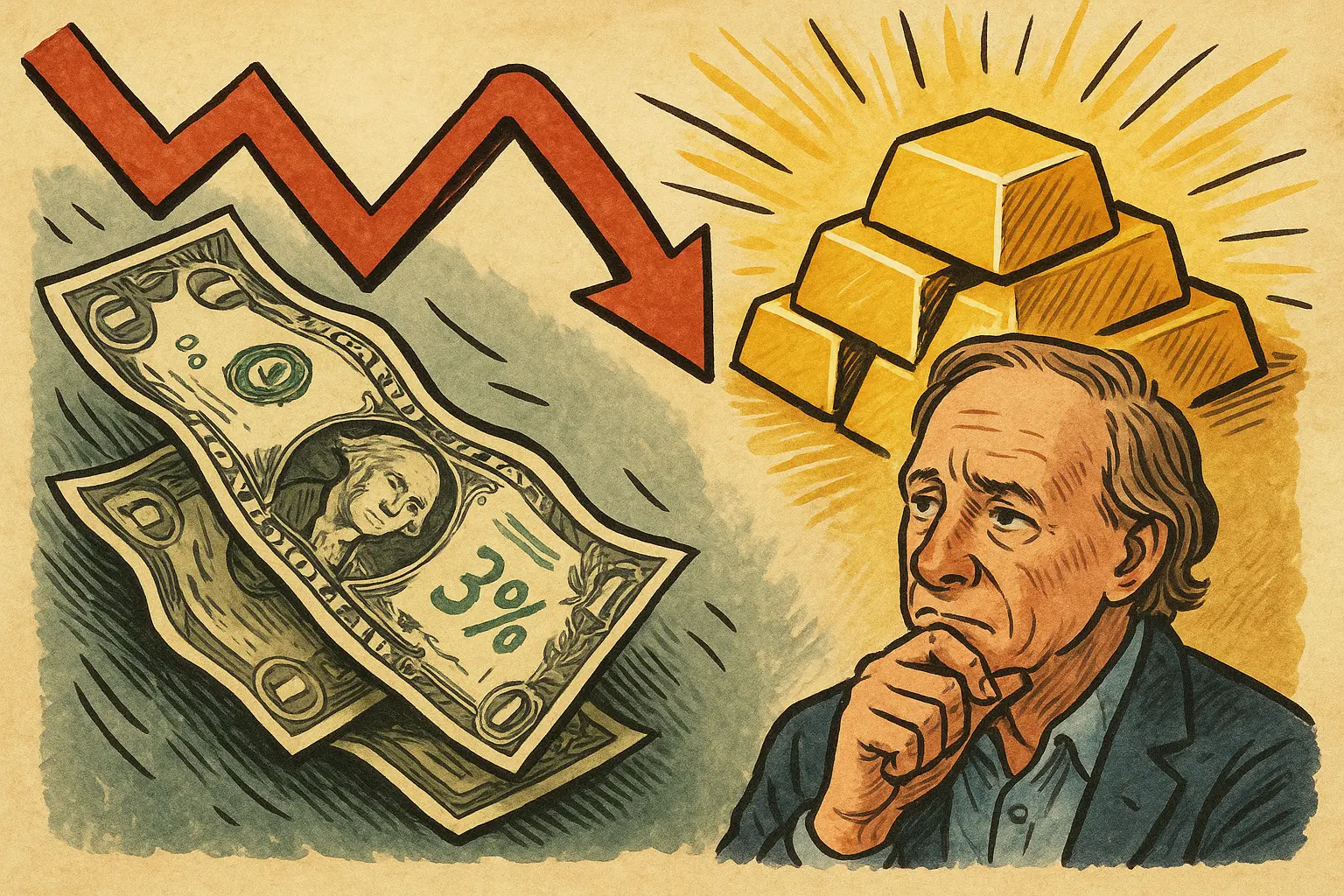
Ray Dalio, founder of Bridgewater Associates, points out that the biggest story of 2025 is the devaluation of the US dollar and the rise of gold. The dollar has depreciated 39% against gold, while gold has risen 65%, far surpassing the S&P 18%. From a gold perspective, the S&P has effectively fallen 28%. Non-US stock markets outperformed, with Europe leading by 23%. Dalio warns that valuations are expensive, and stock risk premiums have fallen to the 10th percentile.
The Shocking Truth of 39% Dollar Devaluation
As a systematic global macro investor, Dalio reflects on market mechanisms at the end of 2025. He believes that most people think US stocks, especially those related to artificial intelligence, are the best investments for 2025, but this view overlooks more important facts.
In 2025, the USD depreciated 0.3% against the Japanese Yen, 4% against the Chinese Yuan, 12% against the Euro, 13% against the Swiss Franc, and 39% against gold (the second-largest reserve currency and the only major non-fiat currency). In other words, all fiat currencies are depreciating, and the biggest market story and volatility come from the weakest fiat currency depreciating the most, while the strongest “hard currency” performs the best.
The top-performing major investment in 2025 was gold, with a USD-denominated return of 65%, outperforming the S&P 500’s USD return of 18% by 47%. In other words, from a gold perspective, the S&P 500 has effectively declined 28%. This data overturns the superficial impression of a US stock bull market and reveals the actual wealth loss masked by currency depreciation.
When a domestic currency depreciates, it reduces the country’s wealth and purchasing power, making domestic goods and services cheaper in foreign currencies, while foreign goods and services become more expensive in the domestic currency. These changes influence inflation rates and who buys what from whom, but the effects usually have a certain lag.
S&P 500 Returns from Different Currency Perspectives
USD Investors: 18%
JPY Investors: 17%
CNY Investors: 13%
EUR Investors: Only 4%
CHF Investors: Only 3%
Gold Investors: -28%
The Wealth Shift: Non-US Stock Markets Outperform Across the Board
Despite US stocks performing strongly in USD terms, their performance is much weaker when valued in strong currencies, lagging significantly behind stock markets in other countries. Clearly, investors prefer non-US stocks over US stocks; similarly, they are more inclined to invest in non-US bonds rather than US bonds or USD cash.
Specifically, European stocks outperformed US stocks by 23%, Chinese stocks by 21%, UK stocks by 19%, and Japanese stocks by 10%. Overall, emerging market stocks performed even better, with a return of 34%, while emerging market USD-denominated debt returned 14%, and local currency debt in emerging markets returned 18%.
In other words, capital flows, asset values, and wealth transfer have shifted significantly from the US to non-US markets. This trend may lead to more asset rebalancing and diversification. Dalio points out that this phenomenon is mainly driven by fiscal and monetary stimulus policies, productivity improvements, and a substantial transfer of asset allocation from the US market.
The Trump administration’s foreign policy has caused concern and retreat among some foreign investors, as fears of sanctions and conflicts intensify. Investors are more inclined to diversify their portfolios and buy gold, which is reflected in the markets. Its policies have also exacerbated wealth and income inequality, as the “wealthy class” (the top 10% of capital owners) hold more stock wealth, and their income growth is more pronounced.
Debt Crisis and the Political Bomb of the 2026 Midterm Elections
Regarding bonds (debt assets), since bonds are essentially promises to deliver currency, their real value declines when the currency depreciates, even if nominal prices may rise. In 2025, the US 10-year Treasury yield was 9% in USD (about half from yield, half from price appreciation), also 9% in JPY, 5% in CNY, but -4% in EUR and CHF, and -34% in gold.
Cash investments performed even worse than bonds. This also explains why foreign investors are reluctant to hold USD bonds and cash (unless hedged against exchange rates). Although the current bond market’s supply and demand imbalance has not yet become a serious problem, nearly $10 trillion of debt will need refinancing in the future.
Dalio warns that since the top 10% of capitalists do not see inflation as a problem, while the majority (the bottom 60%) are overwhelmed by inflation, the issue of currency value (affordability) could become the primary political issue next year. This may lead to the Republican Party losing House seats in the midterms and set the stage for chaos in 2027, while also foreshadowing a highly confrontational 2028 presidential election.
Today, one-party rule has become rare because parties find it difficult to fulfill their promises. It is increasingly evident that a large-scale confrontation between the far-right led by President Trump and the far-left is brewing. On January 1, Bernie Sanders and AOC joined forces to support the “democratic socialism” movement against billionaires. This battle over wealth and money could have profound impacts on markets and the economy.
Related Articles
QCP: Bitcoin remains resilient amid the Hormuz crisis, while AI and tech industries come under pressure
Bitmine buys the dip again! Tom Lee is optimistic about Ethereum with "three major bullish factors" supporting it
Dark Week for Asian Stocks! Korea locks out margin traders, Taiwan's many frogs are crying out, and Japan's NISA investors are feeling the pain of the stock market crash
BTC 15-minute increase of 0.83%: Short covering and on-chain large funds resonate to drive the move
ETF Frenzy for Capital Inflow, Strong Bearish Momentum in Futures: Bitcoin Surges Past $69,000, Can the Short-term Rebound Continue?
Goldman Sachs CEO Solomon Warns: US-Iran War Impact Could Trigger Several Weeks of Continuous Crypto Market Decline