Moody’s 2026 Outlook report indicates that stablecoins are transitioning from being primarily crypto-native tools to becoming core infrastructure for institutional markets. In 2025, stablecoin settlement volume surged by 87% to $9 trillion, with fiat-backed stablecoins and tokenized deposits evolving into “digital cash” used for liquidity management, collateral transfers, and settlement. Moody’s forecasts that by 2030, institutions will invest over $300 billion in digital finance and infrastructure.
Three Major Drivers Behind the 87% Surge in Stablecoin Settlement Volume
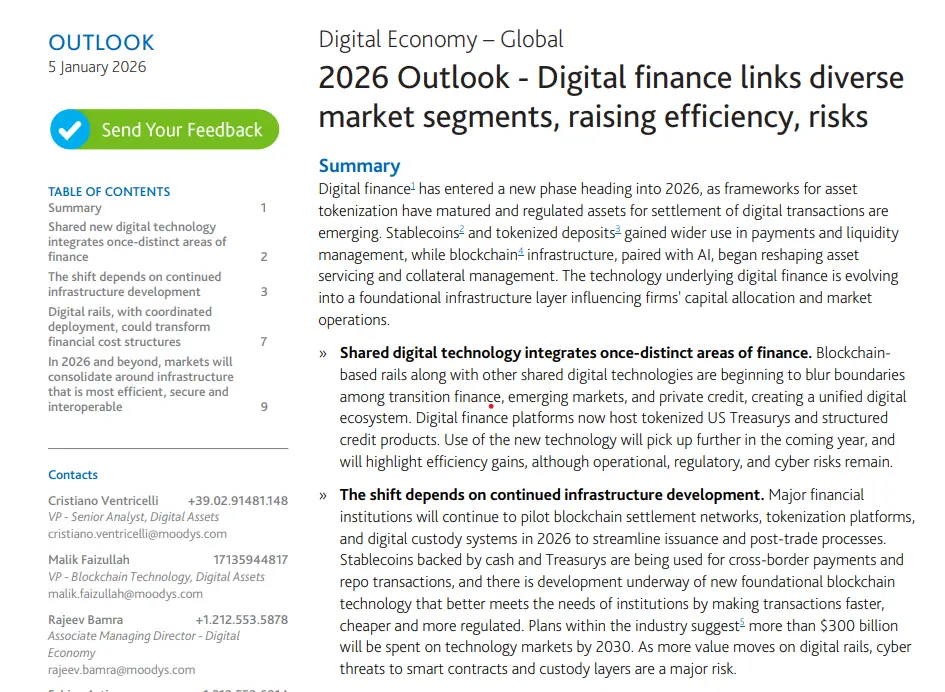
Moody’s 2026 Outlook states that, based on industry estimates of on-chain transactions (rather than purely interbank transactions), stablecoin settlement volume is expected to increase by approximately 87% year-over-year by 2025, reaching $9 trillion. Behind this remarkable growth rate are three core drivers.
The first driver is accelerated institutional adoption. In 2025, banks, asset managers, and market infrastructure providers launched pilot projects involving blockchain settlement networks, tokenization platforms, and digital custody, aiming to streamline issuance, post-trade processes, and intraday liquidity management. Banks such as Citigroup and Société Générale have begun pilots using cash and US Treasury-backed stablecoins to facilitate intraday fund flows between funds, credit pools, and trading venues.
The second driver is a revolutionary boost in cross-border payment efficiency. Traditional cross-border payments rely on the SWIFT system, typically taking 3-5 business days and incurring fees of 5%-10%. Stablecoins enable real-time settlement via blockchain, with fees below 1%. This efficiency advantage is leading more enterprises and financial institutions to adopt stablecoins for cross-border payments. Moody’s notes that stablecoins are increasingly used as settlement assets for cross-border payments, repurchase agreements (short-term secured loans where securities are sold and repurchased at a later date at a higher price), and collateral transfers.
The third driver is the explosive growth of tokenized assets. When bonds, equities, real estate, and other assets are tokenized, an efficient settlement tool is needed. Stablecoins serve this role. Moody’s places stablecoins alongside tokenized bonds, funds, and credit products as part of the broader integration of traditional and digital finance. This convergence creates new demands for financial infrastructure, driving exponential growth in stablecoin usage.
From Crypto Tools to Institutional Digital Cash
Moody’s 2026 Outlook emphasizes that fiat-backed stablecoins and tokenized deposits are evolving into “digital cash.” This shift in positioning is a milestone. Historically, stablecoins were mainly seen as trading tools on crypto exchanges for quick swaps between cryptocurrencies. Now, stablecoins are being adopted by traditional financial institutions as foundational infrastructure for daily operations.
JPM Coin exemplifies the deposit token model, integrating programmable payments and liquidity management into existing banking infrastructure, illustrating how the “digital cash” layer can surpass traditional core systems. JPMorgan processes billions of dollars daily in internal transfers and cross-border payments via JPM Coin, demonstrating stablecoins’ practical utility in corporate finance.
Three Institutional Use Cases for Stablecoins
Intraday Liquidity Management: Institutions rapidly move funds across assets and markets to avoid delays associated with traditional wire transfers.
Cross-Border Settlement and Payments: Companies and banks use stablecoins for international trade settlement, reducing exchange rate risk and transaction costs.
Collateral Transfers and Repurchase Agreements: Financial institutions use stablecoins as collateral for short-term financing, enhancing capital efficiency.
In Europe, Société Générale’s Forge EURCV is recognized as an example of a bank-issued product developed under the emerging EU stablecoin framework. In the Gulf region, banks and regulators are exploring payment tokens based on the UAE Dirham and broader digital currency architectures. These regional practices show stablecoins gradually diversifying away from USD dominance, with countries issuing their own digital currencies to maintain monetary sovereignty.
Moody’s estimates that by 2030, as companies establish large-scale tokenization and programmable settlement tracks, these initiatives could lead to over $300 billion in investments in digital finance and infrastructure. This scale of investment is comparable to building infrastructure for several regional financial centers, highlighting the seriousness of traditional finance’s engagement with blockchain technology.
Regulatory Harmonization and Systemic Risk Warnings
Regulation is also beginning to catch up with this transformation. Moody’s 2026 Outlook highlights that the EU’s Markets in Crypto-Assets (MiCA) regulation, the US proposals for stablecoins and market structure, and licensing frameworks in Singapore, Hong Kong, and the UAE reflect a global trend toward harmonized rules on tokenization, custody, and redemption. This regulatory convergence reduces cross-border compliance costs and creates a favorable environment for the global circulation of stablecoins.
However, Moody’s emphasizes that this transition is not without risks. The report warns that as more value moves onto “digital rails,” vulnerabilities such as smart contract bugs, oracle failures, custody system cyberattacks, and fragmentation across multiple blockchains could introduce new operational and counterparty risks. The agency believes that for stablecoins to serve reliably as institutional settlement assets rather than becoming sources of systemic fragility, security, interoperability, governance, and regulatory clarity are equally critical.
The greatest risk lies in reserve management by stablecoin issuers. If issuers invest reserves in high-risk assets or misappropriate funds, a redemption crisis akin to a bank run could occur. The collapse of Silicon Valley Bank in 2023, which caused a brief de-pegging of USDC, exemplifies this risk. Moody’s warns that markets must establish robust risk management and regulatory frameworks as they embrace stablecoins.
Moody’s report provides authoritative backing for the future development of stablecoins. When one of the world’s top three rating agencies explicitly positions stablecoins as “core market infrastructure,” it signals that stablecoins have moved from the fringes of crypto to the mainstream financial stage. For investors, this means infrastructure projects related to stablecoins (such as Circle, Paxos, and blockchain platforms like Solana offering stablecoin services) are poised for long-term growth.
Disclaimer: The information on this page may come from third parties and does not represent the views or opinions of Gate. The content displayed on this page is for reference only and does not constitute any financial, investment, or legal advice. Gate does not guarantee the accuracy or completeness of the information and shall not be liable for any losses arising from the use of this information. Virtual asset investments carry high risks and are subject to significant price volatility. You may lose all of your invested principal. Please fully understand the relevant risks and make prudent decisions based on your own financial situation and risk tolerance. For details, please refer to
Disclaimer.


