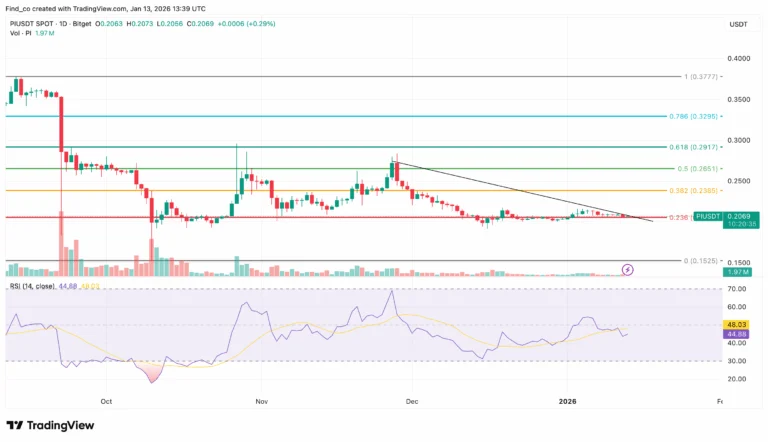
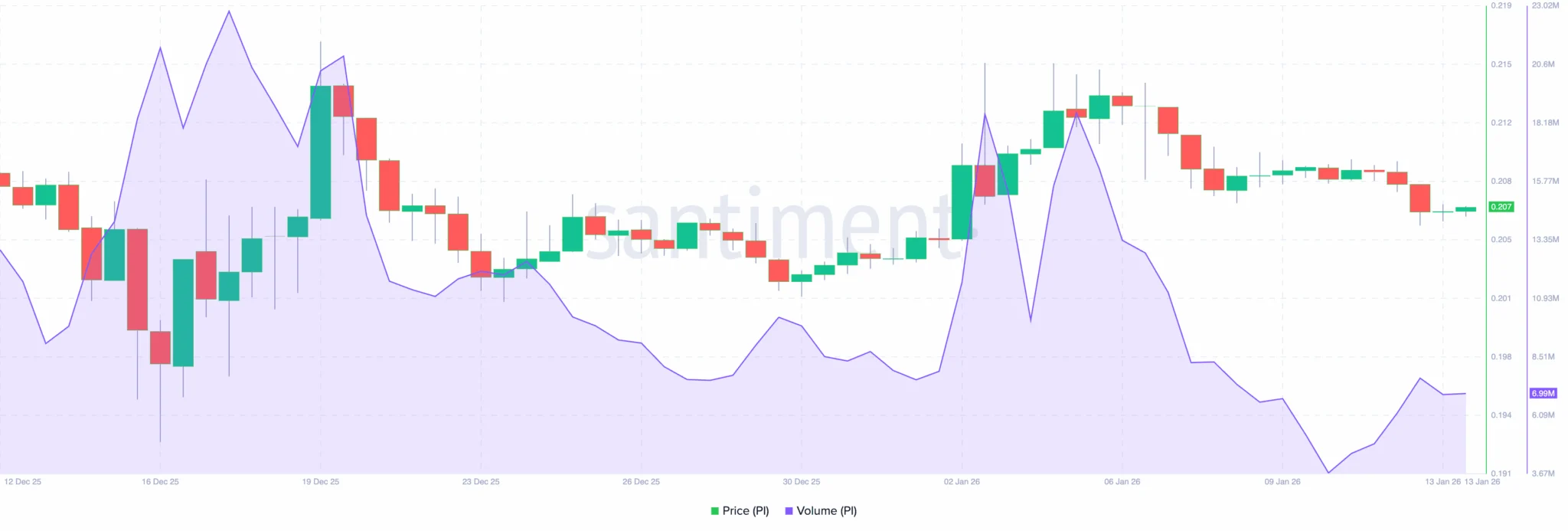
Pi coin continues to face selling pressure, with highs decreasing and falling below the 50-day moving average. Trading volume drops below 7 million, with selling pressure far exceeding buying interest. The support at $0.20 repeatedly tested weakens liquidity, and each retest increases the risk of a crash. The daily chart indicates a break below the target of $0.15. RSI struggles to stay above 50, and the 50-day EMA turns into resistance. A reversal requires a breakout with increased volume along with a moving average breakthrough.
Three Major Technical Signs of a Bearish Structure for Pi Coin
(Source: Trading View)
Pi Coin continues to endure significant selling pressure. Although there have been brief signs of a rebound, the chart still shows a bearish trend. Momentum remains weak, and structural issues have not been resolved. Unless conditions change rapidly, the support at $0.20 may be tested again soon. Over the past few weeks, Pi’s price has failed to reclaim key resistance levels. Each bounce has been small and short-lived.
This phenomenon typically indicates market weakness rather than strength. Buyers enter the market, but their stay is too brief to reverse the trend. As a result, sellers quickly regain control. Structurally, the problem is clear. As shown on the 4-hour chart, PI lost the previous higher-low pattern earlier this year. Since then, the price has formed a series of lower highs. Meanwhile, the Bollinger Bands have widened, indicating increased volatility, but no breakout has occurred.
This shift marks a change in market structure from bullish to bearish. Until Pi can stabilize and hold above the previous major low, the overall downtrend remains intact. Additionally, moving averages further reinforce the bearish outlook. The price remains below the 50-day exponential moving average (EMA). Worse still, the 50-day EMA is trending downward, which typically acts as a significant resistance level.
Three Major Bearish Technical Signals for Pi Coin
Lower Highs Structure: The price on the 4-hour chart shows a series of lower highs, losing bullish structure
50-day EMA Resistance: The price remains below and the EMA slopes downward, with each rebound met by selling
Bollinger Bands Expansion: Volatility increases but no upward breakout, indicating consolidation rather than trend
$0.21 Resistance Firm: Multiple failed attempts to break through, repeatedly confirming strong resistance
Every rebound to these levels triggers new selling pressure. So far, Pi’s price has not demonstrated the ability to break through these levels. If this continues, Pi may struggle to surpass the $0.21 resistance, potentially dropping nearly 20%.
Warning: Trading Volume Below 7 Million on the Ghost Chain
(Source: Santiment)
Volume changes are also concerning. Downtrends are often accompanied by higher volume, while rebounds tend to have lower volume. However, as of press time, Pi Network’s trading volume has fallen below $7 million. This imbalance indicates sellers are more active than buyers. In a healthy bullish trend, the situation is usually the opposite. Currently, distribution still appears to be ongoing.
A trading volume below $7 million is a key negative signal. Compared to Pi’s peak at the end of 2024, when daily volume reached tens of millions of dollars, the current contraction shows market participation is sharply declining. Both bulls and bears lack strong trading interest. This “ghost chain” state is ironic for a project claiming millions of users.
Deeper issues lie in the structural distribution of volume. When prices fall, volume often expands, indicating panic selling. But when prices attempt to rebound, volume shrinks, showing weak buying power. This pattern of “volume expanding on declines and contracting on rises” is typical of a bear market, suggesting the downtrend is not over. If this continues, Pi may remain trapped at lower levels.
From a liquidity perspective, low trading volume increases the risk of price volatility. When market depth is insufficient, even small large sell orders can trigger sharp price swings. For investors holding large amounts of Pi, exiting positions in such a low-liquidity environment is very difficult, and this liquidity trap may force them to accept lower prices.
Final Struggle at $0.20 Support
All eyes are currently on the daily chart showing the $0.20 support zone. This level has historically served as both psychological and technical support, with buyers previously steadfastly defending it. However, repeated tests tend to weaken support over time. Each rebound consumes liquidity, and each retest increases the risk of a crash.
If Pi’s price falls below $0.20 again without a substantial change in momentum, the probability of holding the position diminishes significantly. A daily close below this level could lead to larger losses. In such a case, as stop-loss orders are triggered, the price may accelerate downward, targeting $0.15, representing about a 25% drop from current levels.
That said, a bearish outlook is not inevitable. Markets can always surprise. For Pi to overturn this pattern, bulls must regain key resistance levels. A sustained breakout above declining moving averages would be a good start, and a significant increase in volume would help. However, without these signals, optimism remains speculative. In the short term, traders should remain cautious, as technical patterns favor the bears. Until Pi proves otherwise, the downward trend remains clear.
Disclaimer: The information on this page may come from third parties and does not represent the views or opinions of Gate. The content displayed on this page is for reference only and does not constitute any financial, investment, or legal advice. Gate does not guarantee the accuracy or completeness of the information and shall not be liable for any losses arising from the use of this information. Virtual asset investments carry high risks and are subject to significant price volatility. You may lose all of your invested principal. Please fully understand the relevant risks and make prudent decisions based on your own financial situation and risk tolerance. For details, please refer to
Disclaimer.


