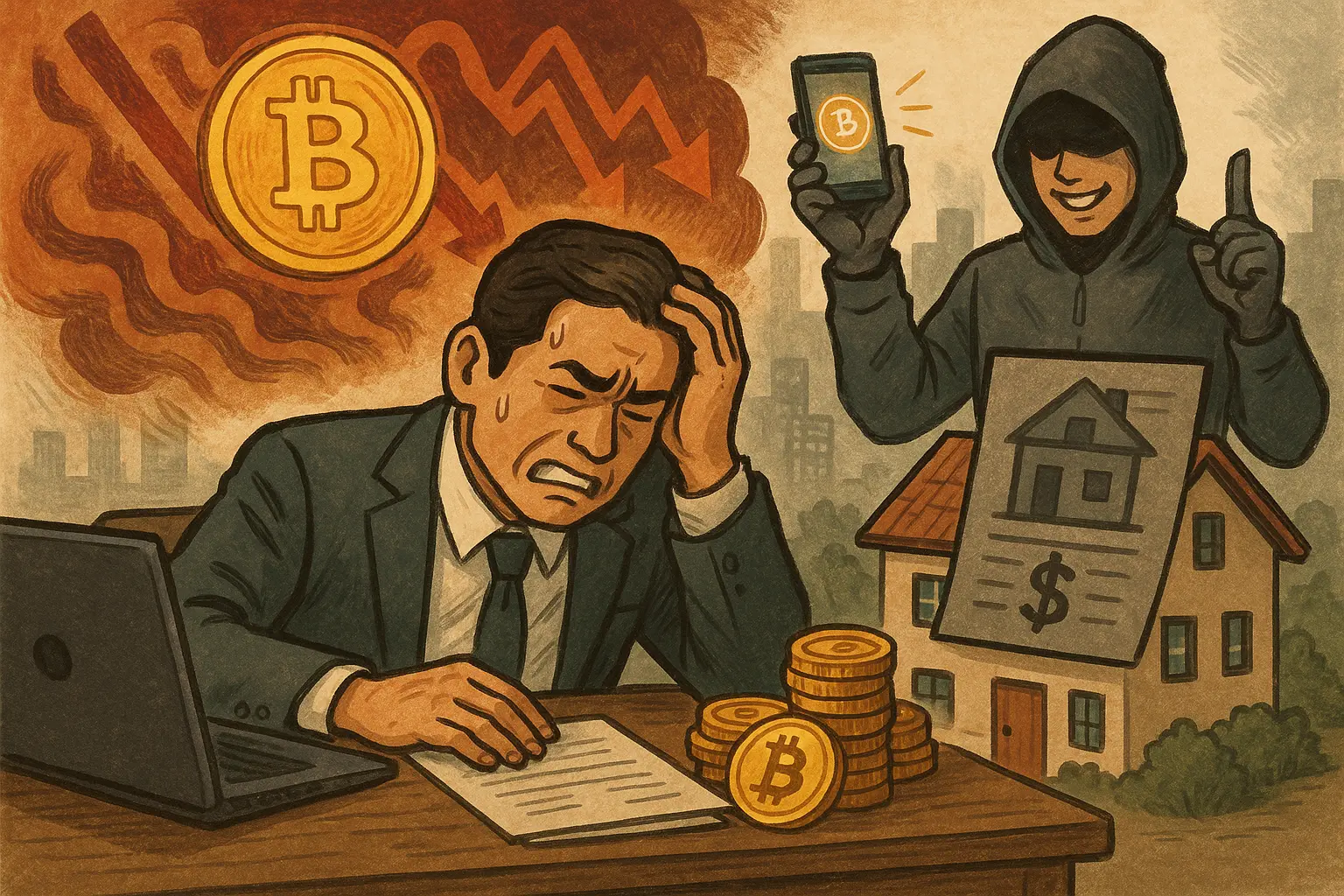
New Taipei City uncovers a Taiwanese cryptocurrency scam group, where a senior biotech executive was drained of 59 million yuan within a year and a half. The victim was first defrauded of 50 million yuan in deposits through a fake app, then lured to “recover” the losses, and referred to a fake notary office to be scammed into mortgage loans exceeding 10 million yuan. Police arrested 17 people in October 2025, with 3 drivers held in detention, and 30 related individuals posted bail with a 300,000 yuan bond.
How the Online Fake APP Absorbs 50 Million Yuan in the Entire Process
The biotech company executive initially fell into a classic Taiwanese cryptocurrency scam trap, meeting scam members claiming to be “investment advisors” via social media or dating apps. These scammers usually establish long-term trust, sharing market analysis and investment insights to create a professional image. Once the victim lowers their guard, they start recommending an “exclusive cryptocurrency investment platform,” claiming it has insider information and high returns.
After downloading a counterfeit cryptocurrency trading app, the victim initially invests small amounts to test, and the scam group facilitates smooth withdrawals with substantial profits. This “long-term fishing” tactic is very common in Taiwan’s crypto scams. Seeing high returns on the account, the victim continues to add funds, gradually investing larger sums. The backend of the fake app is fully controlled by the scammers, who can arbitrarily adjust account balances and yields, creating a false appearance of continuous profit.
When the victim’s invested amount reaches the scam group’s target, the scam enters the final phase. When the victim finds they cannot withdraw, the scammers fabricate reasons such as “system maintenance,” “tax payments,” or “account anomalies requiring additional deposits,” to induce the victim to add more funds. During this stage, the biotech executive invested about 50 million yuan in deposits, all of which flowed out.
Dissection of Online Scam Stage Tactics
· Establish trust via social media or dating apps
· Recommend fake crypto investment platforms and provide fake apps
· Build initial trust through small withdrawals
· Manipulate backend data to create the illusion of high returns
· During the final phase, block withdrawals with various reasons and demand additional funds
This Taiwanese crypto scam method is not new, but its high success rate stems from exploiting human greed and the sunk cost fallacy. Once victims have invested large sums, they are psychologically more likely to believe the lie that “adding more will recover losses,” which forms the psychological basis for the second phase of harvesting.
Sophisticated Design of the Fake Notary Office for Second Harvesting of Ten Million Property
Subsequently, the scammers do not cut off the victim directly but switch to a second script, an upgraded version of Taiwan’s crypto scam. Scam members pretend to show “sympathy” and “assist,” claiming they also faced similar situations but successfully recovered, and recommend the victim to a “professional notary office” for asset mortgage loans to get recovery funds.
A 52-year-old man surnamed Su, who lacks a land registration qualification, claims to work at a notary office to legally conduct lending. The scam group carefully creates a seemingly legitimate land registration process, with a professional office, prepared legally binding promissory notes and mortgage contracts, and even has a “staff” named Xiao, 51, to handle the property mortgage procedures. The entire process mimics legitimate notary work, making it difficult for victims to detect abnormalities.
Under pressure from sunk costs and urgent need for cash to “recover,” the victim signs a property mortgage agreement. Using a 44-year-old man named Zhou as the loan provider, the victim receives over 10 million NTD in cash, then follows the scam group’s instructions to transfer the money in 15 installments to the drivers. This staged transfer is designed to evade financial regulation and money laundering detection, with each amount kept below the bank’s attention threshold.
This second harvesting method demonstrates the scam group’s deep understanding of victims’ psychology. They know that victims who have lost large sums are unlikely to report to authorities, as doing so admits loss and invites family suspicion. Instead, victims cling to any “recovery” opportunity, even if it involves extreme measures like mortgaging property. The scammers exploit this weakness, pushing victims from financial assets to physical assets, achieving “full asset liquidation.”
Complete Breakdown of the Scam Cycle and Prevention Tips
This type of Taiwanese crypto scam is very popular worldwide, starting with online “investment advisor” creating FOMO to attract victims. The scam group spreads across social media, dating apps, and even professional platforms like LinkedIn, seeking targets with investment needs and certain financial capacity. They often pose as successful investors or professional analysts, sharing market insights and success stories to attract attention.
Taiwan Crypto Scam Cycle Structure
Stage 1: Social media outreach and trust building (1-3 months)
Stage 2: Fake app investment and small profit demonstrations (1-2 months)
Stage 3: Large investments and final harvest (2-6 months)
Stage 4: Physical asset mortgage second harvest (1-3 months)
Stage 5: Severing ties and money laundering exit
After victims operate the fake crypto trading platform, the scammers take full control of backend data. These fake apps often mimic interfaces of well-known exchanges like Binance or OKX, even displaying real-time market data to enhance authenticity. However, the key difference is that victims’ funds are not actually transferred on the blockchain or to any exchange but are directly moved into accounts controlled by the scammers.
If victims possess real estate or other assets for collateral, the scammers will use persuasion to induce asset mortgage and cash conversion. They often cooperate with private lending companies, which sometimes knowingly participate in the scam because they can ultimately acquire the mortgaged property through legal procedures. When victims realize their funds have flowed out, and the loans cannot be repaid, they can only watch as creditors liquidate their collateral.
This closed-loop design of Taiwan’s crypto scams is extremely sophisticated, with each link handled by dedicated personnel—from initial social media “salespeople,” to “technical staff” controlling fake apps, “customer service” playing the role of investment advisors, “physical harvesters” posing as notaries, and finally “drivers” and “money laundering groups,” forming a complete criminal industry chain. This explains why police arrested as many as 17 people, indicating a tightly organized group crime.
Police Seize 17 People, Revealing Scam Group Roles and Legal Challenges
In October 2025, police raided and arrested 17 individuals on fraud charges. The operation revealed the large scale and detailed division of labor within Taiwan’s crypto scam group. Among the suspects, 3 drivers involved in directly collecting stolen funds were detained, showing judicial focus on the flow of illicit money.
The notary-related individuals involved in property loans—Su, Xiao, Zhou—claimed they were merely providing normal lending services for clients and were unaware of the scam, posting bail with 300,000 yuan. Such defense strategies are common in similar cases, with private lenders often claiming to be legitimate financial service providers, unaware of the source and purpose of the funds. The effectiveness of such defenses depends on whether prosecutors can prove they “knew or should have known” that the loans involved fraud.
This case exposes several key issues in Taiwan’s crypto scam prevention. First, the proliferation of fake apps is hard to control, as scammers can quickly change domains and app names. Second, the lack of regulation in the private lending market provides space for scammers and lending companies to collude. Third, victims often delay reporting due to shame and sunk cost psychology, giving scammers ample time to operate.
For the general public, key prevention points include recognizing warning signs: any investment promising high and stable returns should be approached with suspicion, avoid downloading unknown investment apps, only use reputable and regulated exchanges, never mortgage assets to “recover” after losses, and report abnormalities to authorities immediately rather than attempting self-rescue. The tragic experience of this biotech executive should serve as a warning to all investors—cryptocurrency investments are not inherently scams, but criminals exploit their complexity and novelty to carry out frauds with increasing frequency.


