Derivatives platform Trove Markets suddenly announced a few days before the token launch that it would abandon Hyperliquid and switch to the Solana camp, while withholding approximately $9.4 million in fundraising funds, causing a stir among investors. Even more concerning, the TROVE token plummeted 95% within 10 minutes of listing, with a market cap evaporating over $19 million, and on-chain analysis revealing suspicious token distribution patterns.
(Background summary: Rug pull tactics analysis: Nearly 20,000 rug pull projects, scammers ultimately cash out in DeFi)
(Additional background: Hyperliquid analysis: Decentralized future pillar or another high-valuation bubble?)
Table of Contents
- Raised $11.5 million, team withholds 80% of funds
- Token crashes immediately after listing: 95% market cap wipeout in 10 minutes
- On-chain analysis reveals suspicious distribution patterns
- Team claims “won’t rug pull,” but trust is already hard to regain
Just days before the Token Generation Event (TGE), Trove Markets dropped a bombshell: the team will abandon the original Hyperliquid integration plan and instead build a perpetual contract decentralized exchange on Solana. This sudden change not only caught investors off guard but also sparked questions about potential “Rug Pull” scams.
Raised $11.5 million, team withholds 80% of funds
According to an official statement, Trove previously raised over $11.5 million through an ICO, originally promised to be used for deep integration within the Hyperliquid ecosystem. However, the team announced that, citing “liquidity partner’s sudden withdrawal of 500,000 HYPE tokens,” they would retain about $9.397 million (approximately 82% of the total raised) to continue development on the Solana version.
Developer “Unwise” described this decision as “the only feasible way forward,” but this explanation clearly failed to quell investor anger. Many participants immediately demanded refunds, questioning why the team couldn’t continue operating under the original framework or at least offer a higher refund ratio.
Funds allocation details raise further doubts
Trove team disclosed the use of funds as follows:
- Front-end and back-end infrastructure development
- Chief Technology Officer (CTO) position
- Advisory team
- Marketing and operational expenses
Notably, the team only refunded $2.44 million for “clearing participant lists and protecting distribution fairness,” and another $100,000 was returned to ICO participants—less than 22% of the total funds raised.
Token crashes immediately after listing: 95% market cap wipeout in 10 minutes
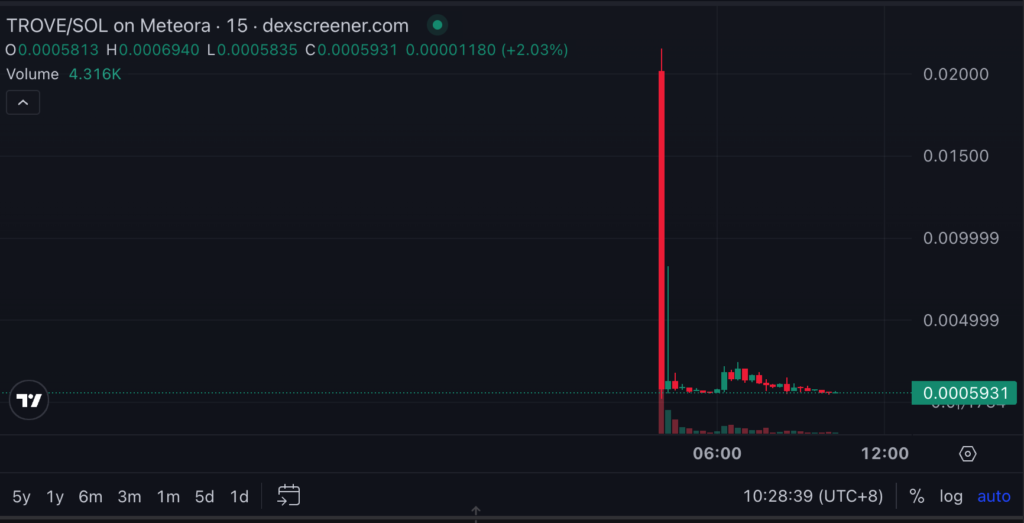
The market performance of TROVE tokens was even worse. According to DEXScreener data, the token plummeted 95% from its opening price within just 10 minutes of listing, hitting a low of $0.0008. Its market cap also dropped from about $20 million to less than $1 million, nearly “zeroing out.”
This flash crash pattern is similar to many past Rug Pull cases: project teams quickly sell off their tokens after fundraising, causing prices to collapse in a short period, leaving retail investors as the final bagholders.
On-chain analysis reveals suspicious distribution patterns
Blockchain analysis platform Bubblemaps’ investigation adds more doubt to this incident. The platform found that a single entity acquired up to 12% of the TROVE supply through 80 newly created wallet addresses. Even more concerning, these wallets’ funds all originated from non-custodial exchange ChangeHero.
Although Bubblemaps stated that they cannot currently confirm direct links between these wallets and the Trove team, such concentration of distribution and the “split transfer” method common in money laundering significantly heighten community concerns about the team’s integrity.
Team claims “won’t rug pull,” but trust is already hard to regain
In response to widespread criticism, Trove’s team issued a statement emphasizing: “We will not disappear; we are still building,” and promised to “regain trust through actual execution.”
According to their plan, the platform will focus on sustainable contract trading related to collectibles, including assets like Pokémon cards and game skins from “Counter-Strike 2” (CS2). Asset management firm Bitwise has estimated that this market could reach a scale of $21.4 billion.
However, with 80% of raised funds retained, token prices nearly zero, and on-chain data riddled with doubts, whether Trove can truly fulfill its promises and rebuild investor confidence remains a big question mark.
Investor cautionary advice
This incident highlights the high risks involved in participating in ICOs. Experts recommend that investors carefully evaluate the following before engaging in any token issuance:
- Whether the team’s background and past track record are transparent and verifiable
- Whether the fund utilization plan is specific and reasonable
- Whether the token distribution mechanism poses centralization risks
- Whether there are independent third-party audits or guarantee mechanisms

Disclaimer: The information on this page may come from third parties and does not represent the views or opinions of Gate. The content displayed on this page is for reference only and does not constitute any financial, investment, or legal advice. Gate does not guarantee the accuracy or completeness of the information and shall not be liable for any losses arising from the use of this information. Virtual asset investments carry high risks and are subject to significant price volatility. You may lose all of your invested principal. Please fully understand the relevant risks and make prudent decisions based on your own financial situation and risk tolerance. For details, please refer to
Disclaimer.
Related Articles
$1.7M in ONE Day – Hyperliquid Is Quietly Destroying Solana
Highlighting An Increasing DeFi Trading activity Hyperliquid 24H Fees. The Hyperliquid 24H fee boom indicates the continued growth of the decentralized trading platforms. Hyperliquid is a high-speed blockchain that is developed to trade perpetual futures. Users can buy and sell crypto derivatives
Coinfomania2h ago
Yesterday, the US SOL spot ETF experienced a net outflow of $8,225,500.
According to SoSoValue data, the US SOL spot ETF experienced a net outflow of $8,225,500 on March 6, with the Invesco Galaxy Solana ETF recording a net inflow of $426,900, and the Fidelity Solana Fund ETF recording a net outflow of $4,997,400. Currently, the total net asset value of SOL spot ETFs is $807 million.
GateNews5h ago
The price of Solana may drop sharply after failing to stay above $94.
The Solana (SOL) price chart is showing signs of weakening overall. Currently, the value of this token has decreased by about 10% compared to last month, reflecting a general cooling of the cryptocurrency market. However, this decline masks a noteworthy development. Over the period
TapChiBitcoin5h ago
Yesterday, the US SOL spot ETF experienced a net outflow of $8,225,500, with Fidelity FSOL seeing an outflow of nearly $5 million.
On March 6th, the US SOL spot ETF experienced a net outflow of $8.2255 million, with the Invesco Galaxy Solana ETF seeing a net inflow of $426,900, while the Fidelity Solana Fund ETF had a net outflow of $4.9974 million. The total net asset value is $807 million, with a historical cumulative net inflow of $958 million.
GateNews12h ago
SOL Life increased by 507.92% after launching Alpha, current price is 0.0007232 USDT
Gate News bot message, Gate Market Display, since launching Alpha, SOL has increased by 507.92%, now priced at 0.0007232 USDT.
CryptoRadar12h ago
Solana Price Prediction 2026: Pepeto Targets 267x Over SOL and AVAX as SEC Drops Justin Sun Lawsuit Signaling Enforcement Pivot
The SEC just dropped its lawsuit against Justin Sun with a $10 million settlement from Rainberry, and when the most aggressive crypto enforcement agency in the world starts settling cases and walking away from lawsuits it spent years building, it means the regulatory posture has fundamentally s
CaptainAltcoin18h ago


