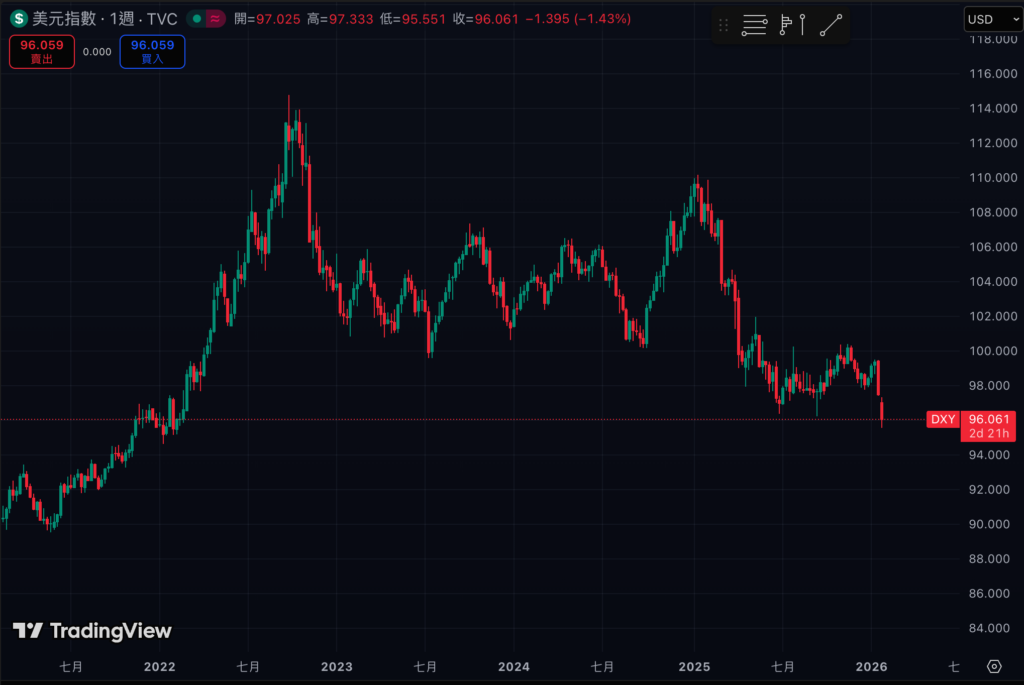
The US dollar index has been plummeting for consecutive days, reaching its lowest level since early 2022. In response to market concerns, President Trump of the United States unusually expressed support for a weak dollar on the 27th, stating outright that the dollar’s performance is “very good,” which immediately triggered market volatility.
(Background: Powell once said, “Unless I die,” he would never resign early, the last bastion of Federal Reserve independence)
(Additional context: The story of Trump pressuring Fed Chair Powell: Global easing triggered by Fed’s remodeling)
Table of Contents
- The US dollar 2025 performance hits seven-year low, possibly down another 3% this year
- Trump hints at “manipulating exchange rates”
- Limited room for Fed rate cuts, rates likely to stay at 3%
On Tuesday (27th), President Trump of the United States, in Iowa, when asked whether he is worried that the dollar has already depreciated excessively, clearly stated, “I think that’s very good,” and emphasized that the dollar should “find its own level, which is fair.” He believes that based on the current US business environment, the dollar’s value and performance are very good.
Trump’s remarks were interpreted by Wall Street as a clear signal of government tacit approval of a weaker dollar to boost export competitiveness. After his statement, the dollar index fell further, hitting a low of 95.56 during the session, the lowest since February 2022, with a daily decline of 1.5%. At the same time, gold prices surged to a historic high of $5,185.
Many members of Trump’s cabinet hope for a weaker dollar to enhance export competitiveness, but economists also emphasize that while currency depreciation can be beneficial, if the situation spirals out of control, the consequences could be dire.
The US dollar 2025 performance hits seven-year low, possibly down another 3% this year
The dollar’s weakness is not a one-day phenomenon. Influenced by Trump’s unpredictable tariff policies, the dollar index fell over 9% throughout 2025, marking the worst annual performance since 2017. The euro has appreciated about 16% against the dollar since Trump took office last January, with the Swiss franc and Mexican peso soaring over 19%.
Factors contributing to the continued pressure on the dollar include market expectations of the Fed entering a rate-cut cycle, tariff policy uncertainties, policy fluctuations, and rising fiscal deficits, all of which have undermined investor confidence in the stability of the US economy.
Trump hints at “manipulating exchange rates”
For years, Trump’s views on the dollar have been inconsistent. On one hand, he praised a strong dollar for helping the US maintain an advantage in bilateral negotiations; on the other hand, he talked about the benefits of a weak dollar for manufacturing. Last year, Trump said he liked a strong dollar, but also claimed that a weak dollar allows people to make more money.
What is notable is that on Tuesday, Trump further hinted that he could “manipulate the US dollar exchange rate,” claiming he could make the dollar rise and fall like a yo-yo, although he also described this as an unfavorable outcome. He then singled out China and Japan, criticizing Asian economies that attempt to devalue their currencies as “unfair,” making it difficult for the US to compete.
Limited room for Fed rate cuts, rates likely to stay at 3%
On the other hand, the Federal Reserve is expected to announce its latest rate decision at 3 a.m. Taiwan time on the 29th. According to FedWatch data, the market estimates a 97.2% probability that rates will remain unchanged within the 3.5%-3.75% range.
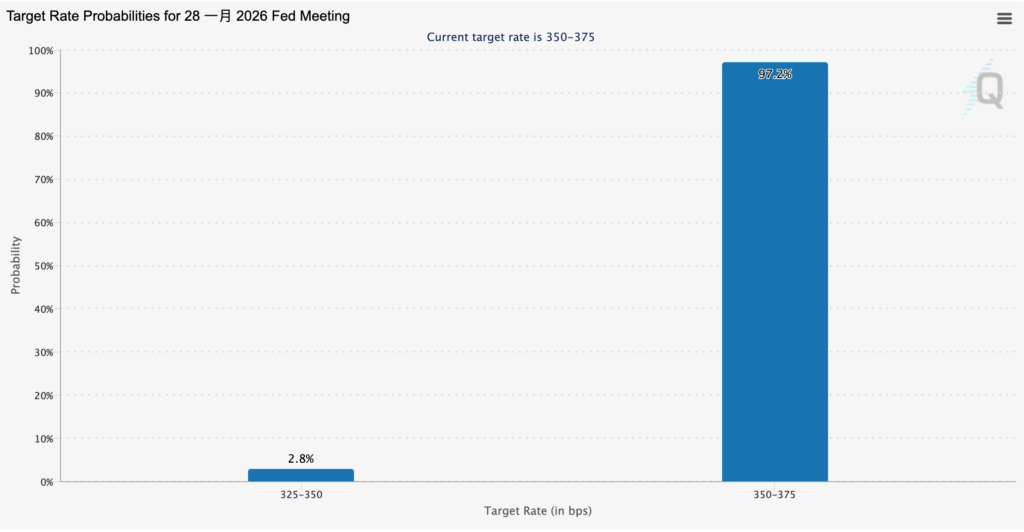
Wall Street and economists generally expect the Fed to cut rates only twice more this year, totaling two cuts (50 basis points), with rates stabilizing around 3%, still falling short of Trump’s advocated “world’s lowest interest rates.”
Interviewees pointed out that the improvement in economic growth outlook is a key reason limiting room for rate cuts; regarding inflation, CPI is expected to fall to 2.7% by the end of this year and further decline to 2.5% in 2027, but short-term conditions do not support significant easing.

Disclaimer: The information on this page may come from third parties and does not represent the views or opinions of Gate. The content displayed on this page is for reference only and does not constitute any financial, investment, or legal advice. Gate does not guarantee the accuracy or completeness of the information and shall not be liable for any losses arising from the use of this information. Virtual asset investments carry high risks and are subject to significant price volatility. You may lose all of your invested principal. Please fully understand the relevant risks and make prudent decisions based on your own financial situation and risk tolerance. For details, please refer to
Disclaimer.


