Over the past two weeks, the stablecoin economy trimmed $6.22 billion after topping out at an all-time high of $311.333 billion. Just this past week, the sector edged lower by 1.21%, shaving off another $3.748 billion.
Stablecoin Sector Trims Billions
The stablecoin, or fiat-pegged token economy, according to defillama.com stats, is in the red this week, logging a full two-week pullback since crossing the $311 billion mark. Out of the top 12 stables, Tether’s USDT still dominates with a commanding $185.18 billion market cap, brushing off a modest 0.81% dip over the last week.
Circle’s USDC follows at $70.07 billion but looks shakier, down 3.40% in seven days. That equates to a loss of $5.05 billion during that timeframe. Ethena’s USDe holds third place with a $6.51 billion cap and a 0.92% weekly dip. Sky’s USDS barely budged, inching up 0.17% to $6.22 billion.
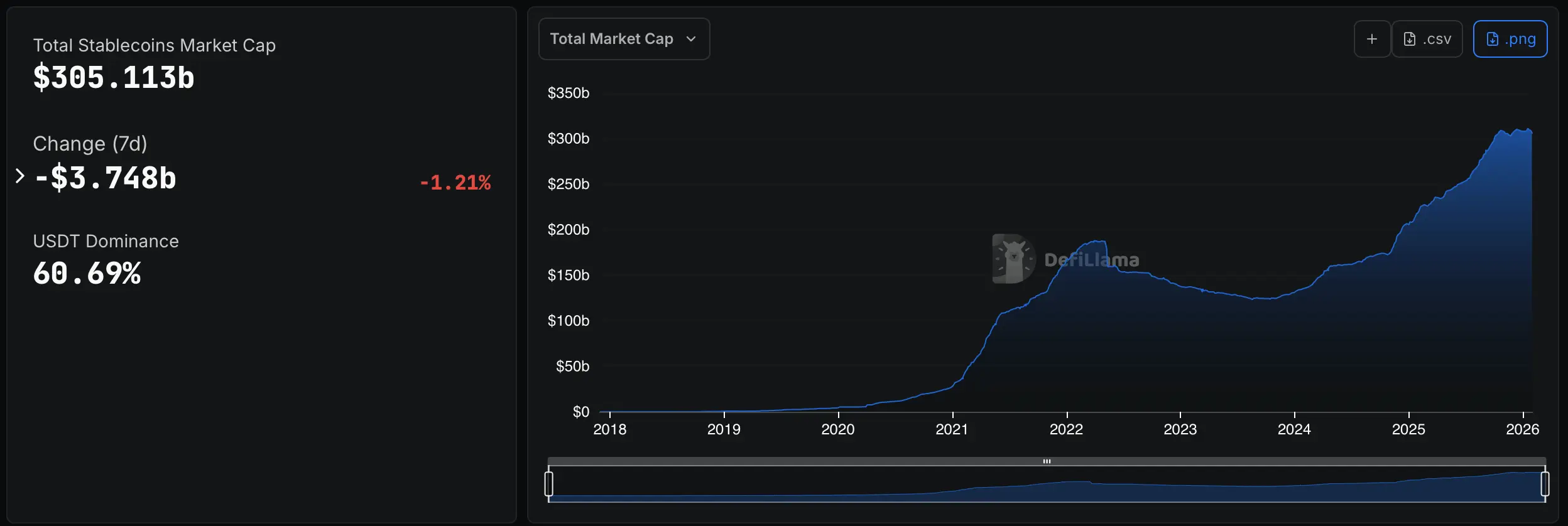 At press time on Feb. 1, 2026, the stablecoin economy stands at $305.113 billion.
World Liberty Financial’s (WLF) stablecoin USD1 showed the biggest muscle, climbing 7.37% to a $5.07 billion valuation. It marks the first time USD1 has pushed past the $5 billion milestone. Sky’s DAI eased a hair by losing just 0.54% to $4.6 billion. Paypal’s PYUSD took a bruising, sliding 3.98% to $3.60 billion.
At press time on Feb. 1, 2026, the stablecoin economy stands at $305.113 billion.
World Liberty Financial’s (WLF) stablecoin USD1 showed the biggest muscle, climbing 7.37% to a $5.07 billion valuation. It marks the first time USD1 has pushed past the $5 billion milestone. Sky’s DAI eased a hair by losing just 0.54% to $4.6 billion. Paypal’s PYUSD took a bruising, sliding 3.98% to $3.60 billion.
Meanwhile, Falcon Finance’s USDf edged down 0.27% and now stands at $2.05 billion. Circle’s U.S. Treasury-backed stablecoin USYC slid 2.3% to $1.62 billion. Global dollar (USDG) trimmed 1.22% and holds at $1.49 billion. Ondo’s yield-bearing dollar USDY grabbed attention with a 10.10% weekly jump to $1.39 billion. Ripple USD trails the top 12, off 4.12% with a $1.36 billion market cap.
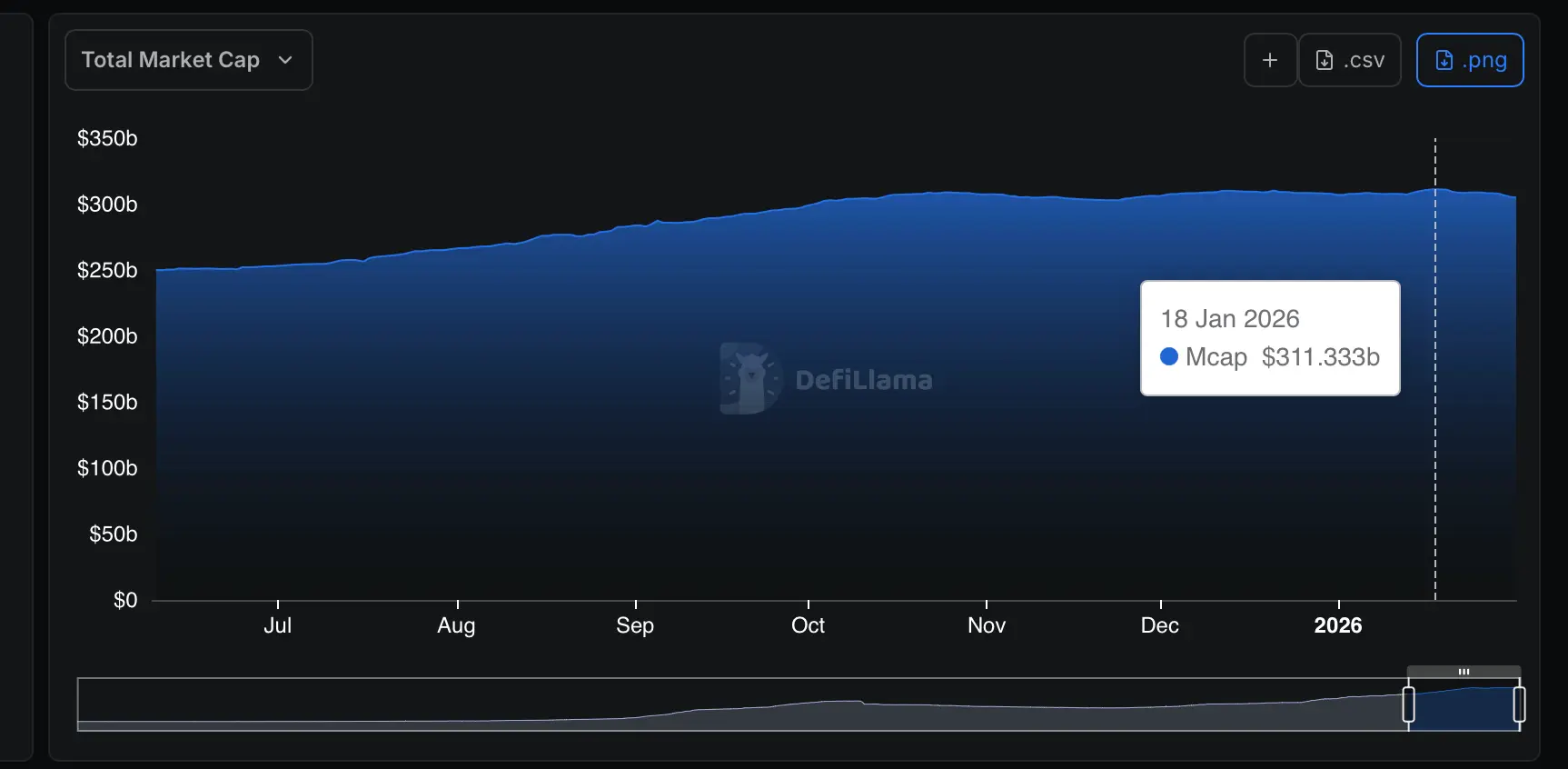 Fourteen days ago, the stablecoin economy tapped a lifetime high of $311.333 billion.
The stablecoin economy’s pullback arrives in step with the wider crypto slump, as heavyweights like bitcoin and ethereum see billions wiped from their market caps. Even as $3.748 billion vanished from select fiat-pegged tokens, names like WLF’s USD1 and Ondo’s USDY chose to buck the mood and swim upstream.
Fourteen days ago, the stablecoin economy tapped a lifetime high of $311.333 billion.
The stablecoin economy’s pullback arrives in step with the wider crypto slump, as heavyweights like bitcoin and ethereum see billions wiped from their market caps. Even as $3.748 billion vanished from select fiat-pegged tokens, names like WLF’s USD1 and Ondo’s USDY chose to buck the mood and swim upstream.
With the dust settled across the top 12 this week, as of Feb. 1, 2026, the stablecoin economy’s net value stands at $305.113 billion, making up 11.74% of the crypto economy’s total valuation of $2.6 trillion.
Also read: OSL Group Raises $200 Million to Accelerate Stablecoin and Payments Expansion
Over the last week and since Jan. 18, the numbers paint a market catching its breath rather than losing its nerve. While the stablecoin economy has cooled in tandem with broader crypto weakness, dominance remains concentrated and selective winners still emerge. For instance, out of the $305.113 billion today, USDT dominates by 60.69%.
Capital is rotating, and the $305 billion base shows sticky demand for dollar-linked liquidity—even when risk appetite thins and valuations across digital assets tighten.
FAQ ❓
- What is the current size of the stablecoin market? As of Feb. 1, 2026, the stablecoin economy totals $305.113 billion, representing 11.74% of the broader crypto market.
- Why has the stablecoin market declined recently? The pullback reflects reduced crypto market activity as bitcoin and ethereum prices weaken and capital rotates defensively.
- Which stablecoin remains dominant today? Tether’s USDT leads the market with a 60.69% share, holding roughly $185 billion in circulation.
- Are any stablecoins still growing despite the slowdown? Yes, USD1 and USDY expanded over the past week, defying the broader contraction.
Disclaimer: The information on this page may come from third parties and does not represent the views or opinions of Gate. The content displayed on this page is for reference only and does not constitute any financial, investment, or legal advice. Gate does not guarantee the accuracy or completeness of the information and shall not be liable for any losses arising from the use of this information. Virtual asset investments carry high risks and are subject to significant price volatility. You may lose all of your invested principal. Please fully understand the relevant risks and make prudent decisions based on your own financial situation and risk tolerance. For details, please refer to
Disclaimer.
Related Articles
Short-selling firm Culper releases bearish report on Ethereum: Fusaka upgrade disrupts ETH token economics
Aggressive short-selling firm Culper Research has released a report bearish on Ethereum (ETH), believing that the Fusaka upgrade in 2025 will cause structural damage to ETH's token economy. The report points out that a significant decrease in Gas fees has led to increased address pollution attacks and reduced validator rewards, and emphasizes that Ethereum is facing competitive pressure from Solana and L2 solutions. Culper believes that ETH's value capture ability is declining and has started shorting ETH.
ChainNewsAbmedia23m ago
Geopolitical Turmoil! Dalio Declares "Gold is the Only True God," but Its Safe-Haven Performance Trails Bitcoin
As geopolitical tensions in the Middle East escalate, Bridgewater founder Ray Dalio questions Bitcoin and reaffirms gold as the preferred safe haven. Nevertheless, gold prices fell accordingly, while Bitcoin only experienced a slight correction, indicating that the correlation between the two is weakening. Dalio doubts Bitcoin's transparency and future risks, but he still maintains a small allocation of Bitcoin for diversification.
区块客33m ago
Zcash (ZEC) at the important crossroads: What could happen in the next few weeks?
Zcash (ZEC) shows signs of stabilization after declining from over 700 USD, with price nearing critical support around 200 USD. Recent recovery indicates buyer strength, but momentum indicators suggest caution. A breakout above 250 USD could initiate further recovery.
TapChiBitcoin35m ago
ETH 15-minute sharp decline of 1.53%: Large investors' short-term profit-taking and ETF capital outflows resonate, triggering a significant drop
From 13:45 to 14:00 on March 6, 2026 (UTC), ETH experienced a significant fluctuation, with a short-term decline of 1.53%. The price fluctuated sharply between 2019.21 and 2051.26 USDT, with an amplitude of 1.56%. High-frequency sell orders surged, market attention spiked, trading volume increased, and the divergence between bulls and bears intensified. Market sentiment became more cautious.
The main driving force behind this fluctuation was large investors and whale accounts reducing their positions after a short-term rebound, leading to a rapid release of large sell orders and triggering short-term selling pressure in the market. On the ETF front, holdings
GateNews36m ago
BTC short-term decline of 1.23%: whale fund outflows and leveraged long liquidations trigger concentrated selling
On 2026-03-06 from 13:45 to 14:00 (UTC), the price of Bitcoin (BTC) experienced a -1.23% return over 15 minutes, with a price range of 69,219.0 to 70,086.3 USDT, and an amplitude of 1.24%. Trading activity significantly increased in a short period, with the market focusing on intense volatility and a resurgence of risk sentiment.
The main drivers of this anomaly are continuous outflows of on-chain whale funds and large-scale leveraged long liquidations in the derivatives market. According to on-chain data, whale withdrawals reached as high as 16,972 BTC in a single day, Whales O
GateNews36m ago
Samson Mow Objects to Michael Saylor's Bitcoin Insufficiency Post - U.Today
The debate over Bitcoin's supply scarcity is highlighted by Michael Saylor's claim that there isn't enough Bitcoin for everyone, which Samson Mow counters with calculations showing each person could receive around 259,259 satoshis if distributed globally. Mow's argument underscores the reality that large entities hold significant portions of Bitcoin, emphasizing its scarcity and potential value.
UToday2h ago


