
Bhutan sells $22 million worth of BTC, reducing holdings from 13,295 to 5,700 coins, dropping to seventh place. In 2019, hydroelectric mining accumulated $765 million worth of BTC, but after the halving, costs doubled, leading to a significant decline in production. Bitcoin crashed this week, with prices once approaching the $70,000 mark.
Cost Pressure Behind the Sale of 7,595 BTC
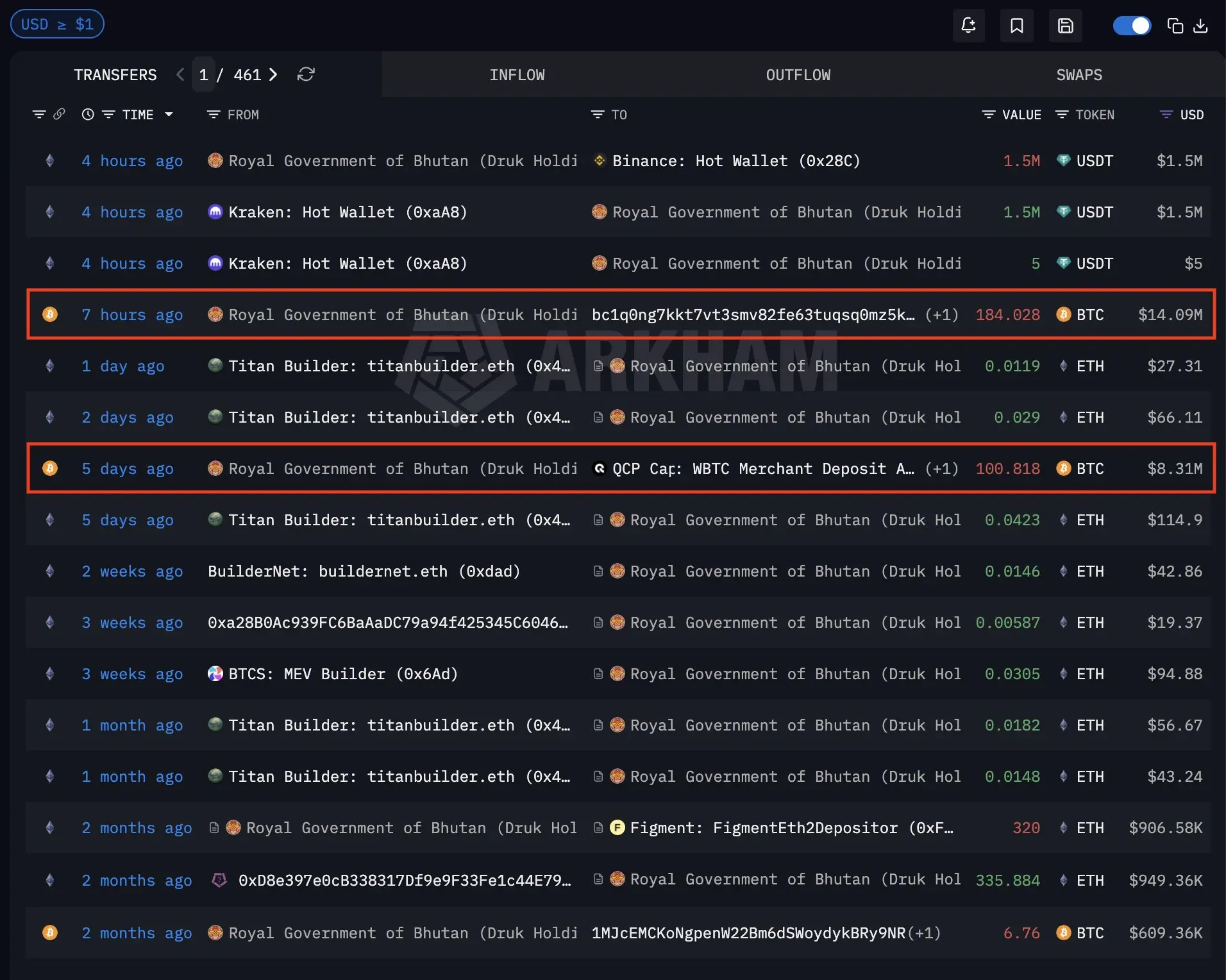
(Source: Arkham)
Data from blockchain analysis platform Arkham shows that Bhutan transferred 184 Bitcoin on Wednesday, moving Bitcoin worth $14 million from the national reserve, along with 100.8 Bitcoin transferred last Friday, valued at $8.3 million. Arkham states that this transfer of $23.3 million was sent to crypto market maker QCP Capital. Transferring assets to market makers usually indicates a sale, as they help convert these assets into more liquid market assets.
This sale has reduced Bhutan’s total holdings by approximately 7,595 Bitcoin (from 13,295 to 5,700). While the exact reason behind the sale remains unclear, Arkham notes that Bhutan regularly sells Bitcoin in batches of about $50 million, with the most recent large-scale sale occurring in mid to late September 2025. This regular selling pattern suggests Bhutan may view Bitcoin as a source of national income, periodically liquidating to fund government expenses or debt.
Arkham points out that since launching Bitcoin mining operations in 2019, Bhutan has accumulated about $765 million worth of Bitcoin, primarily driven by hydroelectric power. Bhutan has abundant water resources and extremely low electricity costs, giving it a natural advantage in Bitcoin mining. The government-led mining operations utilize surplus electricity from state-owned hydroelectric plants, directly converting energy into Bitcoin assets.
However, the report indicates that since the Bitcoin halving in 2024, the cost to mine one Bitcoin has roughly doubled, and Bhutan now mines far fewer Bitcoins than the 8,200 mined in 2023. The halving reduced block rewards from 6.25 BTC to 3.125 BTC, meaning the same computational power produces half as much, naturally doubling the unit cost. For a country like Bhutan, which relies on mining to accumulate Bitcoin, the halving has a direct and significant impact.
Changes in Bhutan’s Bitcoin Holdings
Peak in October 2024: 13,295 BTC
Current holdings: 5,700 BTC
Amount reduced: 7,595 BTC (57% cut)
Ranking change: dropped from high position to seventh globally
The sharp decline in production from 2023’s 8,200 coins is also noteworthy. This collapse in output could be due to multiple reasons: the halving reducing yields, increased mining difficulty requiring more hash power, aging equipment decreasing efficiency, or Bhutan actively reducing mining scale to control costs. Regardless of the cause, the drop in production means Bhutan can no longer quickly replenish sold Bitcoin through mining, and its holdings may continue to decrease.
Risks of Dropping from Seventh Place Globally
Data from Bitcoin Treasuries shows Bhutan has fallen to seventh place in global Bitcoin holdings, behind the United States, China, the United Kingdom, Ukraine, El Salvador, and the United Arab Emirates. This ranking decline is not just a numerical change but also reflects a shift in national strategic positioning. Bhutan was once seen as a pioneer in national Bitcoin adoption, but now it serves as a warning of forced reduction due to cost pressures.
The United States, as the largest holder, mainly acquires Bitcoin through law enforcement seizures (such as Silk Road cases) and potential future strategic reserves. China, despite banning mining, has large amounts of Bitcoin confiscated by law enforcement. The UK and Ukraine also primarily obtain Bitcoin through law enforcement. El Salvador is the only country that has adopted Bitcoin as legal tender and continues to buy. The UAE has accumulated Bitcoin by attracting crypto companies and investors.
Bhutan’s model is somewhat unique among these countries: it relies entirely on mining to accumulate Bitcoin, with mining fully state-controlled. This model is highly effective when electricity costs are low and Bitcoin prices are high but faces severe challenges in the current environment. If Bhutan continues to sell at the current rate and production cannot recover, its holdings could fall below 3,000 coins within a year, potentially dropping out of the top ten.
42.8% Bitcoin Crash Worsens Mining Difficulties
The decline in Bhutan’s Bitcoin holdings coincides with Bitcoin prices falling 42.8% from the all-time high of $126,080 last October to below $72,000. Market sentiment over the past three months has also dropped to mid-2022 levels. Influenced by the U.S. government shutdown, ongoing wars and tariffs under Donald Trump, and legislative stagnation in Washington’s crypto market structure, Bitcoin prices have plummeted.
Despite global liquidity approaching historic highs, macroeconomic uncertainties have led investors to shift risk assets into gold and silver. Risks from quantum computing to Bitcoin’s security model, along with the hash rate dropping below 1 zettahash per second due to more miners shutting down unprofitable machines, have fueled recent discussions about Bitcoin.
For countries like Bhutan with mining projects, the Bitcoin price crash is a double blow. On one hand, the market value of holdings at the peak (13,295 coins) was about $1.67 billion; now, even if holdings are retained, they are worth only about $960 million, evaporating $700 million. On the other hand, mining operations have shifted from profit to loss or marginal profit, with the cost to mine each Bitcoin possibly approaching or exceeding market price.
The doubling of mining costs is specifically reflected in the halving: after halving, block rewards are cut in half, so under the same electricity and equipment costs, output halves, and unit costs naturally double. Although Bhutan’s electricity is cheap, procurement, maintenance, site, and personnel costs still exist. When Bitcoin prices fall from $120,000 to $70,000, these fixed costs occupy a larger proportion, squeezing profit margins.
Cointelegraph contacted Druk Holding and Investments, the state-owned entity behind Bhutan’s Bitcoin strategy, but received no immediate response. The lack of official explanation increases market speculation and uncertainty. Whether Bhutan will fully exit Bitcoin mining or merely reduce holdings temporarily while waiting for market recovery remains uncertain.
For the global Bitcoin market, Bhutan’s case offers an important lesson: national Bitcoin mining projects are not guaranteed to be profitable. Even with the advantage of cheap electricity, the combined impact of halving and price crashes can make mining economics unsustainable. El Salvador’s approach of buying rather than mining may be more resilient under current conditions.


