
Standard Chartered Turns Conservative, Predicts Bitcoin May Drop to $50,000 Short-Term, Ethereum Could Fall to $1,400. Main Factors Include ETF Outflows and Overall Economic Impact, but Still Optimistic About Bitcoin Reaching $100,000 by Year-End.
Standard Chartered: Bitcoin Will Drop to $50K, Ethereum to $1,400
Renowned investment bank Standard Chartered has adopted a cautious stance in its latest cryptocurrency market report. The bank’s Digital Asset Research Head, Geoffrey Kendrick, predicts that the current macroeconomic environment is difficult to support, and improvements are not expected until Kevin Warsh takes over the Federal Reserve.
Until then, Bitcoin’s price may dip to $50,000 or lower, and Ethereum could fall to $1,400. However, he also emphasizes these levels will be buying opportunities. The bank’s current year-end forecast for Bitcoin is $100,000, and for Ethereum, $4,000.
Mainstream Crypto Year-End Target Prices Cut Across the Board
Standard Chartered has significantly lowered its target prices for several cryptocurrencies, reducing Bitcoin’s year-end target from an initial $150,000 to $100,000. This marks the bank’s second consecutive downward revision; last December, it projected $300,000. Ethereum’s target has also been cut from $7,500 to $4,000.
As for other altcoins/competitors, Solana’s target price has been revised down from $250 to $135, Ripple (XRP) from $8 to $2.80, Binance Coin (BNB) from $1,755 to $1,050, and Avalanche (AVAX) from $100 to $18.
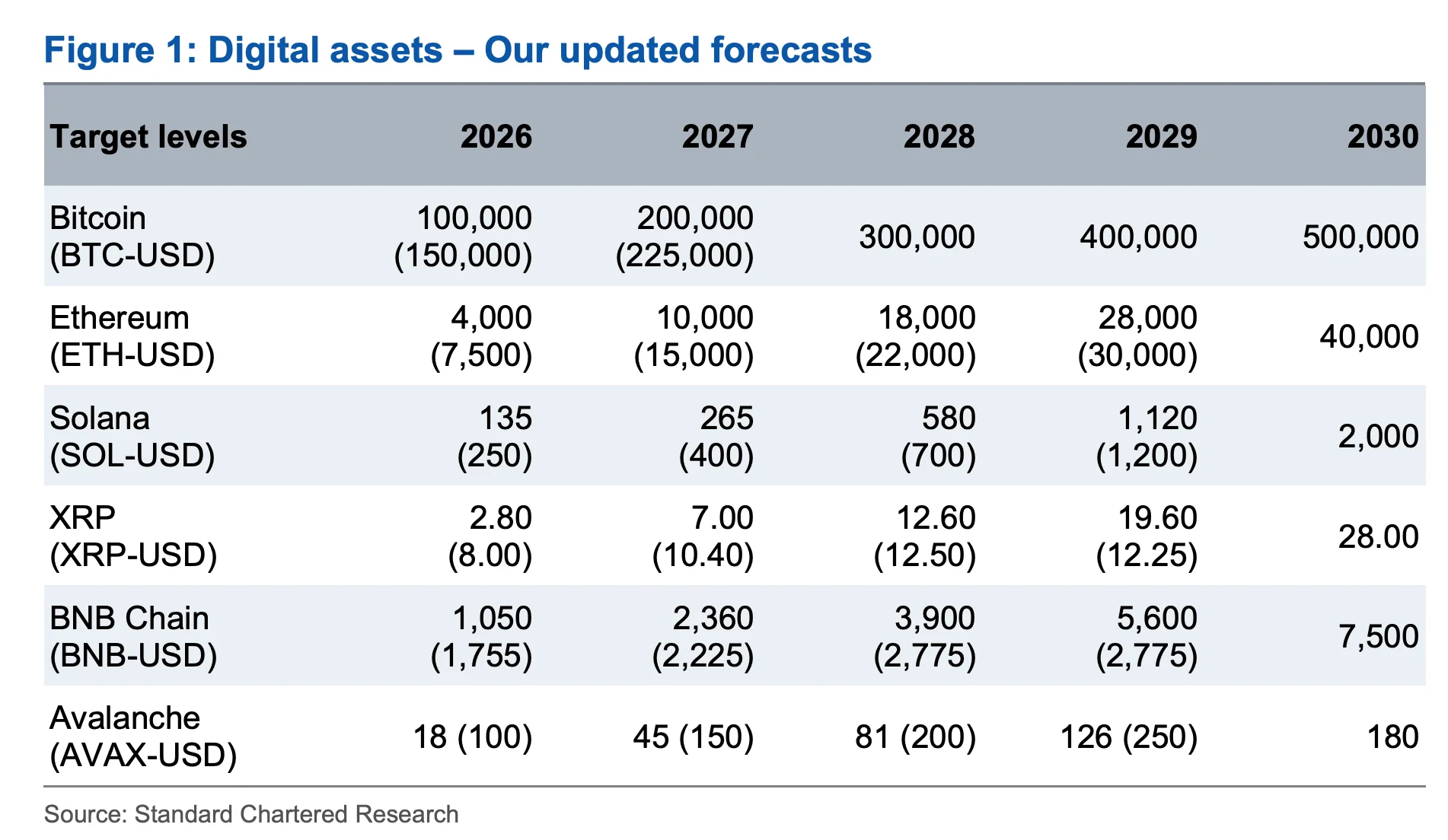
Image Source: The Block, Standard Chartered Revises 2026 End Cryptocurrency Price Targets
ETF Outflows and Overall Environment Are Main Downward Drivers
Although the cryptocurrency market is expected to remain under pressure in the short term, Kendrick emphasizes that the long-term outlook remains unchanged.
One of the reasons for the market’s weakness is the behavior of U.S. Bitcoin spot ETF investors. Kendrick’s analysis indicates that since the peak in October 2025, Bitcoin ETF holdings have decreased by nearly 100,000 BTC.
With an average purchase cost around $90,000, most current buyers are in a paper loss position, making them more likely to sell rather than buy the dip in the short term.
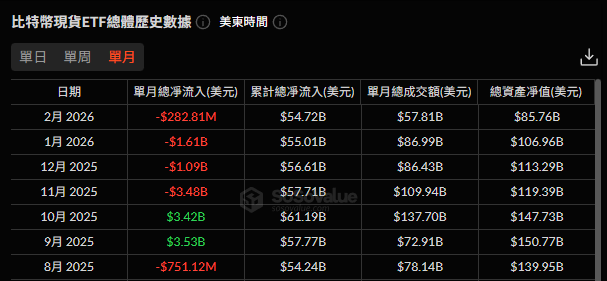
Image Source: SoSoValue, Recent Months Show Net Outflows in U.S. Bitcoin Spot ETFs
Additionally, recent U.S. economic data presents mixed signals, and the market expects the Federal Reserve to delay rate cuts until after leadership changes in June. This environment makes it difficult for the crypto market to attract new capital inflows in the coming months.
This Bear Market Is Different, No Major Platform Failures Yet
Despite turning more cautious, Kendrick stresses that this bear market is different from previous ones. Compared to the collapses of Terra/Luna and FTX in 2022, there have been no major exchange bankruptcies accompanying the current downturn.
He believes that increased institutional participation is making the crypto market more resilient. After prices bottom out, Standard Chartered expects the market to rebound during the remaining period of 2026.
Bernstein Calls It the Weakest Bear Market Ever, Maintains Bullish Target
Recently, investment firm Bernstein also mentioned in a report earlier this week that this Bitcoin bear market is the weakest in history, but they remain optimistic, maintaining a target of $150,000 for 2026.
Bernstein analysts believe that the current Bitcoin weakness is purely a confidence crisis. The market fundamentals are intact, and there are no hidden explosive risks.
Although Bitcoin has nearly halved from its all-time high, net outflows from Bitcoin spot ETFs account for only 7%, indicating no structural pressure. Analysts expect that as liquidity improves, Bitcoin could still return to its previous highs.
- Related report: Still bullish on Bitcoin! Bernstein: This is the weakest bear market in history, year-end target $150,000
Disclaimer: The information on this page may come from third parties and does not represent the views or opinions of Gate. The content displayed on this page is for reference only and does not constitute any financial, investment, or legal advice. Gate does not guarantee the accuracy or completeness of the information and shall not be liable for any losses arising from the use of this information. Virtual asset investments carry high risks and are subject to significant price volatility. You may lose all of your invested principal. Please fully understand the relevant risks and make prudent decisions based on your own financial situation and risk tolerance. For details, please refer to
Disclaimer.
Related Articles
The Origin Story of Sunny Lu: From a 100 BTC Scam to Building VeChain
VeChain’s Sunny Lu got into crypto after losing $300 on an unsuccessful 100 BTC purchase on Taobao, which led him to research Bitcoin.
Later, Lu used blockchain to track supply chains and launched VeChain in 2015 to target verification and enterprise applications.
The crypto journey of Sunny
CryptoNewsFlash3m ago
Strategy announces the top ten asset management companies' holdings, with Vanguard holding 8.12% in the lead.
On March 6th, Bitcoin Treasury Company Strategy released the top ten holdings of a global asset management firm, with Vanguard Group ranking first, holding 8.12% of the shares, valued at $3.183 billion. Other major companies include Capital Research, BlackRock, and others, reflecting investor interest in Bitcoin.
GateNews27m ago
Gate Ventures strategically invests in Utexo to promote the development of Bitcoin-native stablecoin infrastructure.
Gate Ventures announced a strategic investment in Utexo on March 6th. Utexo is a Bitcoin-native settlement infrastructure that combines the RGB protocol and the Lightning Network, supporting private and instant stablecoin transactions, integrating them into the Bitcoin ecosystem. This investment will promote ecosystem development and expand into global markets.
GateNews48m ago
Utexo Raises $7.5M Led By Tether to Launch Native USDT Settlements on Bitcoin
Dubai, UAE, March 6th, 2026, Chainwire
Utexo makes Bitcoin-native stablecoin settlement practical, predictable, and easy to integrate
Utexo now announces the raise of a $7.5M seed round co-led by Tether, Big Brain Holdings, and Portal Ventures, with participation from Franklin Templeton, Maven11 C
BlockChainReporter55m ago


