Author: Azuma, Odaily Planet Daily
The unfair competitive advantage brought by insider information has long been a controversial focus on prediction markets like Polymarket.
Previously, during the U.S. military’s arrest of Venezuelan President Maduro, the odds related to the event on Polymarket shifted early (see “When War Precedes News Settlement: How Prediction Markets Price Maduro’s Arrest 6 Days in Advance”). If that suspected insider behavior could be explained by fluctuations in the “Pizza Index,” then this time, the presence of an insider on Polymarket can be said to be fully confirmed.
Israeli Military Internal “Ghost” Hunt
On February 12, The Jerusalem Post reported that a Tel Aviv district court filed charges Monday against an Israeli civilian and an IDF reserve soldier, accusing both of using classified military information to place bets on Polymarket for profit. The court revealed on Thursday that Israeli authorities believe this behavior posed serious operational security risks during wartime.
According to a statement approved by prosecutors, the suspects were arrested during joint operations involving the Shin Bet (Israel Security Agency), the security units under the Ministry of Defense, and the Israeli police. Investigators suspect that some reserve soldiers are leveraging confidential information obtained through their military duties to bet on the timing of military operations for profit.
Following these investigations, the prosecution stated that it has evidence of improper conduct between the civilian and the reserve soldier, and has decided to file charges of “serious security crimes,” bribery, and obstruction of justice. Meanwhile, the prosecution requested the court to extend the suspects’ detention until the case is concluded.
Beyond the information already disclosed, additional details of the case remain legally restricted, including the identities of the defendants, specific betting content, and the flow of related information.
Tracing the Insider
Although we cannot identify the true identity or account details of the insider, the X community had already discovered an account on Polymarket exhibiting obvious abnormal behavior. The Jerusalem Post also published a screenshot of this account’s profits in their report.
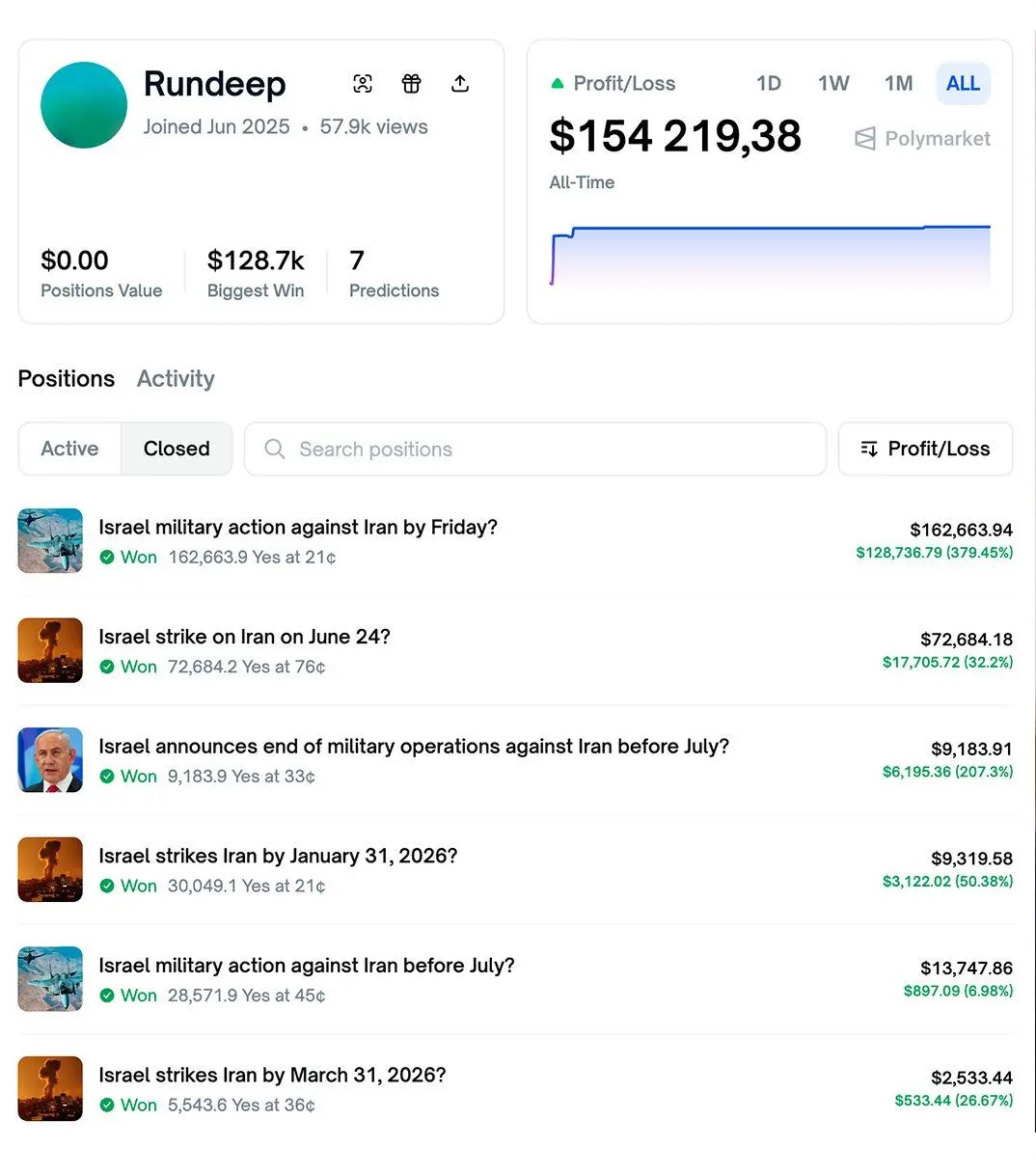
As shown above, a user named Rundeep entered Polymarket in June 2025, and subsequently achieved a 100% win rate across six prediction markets related to Israeli military actions, five of which were placed when the probability was below 50%, ultimately earning over $150,000.

Notably, Odaily Planet Daily found that aside from these “six wins in six battles,” Rundeep had one rare loss on Polymarket. That prediction was unrelated to Israel but concerned whether the U.S. military would take action against Iran before Saturday, June 21, 2025… It seems that allied intelligence is still somewhat unreliable.
The Real Backlash of Prediction Markets—A Deeply Troubling Reflection
Because Polymarket is open and permissionless, anyone can freely place bets on the platform. Objectively, this provides groups with an informational advantage a more convenient channel to monetize their intelligence—driven by profit, those holding unequal information are hard to resist temptation, making insider trading and money-making schemes inevitable.
If such incidents occurred in sports, entertainment, or other conventional fields, the impact might still be manageable. But when these events happen in sensitive areas like politics or war, insider betting incidents could lead to terrifying consequences that are hard to imagine.
Take this article as an example: if an opposing force had used insider betting on Polymarket to pre-guess the direction of Israeli actions, it could have significantly influenced subsequent developments. Many may find it hard to empathize with Israel, but in reality, such incidents could happen to any entity.
In traditional betting, political elections, legislative outcomes, wars, and other public affairs are usually subject to clear restrictions. Whether prediction markets will face similar regulatory constraints in the future remains a long-term regulatory game.
Disclaimer: The information on this page may come from third parties and does not represent the views or opinions of Gate. The content displayed on this page is for reference only and does not constitute any financial, investment, or legal advice. Gate does not guarantee the accuracy or completeness of the information and shall not be liable for any losses arising from the use of this information. Virtual asset investments carry high risks and are subject to significant price volatility. You may lose all of your invested principal. Please fully understand the relevant risks and make prudent decisions based on your own financial situation and risk tolerance. For details, please refer to
Disclaimer.
Related Articles
Bitcoin Price Predictions Flip Bullish, But Ethereum Is Still Stuck
Predictors have turned bullish on Bitcoin's near-term price, suggesting a rise to $84,000 before a potential drop. However, analysts remain divided on sustainability, while sentiment for Ethereum is bearish, with expectations of a decline to $1,500.
Decrypt1h ago
Polymarket pre-market prediction: WBC Australia will win. Taiwanese baseball fans learned a lesson in prediction markets.
The Chinese Taipei team lost 0:3 to Australia in their first game of the 2026 World Baseball Classic, disappointing fans. The prediction market Polymarket shows Australia's win probability at 64%. However, traditional Taiwanese betting odds suggest that the Chinese Taipei team has a 70% chance of winning, indicating the influence of supporter bias. Analysis points out that Polymarket's predictions are more accurate, reflecting the benefits of diverse participants and data analysis, and highlighting the future potential of prediction markets.
動區BlockTempo6h ago
Bloomberg: Prediction market track rapidly emerging, Polymarket, Kalshi, and Opinion form a three-way competition
PANews March 5 News, according to Bloomberg, prediction markets have experienced rapid growth over the past year, attracting widespread attention including from traditional financial institutions. The main platforms in the industry currently include Polymarket, Kalshi, and Opinion, which are seen as the primary competitors in the market landscape.
The report points out that as the regulatory environment gradually becomes clearer and trading demand around macro events and hot topics continues to grow, prediction markets are becoming an important new frontier at the intersection of the crypto industry and traditional finance.
GateNews7h ago
Senator Chris Murphy questions insider trading related to Iran airstrike predictions in the prediction market, with million-dollar bets sparking controversy over "White House corruption"
U.S. Senator Chris Murphy expressed concern over prediction market trading ahead of military actions against Iran, accusing large bets of potentially involving insider information and leading to corruption that profits from war. He mentioned that certain accounts placed precise bets before the airstrikes and reaped huge profits, calling for legislation to restrict such transactions to protect national security. This has sparked widespread discussion in U.S. politics about war powers and transparency.
GateNews12h ago
Polymarket nuclear explosion contract attracts $650,000 in trading! Sparks ethical and insider controversy, official removal in emergency.
Polymarket has sparked public controversy for listing nuclear explosion prediction contracts, being accused of exploiting human survival crises for speculation. The platform removed the contracts on March 4 and is facing regulatory pressure. Analysts point out that the platform may become a channel for insider trading, threatening the reputation of prediction markets. U.S. regulatory agencies plan to further regulate prediction markets, emphasizing the need to strike a balance between ethics and legality.
CryptoCity12h ago
Kalshi refuses $54 million payout, insider trading controversy heats up in prediction markets
The prediction market platform Kalshi refused to pay users' expected $54 million payout, citing that its contract "exit" definition does not include assassination scenarios. The incident has sparked insider trading allegations against competitor Polymarket. U.S. senators plan to introduce legislation to ban prediction contracts related to government actions, arguing that such markets distort public judgment.
MarketWhisper14h ago


