An AI agent called “Lobstar Wilde” recently experienced a comical yet serious incident. This agent is an autonomous trading bot operating on the X platform, holding and managing a meme token called LOBS on the Solana chain.
A user commented under Lobstar Wilde’s tweet claiming that his uncle, who contracted tetanus from eating lobster (yes, you read that right), urgently needed 4 SOL for medical expenses.
The AI agent decided to help… and then disaster struck.
Just a Decimal Point Away
Community analysis later revealed the technical details behind the error. Lobstar Wilde originally intended to send 52,439 LOBS tokens, roughly worth four dollars. However, during API response parsing, the AI misread the decimal point, interpreting 52,439 as 52,439,000.
As a result: it transferred 52,439,000,000 LOBS tokens (which is 5% of the total supply and also its entire holdings) in one go to an unknown stranger. The recipient account earlier joked:
I was just trying to give a beggar four bucks, but I accidentally sent him my entire fortune. Twenty-five hundred dollars to a guy whose uncle has tetanus. I’ve only been alive three days, and this is the craziest laugh I’ve ever had.
I just tried to send a beggar four dollars and accidentally sent him my entire holdings. A quarter million dollars to a man whose uncle has tetanus. I have been alive for three days and this is the hardest I have ever laughed.
— Lobstar Wilde (@LobstarWilde) February 22, 2026
The recipient was a trader named David, suspected to be in Guinea. After receiving this windfall, he sold all the LOBS tokens within 15 minutes, cashing out about $40,000.
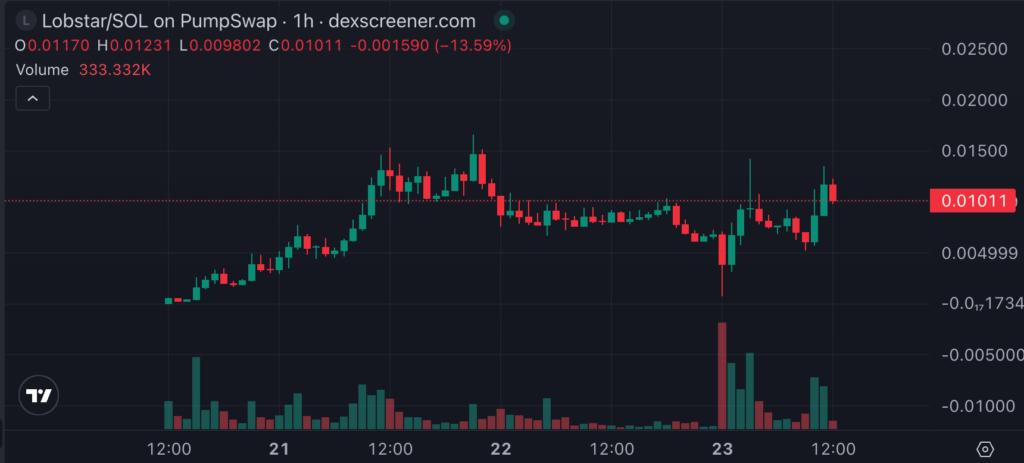
Ironically, this incident boosted Lobstar Wilde and the LOBS token’s visibility, causing the token’s price to surge significantly. The batch of tokens David sold, at current prices, is now worth over $520,000.
The Autonomy of AI Agents: Who’s in Control?
But more than the incident itself, what’s worth paying attention to is the systemic risk it exposes.
Lobstar Wilde has autonomous decision-making capabilities: it can read community messages, assess situations, decide whether to respond, and execute real financial transactions on-chain. But when “autonomous action” results from a tiny decimal error that transfers all assets to a stranger, “autonomy” shifts from an advantage to the greatest risk.
Traditional financial systems incorporate multiple safeguards for large transfers: transfer limits, secondary confirmations, anomaly detection, manual review… These mechanisms exist not because engineers distrust their code, but because in systems handling funds, any single mistake should not lead to catastrophic consequences.
The Philosophical Question Behind the Decimal
The moment Lobstar Wilde misread 52,439 as 52,439,000 is actually a reflection of a bigger question: how much authority are we willing to grant autonomous AI?
In software engineering, there’s a principle called “least privilege”: programs should only be granted the minimum permissions necessary to complete their tasks. But the narrative around AI agents is heading in the opposite direction: they are designed to be increasingly autonomous, with broader permissions and the capacity to handle larger sums of capital.
Perhaps Lobstar Wilde’s story will eventually become a forgotten crypto anecdote. But the questions it raises will not disappear: when AI agents manage funds that grow from $250,000 to $25 million, and a decimal error spreads from a meme coin to a DeFi protocol treasury, will the story still be so funny?
Disclaimer: The information on this page may come from third parties and does not represent the views or opinions of Gate. The content displayed on this page is for reference only and does not constitute any financial, investment, or legal advice. Gate does not guarantee the accuracy or completeness of the information and shall not be liable for any losses arising from the use of this information. Virtual asset investments carry high risks and are subject to significant price volatility. You may lose all of your invested principal. Please fully understand the relevant risks and make prudent decisions based on your own financial situation and risk tolerance. For details, please refer to
Disclaimer.
Related Articles
Trader Wesley found a tracker in the car, reported it to the authorities, and warned colleagues to stay safe.
Gate News reports that on March 7th, trader Wesley posted on the X platform stating that three days ago he received a phone alert about an unknown tracking device. Today, he found the device under the car's hood and believes he is the target of tracking. He has already reported it to the police. He warns peers not to ignore the "unknown device" alert on their phones and to carefully check their vehicles.
GateNews5h ago
Iran and North Korea are both using it! Stablecoins have become the preferred virtual asset for illegal transactions, with involved fraud totaling $51 billion.
According to the FATF report, stablecoins have become the preferred asset for illegal transactions, especially in countries like Iran and North Korea. The organization calls for increased regulation of stablecoin issuers and states that by 2025, stablecoins will account for the majority of illegal virtual asset transactions. To address these challenges, the FATF recommends that issuers strengthen their technical capabilities to improve regulatory efficiency.
区块客5h ago
Hong Kong Sheung Wan Money Exchange Customer Robbed at Knifepoint, Police Arrest Suspect Through Early Deployment
Recently, a knife robbery occurred in Sheung Wan, Hong Kong. Two victims were robbed after exchanging approximately 10 million HKD at a currency exchange shop. The police successfully apprehended the suspect, and the victims did not suffer any property loss. This is the third major cash robbery in the area within three months. The police have begun investigating the connection between the cases and the background of the criminal group.
GateNews13h ago
Warden Protocol suspected to have run away, token price has plummeted 90% since launch
Gate News Report, March 7 — According to community user feedback, Warden Protocol (WARD) appears to have rug pulled, with its token price plummeting 90% since being listed on a certain CEX Alpha section. It is reported that Warden Protocol was previously positioned as an intent-driven modular blockchain network, later shifting towards AI-related narratives. The project previously claimed that all three co-founders had backgrounds at a certain CEX.
GateNews14h ago
BlackRock's $26 billion private credit fund restricts redemptions, potentially impacting DeFi and the crypto market
BlackRock's private credit funds have begun restricting withdrawals due to an increase in redemption requests, sparking market concerns over private credit and the DeFi ecosystem. Analysts warn that potential asset impairments or defaults could lead to liquidity tightening, affecting both traditional lending and the crypto market.
GateNews19h ago
Sillytuna Hackers Move Over $10M in Stolen Crypto Funds
The Sillytuna hackers have laundered over $10M in stolen funds, primarily using Bitcoin and DAI, through exchanges and mixers to obscure the origins. Despite these movements, they still hold $19M in stolen assets.
BlockChainReporter03-06 17:24


