
Several institutional investors have disclosed through their latest quarterly 13F filings that they have significantly reduced or completely liquidated their holdings in MicroStrategy (MSTR), including Angeles Wealth Management and Wealth Watch Advisors, both announcing 100% exits. Although MSTR’s stock price rebounded approximately 30% after hitting a bottom in early February, it still declined a total of 19% over the past month.
Institutional 13F Filings Reveal Systematic Liquidation Trend
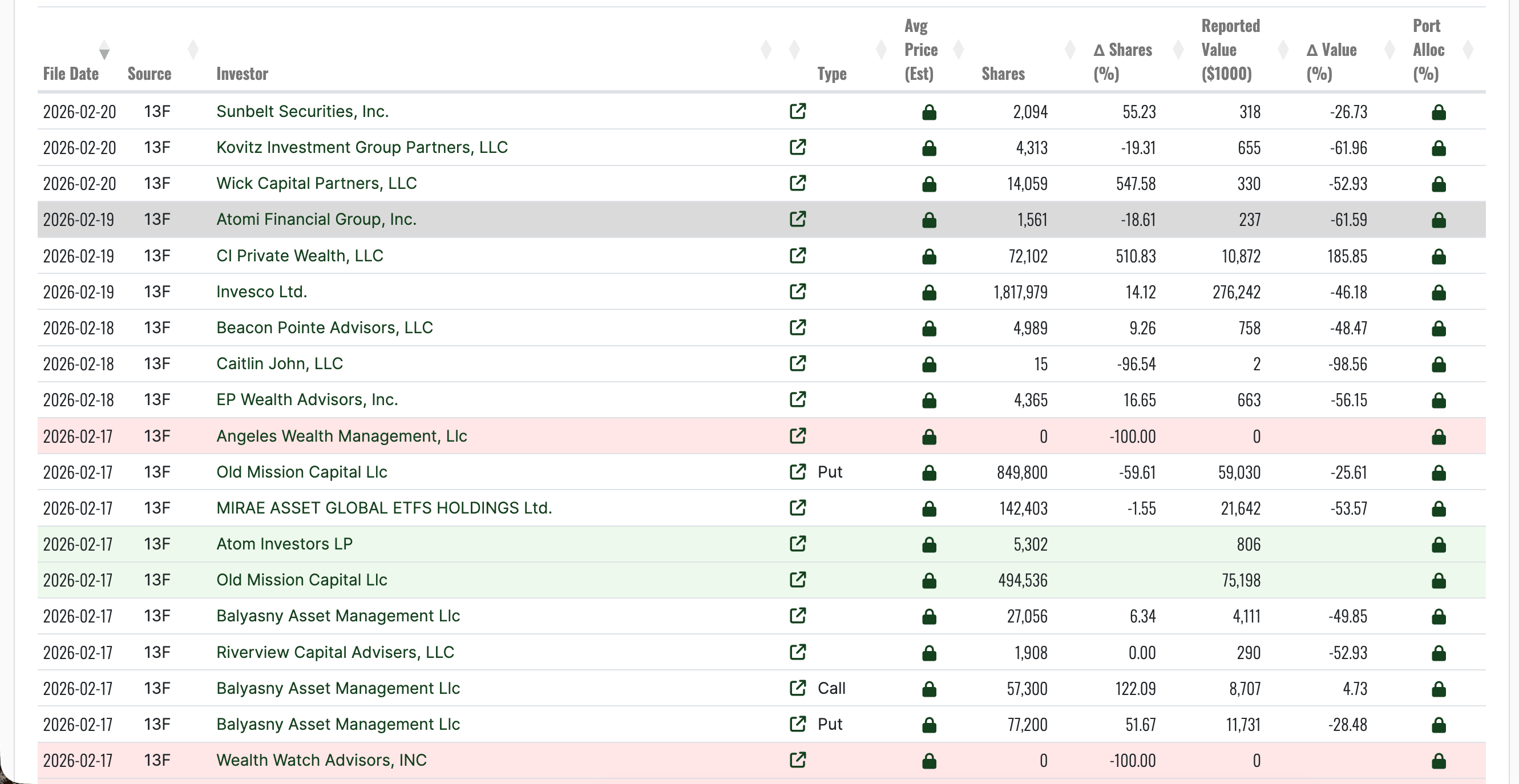
(Source: Fintel)
The 13F is a quarterly report filed with the U.S. Securities and Exchange Commission (SEC) by institutional investment managers overseeing over $100 million. It discloses their holdings, typically with a 45-day delay, reflecting decisions made at the end of the previous quarter. The concentrated disclosures from multiple institutions indicate that during MicroStrategy’s recent decline cycle, institutional funds generally chose to reduce or exit their positions.
Overview of Major Institutional Holdings Adjustments
Angeles Wealth Management: Fully liquidated, 100% reduction
Wealth Watch Advisors: Fully liquidated, 100% reduction
Caitlin John LLC: Reduced by 96.54%, retaining only symbolic holdings
Kovitz Investment Group: Reduced by 19.31%, with holdings value down over 62% in the same period
Atomic Financial Group: Reduced by 18.61%, with holdings value down over 61%
Invesco Group: Increased holdings by 14.12% against the trend, but overall position value still down over 46%
During the rebound, the concentrated disclosures of liquidation by institutional investors are viewed by the market as a systemic sign of waning confidence.
Technical Indicators Issue Triple Warnings: Momentum Divergence Continues to Worsen
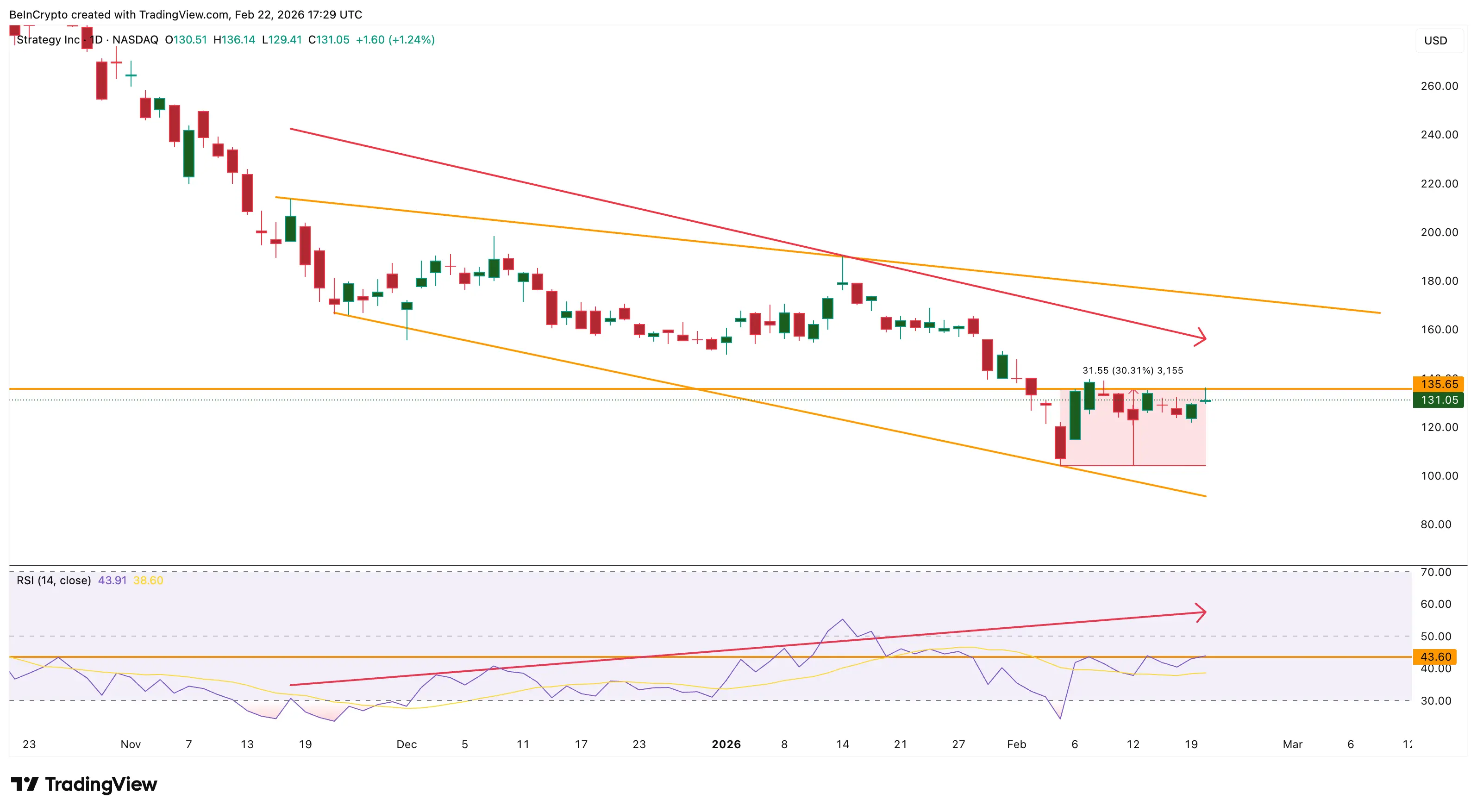
(Source: TradingView)
RSI Bearish Divergence
From November 18 to February 20, MSTR’s stock price formed lower highs, but the Relative Strength Index (RSI) showed higher highs, indicating a bearish divergence. This divergence appears within a sustained downtrend, suggesting that recent rebound momentum is gradually dissipating; if the price cannot effectively break above $135 resistance, the signal’s reliability will further strengthen.
Weakening OBV Indicates Dominant Selling Pressure
On-Balance Volume (OBV) has been declining since February 9, while the stock price has mostly moved sideways. The decline in OBV indicates that selling volume has been consistently higher than buying volume, suggesting that the current rebound lacks sufficient trading volume support, raising doubts about its sustainability.
MFI Shows Limited Retail Participation at Lows
The Money Flow Index (MFI) formed slightly higher lows between February 5 and 19, indicating some funds are buying at lows, which may explain why MSTR has remained above recent lows. However, without institutional funds re-entering, retail buying power alone usually cannot sustain a continued rebound.
Key Technical Levels: The Dual Test of $139 Resistance and $106 Support
MSTR is currently within a descending wedge pattern formed since November last year. The following technical levels will dominate the short-term trend:
$139: The 20-day Exponential Moving Average (EMA), a breakout above this could extend gains toward $163; the last test of this level in January saw the stock rise nearly 15% shortly afterward.
$119: Recent consolidation support; losing this level would significantly weaken the current rebound structure.
$106: Critical support level; a break below could trigger a chain of declines.
$96 / $86: Secondary supports after losing $106, with downside potential of 20% to 35% from current levels.
MicroStrategy currently holds over 717,000 BTC, and its stock price is highly correlated with Bitcoin’s market. Continued pressure on Bitcoin will directly amplify the aforementioned technical downside risks.
Frequently Asked Questions
What does the institutional liquidation disclosed in MicroStrategy’s 13F filings signify?
13F filings are quarterly disclosures required by the SEC for institutional managers overseeing over $100 million, with a 45-day lag. The significant reductions or complete liquidations disclosed by multiple institutions reflect decisions made at the end of the previous quarter, indicating that during the recent decline, institutions systematically reduced their exposure to MicroStrategy.
What are the key technical support levels for MSTR now?
The most critical support levels are $119 and $106. Technical analysis shows that if $106 is broken, support levels below are at $96 and $86. The key resistance to regain upward momentum is $139 (the 20-day EMA).
How does MicroStrategy’s Bitcoin holdings impact its stock risk?
MicroStrategy holds over 717,000 BTC, making its stock valuation highly dependent on Bitcoin’s market performance. If Bitcoin continues to face downward pressure, it will directly affect MicroStrategy’s asset valuation and magnify the downside risk of MSTR’s stock.
Disclaimer: The information on this page may come from third parties and does not represent the views or opinions of Gate. The content displayed on this page is for reference only and does not constitute any financial, investment, or legal advice. Gate does not guarantee the accuracy or completeness of the information and shall not be liable for any losses arising from the use of this information. Virtual asset investments carry high risks and are subject to significant price volatility. You may lose all of your invested principal. Please fully understand the relevant risks and make prudent decisions based on your own financial situation and risk tolerance. For details, please refer to
Disclaimer.
Related Articles
Culper Research shorted Ethereum, citing the upgrade as the trigger for a death spiral
Culper Research report indicates that Ethereum's Fusaka upgrade caused excess block space, leading to a 90% drop in transaction fees, potentially entering a "death spiral" cycle, resulting in decreased staking demand and network security. The report mentions Vitalik Buterin selling large amounts of ETH, questioning Tom Lee's bullish outlook, and points out BitMine's loss risks held in Ethereum.
MarketWhisper8m ago
Pi Network Today's News: $0.20 Becomes the Bull-Bear Threshold, Token Unlock Adds Variables
Pi Network (PI) tokens recently surged in price, breaking through $0.1900, with a total increase of about 15%. Market sentiment has improved, and the fear index has risen back to 29. However, 20.8 million PI tokens will be unlocked on Saturday, which could increase selling pressure and pose a short-term risk to the price. If it can break through $0.1959, the target price is $0.2613; but a drop below the 50-day moving average could turn the trend bearish.
MarketWhisper19m ago
Glassnode: Bitcoin selling pressure has eased, but institutional demand remains in the testing phase
PANews March 6 News, Glassnode posted on X platform analyzing that the outflow trend of Bitcoin spot ETF funds has stabilized. The 14-day net flow trend has turned upward, indicating that as Bitcoin breaks through $70,000, selling pressure is easing. Institutional demand remains in a tentative stage, but early signs of reaccumulation are beginning to appear.
GateNews25m ago
XRP Today's News: Musk X Money Beta Released, Sparks On-Chain Integration Speculation
Elon Musk's X company has launched a beta version of the X Money payment system, allowing users to transfer and manage funds, sparking widespread discussion about XRP integration. Although there are no official plans for cryptocurrency integration at the moment, the market is generally optimistic. Analysts believe that XRP has design advantages for payments, especially with improved regulatory environments, making it more promising. However, the practicality of stablecoins is also under scrutiny. XRP is currently testing the $1.50 technical resistance level. If successfully broken through, it could trigger further gains.
MarketWhisper26m ago
ETH short-term upward movement of 0.99%: Driven by whale inflows and external capital transfers, a structural rebound
From 01:30 to 01:45 (UTC) on March 6, 2026, ETH achieved a return of +0.99% within 15 minutes, with a price range of 2065.42 to 2088.57 USDT, and an amplitude of 1.12%. The volatility during this window was significantly higher than the daily average, increasing short-term market attention. Liquidity was relatively low, and some large transactions drove the trading volume upward.
The main driver of this abnormal movement was the concentrated inflow of whale funds into decentralized exchanges and large transfers. On-chain monitoring detected multiple large ETH fund inflows into DeFi protocols and trading platforms, effectively pushing
GateNews50m ago
Bitcoin drops to $70,600, Ethereum holds at 2,055. Analysts: Bull market score is only 10; don't put too much faith in this rebound.
Bitcoin has recently continued to hit new lows, currently trading at $70,923, and CryptoQuant has warned that the recent rebound is only a short-term rally in a bear market, with a bull market score of only 10 points. The US stock market has declined across the board, and the crypto market is also under pressure. The future trend depends on whether spot demand turns positive. There are multiple scenarios in the market, including possible sideways consolidation or a drop to the $56,000-$60,000 support zone. Ethereum has shown relative strength in this wave of market movement, but if Bitcoin continues to decline, its support levels will need to be observed.
動區BlockTempo1h ago


