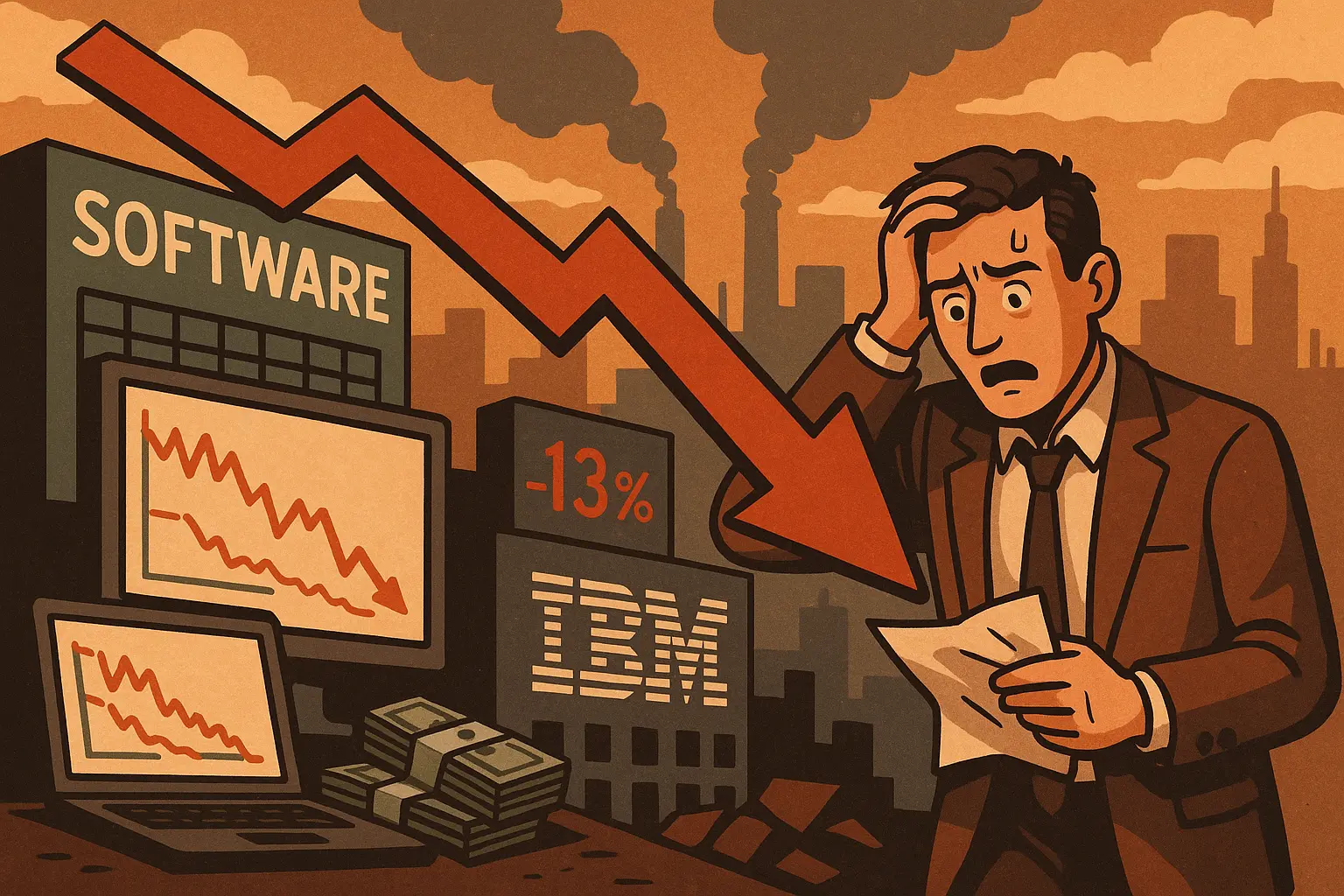
Research organization Citrini Research released the “Global Intelligence Crisis” report, which received over 22 million views on the X platform on February 23, 2026. It is considered one of the catalysts for the collective sell-off of software and payment stocks that day, with IBM plummeting 13.1%, marking its largest single-day decline in 25 years.
Core Argument of the Report: How AI Agents Trigger “Ghost GDP” and White-Collar Layoff Chain Reactions

(Source: Citrini Research)
Citrini’s report envisions an extreme scenario set in June 2028: Large-scale deployment of AI Agents significantly boosts corporate profits while increasingly rendering human white-collar workers redundant, ultimately leading to a contraction in consumer spending, a collapse of private credit, and threatening the $13 trillion US mortgage market. In this scenario, the S&P 500 index drops 38% from its all-time high, and the unemployment rate exceeds 10%.
The report’s concept of “Ghost GDP” has sparked widespread discussion. Citrini defines it as output appearing in national accounts but never circulating in the real economy. An illustrative example states: “The output generated by a GPU cluster in North Dakota is equivalent to the total output of 10,000 office workers in Manhattan.” This framework suggests that AI agents may increase nominal GDP while systematically compressing consumers’ actual disposable income.
Anthropic announced that its Claude Code can modernize COBOL programs (widely used in government, banking, and airline transaction processing systems), which is seen as a near-term event directly impacting IBM’s stock price, since COBOL primarily runs on IBM systems. Renowned risk theorist Nassim Taleb also warned that AI could lead some software companies toward bankruptcy.
Market Data: Impact on Software and Payment Stocks on February 23
Major affected stocks’ single-day declines:
IBM: -13.1% (to $223.35), the largest single-day drop in 25 years
American Express: -7.2%
Accenture: -6.58%
Mastercard: -5.77%
Oracle: -4.57%
Visa: -4.5%
Microsoft: -3.21%
Citrini’s report believes that the pressure on payment stocks stems from: the wave of white-collar layoffs triggered by AI will cause a large-scale reduction in consumer spending, leading to a chain of defaults on software-supported loans and private credit.
It is noteworthy that some prominent tech investors have challenged the speed at which AI is replacing humans as described in the report. Jason Calacanis pointed out that he spends $300 daily to run an AI agent operating at only 10%–20% capacity; Chamath Palihapitiya stated that AI agents’ productivity must be at least twice that of human workers to be cost-justified; Mark Cuban called the cost constraints argument the “most compelling anti-AI replacement argument” he has seen.
FAQs
What is Citrini Research, and why did this report trigger such a strong market reaction?
Citrini Research is a relatively low-profile research organization. Before this report, it maintained a low profile. The “Global Intelligence Crisis” report garnered over 22 million views on the X platform. Coupled with existing market concerns about AI disrupting tech profitability, it became a partial catalyst for the large-scale sell-off of software and payment stocks that day.
What is “Ghost GDP,” and what implications does it have for the cryptocurrency market?
Ghost GDP is a concept proposed by Citrini, referring to output recorded in national accounts but never circulating in the real economy. If this phenomenon proves true, the real purchasing power of consumers would decline, suppressing demand for risk assets, including cryptocurrencies, leading to a divergence between nominal GDP figures and actual economic activity.
What impact did this AI shock event have on Bitcoin and other crypto assets?
Macroeconomic uncertainty—including AI disruption fears and tariff policies—continues to suppress crypto market sentiment. Since Bitcoin hit a record high of $126,080 in October 2025, it has fallen nearly 50%. Meanwhile, traditional safe-haven assets like gold have continued to strengthen, indicating capital is shifting toward defensive assets.
Disclaimer: The information on this page may come from third parties and does not represent the views or opinions of Gate. The content displayed on this page is for reference only and does not constitute any financial, investment, or legal advice. Gate does not guarantee the accuracy or completeness of the information and shall not be liable for any losses arising from the use of this information. Virtual asset investments carry high risks and are subject to significant price volatility. You may lose all of your invested principal. Please fully understand the relevant risks and make prudent decisions based on your own financial situation and risk tolerance. For details, please refer to
Disclaimer.
Related Articles
70% of assets heavily invested in Bitcoin! Mexican billionaire urges "buy quickly during the dip," and the wealthy dad is also increasing his holdings
Mexican billionaire Ricardo Salinas Pliego is heavily investing in Bitcoin, believing it can hedge against inflation and symbolize personal freedom. Robert Kiyosaki warns that a stock market crash is imminent and continues to increase his holdings in Bitcoin and precious metals, remaining confident. They both believe that Bitcoin has long-term value potential, and the current price dip is a good buying opportunity.
区块客1h ago
Next week, the US will release February CPI and January PCE data, and the market is focused on stagflation risks.
The worsening situation in Iran has led to market volatility, and the Federal Reserve is facing dual pressures from inflation and employment. Several important economic data releases are scheduled for next week, with a focus on the impact of core CPI and PCE on the US dollar and gold. Meanwhile, Oracle will release its earnings report on Tuesday.
GateNews5h ago
Xinhua News Agency: Middle East conflict impacts Asia-Pacific economy, South Korea's stock index plunges over 12% in a single day, multiple countries activate emergency plans
On March 7th, Xinhua News Agency reported that the conflict between the United States, Israel, and Iran is affecting the Asia-Pacific region, leading to economic uncertainty and an energy security crisis. Multiple countries are calling for a halt to military actions. Southeast Asia faces trade disruptions and rising energy costs, with 64% of Malaysian companies affected. The IMF warns that the conflict will impact the global economy. Countries are actively responding, with ASEAN calling for a ceasefire and China intensifying diplomatic efforts.
GateNews7h ago
Arthur Hayes: The market underestimates the risk of Middle East conflict; AI replacing human labor could trigger a credit crisis
Maelstrom Co-Founder Arthur Hayes warns that the risk of Middle East conflict is underestimated, and disruptions in energy flows could trigger a global economic crisis. He also mentioned that the rapid replacement of labor by artificial intelligence could lead to a credit crisis, calling for attention to liquidity issues in the financial system.
GateNews11h ago
Oil prices hit over two-year highs, with analysts warning that the risk of Gulf oil production stoppages could impact the global economy
On March 7th, Qatar's Energy Minister warned that oil production in the Gulf region could cease, causing oil prices to soar to a two-year high. Analysts warn that if the situation persists for more than two weeks, it could have a significant impact on the global economy, with oil prices potentially exceeding $100 per barrel. The market expects transportation disruptions to be resolved quickly, but the increased risk of conflict and rising energy costs could slow economic growth.
GateNews11h ago
BlackRock's $26 billion private credit fund restricts withdrawals! Experts warn: Cryptocurrency and DeFi ecosystems may be impacted
BlackRock's private credit fund has restricted withdrawals due to increased redemption demands, raising concerns that this could trigger broader financial market stress and potentially impact crypto assets and decentralized finance (DeFi). Several asset management firms' stock prices have declined, and experts warn that if market pressure continues, it could lead to a deleveraging effect impacting other asset classes, including the banking system and tokenized assets.
動區BlockTempo12h ago


