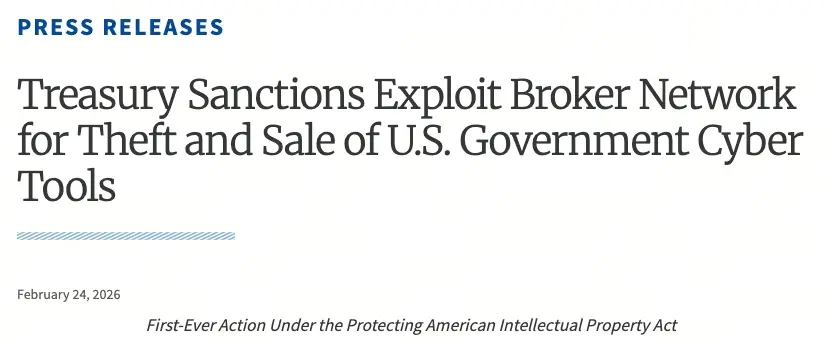
The U.S. Department of the Treasury’s Office of Foreign Assets Control (OFAC) announced on February 25th sanctions against Russian exploitation broker Sergei Zelenyuk and his St. Petersburg company Matrix LLC (also known as “Operation Zero”). They are accused of selling stolen U.S. government proprietary network tools, marking the first law enforcement case under the “Protecting American Intellectual Property Act” to target digital trade secrets theft.
Operation Zero’s Operations and Sanctioned Entities
(Source: U.S. Department of the Treasury)
“Operation Zero” was launched in 2021, employing a public bounty system to purchase security vulnerabilities targeting mainstream operating systems and encrypted communication apps. Multiple bounties have been publicly posted on the X platform. Known rewards include $500,000 for 26 iOS vulnerabilities (November 2025) and $4 million for a complete attack chain vulnerability in Telegram (March 2025).
OFAC states that the exploits sold by “Operation Zero” enable attackers to gain unauthorized access, steal information, or remotely control targeted systems. The client base is explicitly limited to “private and government organizations in Russia,” focusing on offensive security research and software tools.
The sanctions also target two individuals: Oleg Vyacheslavovich Kucherov, suspected member of the Trickbot cybercriminal group, and Marina Evgenyevna Vasanovich, described as Zelenyuk’s assistant.
Australian Contractor Data Theft Case: $1.3 Million in Cryptocurrency as Key Evidence
The sanctions stem from investigations by the U.S. Department of Justice and FBI into Australian citizen Peter Williams. Williams, a former employee of a U.S. defense contractor, is accused of stealing eight “commercial secret zero-day exploits” between 2022 and 2025, selling them to “Operation Zero” for $1.3 million in cryptocurrency. Williams pleaded guilty in October 2025 to two counts of commercial secrets theft.
The U.S. State Department emphasized in an independent statement that the stolen tools were originally intended solely for sale to the U.S. government and its allies. Unauthorized resale poses a direct threat to U.S. intelligence capabilities. The Treasury also disclosed that “Operation Zero” is involved in developing espionage software and AI-driven tools to steal personal identification information, recruiting hackers via social media, and establishing contacts with foreign intelligence agencies.
Key Information on the Sanctions
Sanctioned Parties: Sergei Zelenyuk and Matrix LLC (“Operation Zero”), Kucherov, Vasanovich
Legal Basis: Protecting American Intellectual Property Act, marking its first application to digital trade secrets theft cases
Stolen Tools: Eight U.S. government proprietary network tools, originally intended for U.S. government and specific allies
Cryptocurrency Payments: Peter Williams sold stolen zero-day exploits for $1.3 million in cryptocurrency
Highest Bounty: “Operation Zero” previously offered a $4 million reward for a Telegram attack chain vulnerability
Frequently Asked Questions
What is the historical significance of the legal basis for these U.S. Treasury sanctions?
These sanctions are executed under the Protecting American Intellectual Property Act, which is the first time this law has been used to combat the theft and sale of digital trade secrets. OFAC states this signifies an expansion of U.S. enforcement tools against cyber tool theft into the realm of commercial secrets law, setting an important legal precedent.
What is “Operation Zero,” and how do their vulnerability trading operations work?
“Operation Zero” is a Russian exploitation broker led by Sergei Zelenyuk, purchasing security vulnerabilities for operating systems and encrypted communication apps through public bounties. Its clients are limited to Russian private and government organizations. The bounty rewards can reach up to $4 million, with transactions publicly posted on X, reflecting transparency in their dealings.
What implications does the use of cryptocurrency payments in this case have for crypto regulation?
Peter Williams paid $1.3 million in cryptocurrency to acquire stolen U.S. government zero-day exploits, highlighting cryptocurrency’s role as a primary payment method in transnational cyber espionage. This case raises regulatory concerns about the role of cryptocurrencies in national security crimes and underscores the importance of on-chain tracking tools and anti-money laundering measures in combating such transactions.
Disclaimer: The information on this page may come from third parties and does not represent the views or opinions of Gate. The content displayed on this page is for reference only and does not constitute any financial, investment, or legal advice. Gate does not guarantee the accuracy or completeness of the information and shall not be liable for any losses arising from the use of this information. Virtual asset investments carry high risks and are subject to significant price volatility. You may lose all of your invested principal. Please fully understand the relevant risks and make prudent decisions based on your own financial situation and risk tolerance. For details, please refer to
Disclaimer.
Related Articles
Emphasize technological neutrality! The Federal Reserve: The capital recognition method for "tokenized securities" should follow that of traditional securities
The Federal Reserve and other agencies have issued new guidelines for the banking industry, requiring tokenized securities to follow the same regulatory capital standards as traditional securities, emphasizing that technological form does not affect the method of capital calculation. This reflects regulatory authorities' focus on the legal nature and risk assessment of financial assets, demonstrating the gradual integration of banks and blockchain finance, which helps banks evaluate the risks and costs of tokenization businesses.
区块客19m ago
The CLARITY Act: Key Deadlines in April, US Banks and Crypto Investors Face Choices
The CLARITY Act is entering a critical stage, with lawmakers planning to advance it before April 3rd, aiming to clarify regulatory responsibilities for digital assets. The negotiations mainly focus on the regulation of stablecoin yield products, and no agreement has been reached yet. The passage of the bill will impact the participation of American banks in the digital asset space and their global competitive position.
GateNews31m ago
Former CFTC Chair: Lack of cryptocurrency regulation harms banking industry, the CLARITY Act must be passed quickly
Former CFTC Chairman Giancarlo pointed out that the uncertainty in cryptocurrency regulation has a much greater impact on the banking industry than on the crypto sector. Banks, due to their strict regulatory and legal obligations, cannot make large-scale investments in this area. He warned that if the bill fails to pass, American banks may fall behind in digital financial transformation, facing structural challenges that could affect their global competitiveness. The core controversy of the bill involves stablecoin yields and regulatory jurisdiction. If it fails, regulatory guidance may only provide temporary solutions.
MarketWhisper1h ago
U.S. Treasury Says Crypto Mixers Have Lawful Privacy Uses
The U.S. Treasury Department acknowledges that crypto mixers have legitimate privacy benefits, allowing users to protect their financial transactions. The report indicates a shift from viewing mixers solely as tools for illegal activity, highlighting the need for both privacy protection and stronger regulations to address crime.
Coinfomania1h ago
North Korea stole $2.8 billion in crypto assets over two years, and the U.S. Treasury Department plans to strengthen regulation of stablecoins
The U.S. Department of the Treasury has proposed new measures under the "Genius Act" to combat cryptocurrency crimes, with a focus on monitoring illegal digital asset activities, especially the abuse of stablecoins. The Treasury recommends adopting AI-driven blockchain monitoring tools and bringing major stablecoins into a strict compliance framework to reduce criminal risks and enhance transparency. At the same time, the report shows that North Korean hackers are stealing cryptocurrencies severely, and global online scams are increasing, prompting updates to the regulatory framework.
GateNews1h ago


