Title: The Nakamoto Heist: How David Bailey Used a 99% Stock Collapse to Buy His Own Empire
Author: Justin Bechler, Bitcoin OG
Translation: Ismay, BlockBeats
Editor’s Note: This article delves deeply into the astonishing capital operations behind David Bailey and his control of Nakamoto Holdings ($NAKA). From the crazy surge during the shell listing, to a 99% crash after retail investors entered, and then using a chaotic publicly listed company to buy back his private firms at a huge premium—this is a meticulously designed wealth transfer exploiting information asymmetry and regulatory loopholes.
This is a brutal investigation into greed, compliance games, and influencer capitalism. It warns us that when faith is packaged as financial products, and the slogan of decentralization meets centralized greed, retail investors are often the last to exit liquidity. Understanding this story may give you more clarity and less blind trust when the big players call the shots next time.
Below is the full content:
This morning, David Bailey used a publicly listed company whose market value had evaporated by 99% to acquire his own two private companies—at four times the current stock price—completely without shareholder approval.
What’s most shocking? Long before retail investors bought the first share, this asset transfer scheme was already locked in.
To understand how this was done, we need to start from the beginning.
In May 2025, a zombie company called KindlyMD announced a merger with Nakamoto Holdings, a Bitcoin reserve tool founded by David Bailey.
Within days, the stock soared from $2 to over $30, attracting retail investors en masse. Bitcoin influencers celebrated wildly, with Bailey even comparing himself to the Morgan, Medici, and Rothschild families.
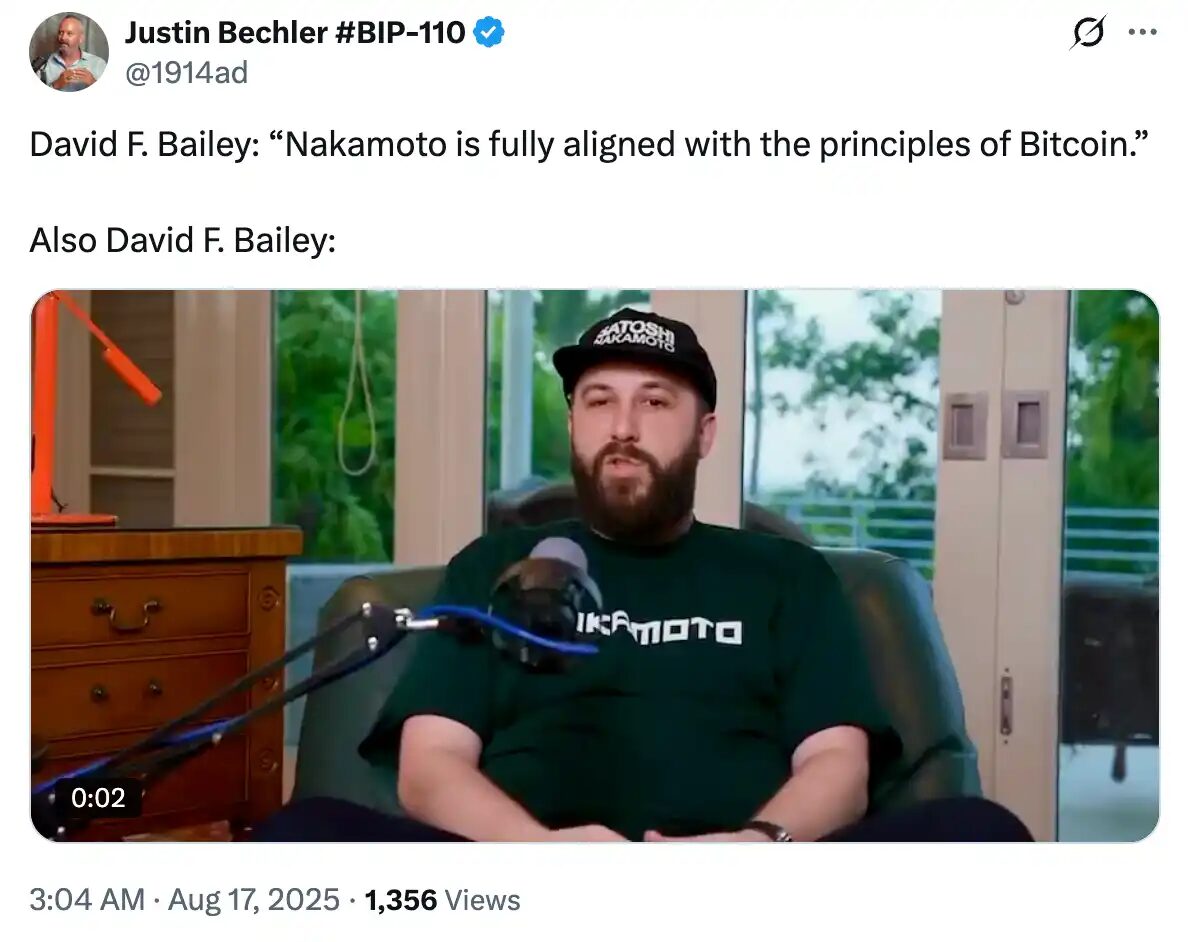
Nine months later, the stock plummeted to 29 cents, and Bailey just used this stock to buy his own company.
The Pump
Its mechanism is quite ingenious.
KindlyMD was originally a little-known microcap on NASDAQ. Nakamoto Holdings went public via reverse merger, backed by $510 million in PIPE (private investment in public equity) financing and $200 million in convertible bonds.
On paper, it looked like the birth of a Bitcoin reserve giant, with a new generation of Bitcoin influencers rushing to tell you why to buy $NAKA (of course, to hold more Bitcoin).
Within days, NAKA’s Price-to-NAV ratio hit an astonishing 23x, meaning speculators paid $23 for every $1 worth of Bitcoin held by the company.
Michael Saylor’s MicroStrategy never reached such a premium. The difference is, MicroStrategy has years of operational history, actual revenue-generating software business, and a CEO who doesn’t manipulate the structure to line his own pockets behind the scenes.

Insiders knew secrets that retail investors didn’t. PIPE investors—including notorious opponents of BIP-110 like Udi Wertheimer, Jameson Lopp, and Adam Back—got their shares at $1.12 each. Meanwhile, retail buyers paid $28, $30, $31, or even higher.
This information asymmetry was embedded in the structure from day one.
In June, Bailey completed another $51.5 million PIPE at $5.00 per share. Although the second batch of investors paid far less than retail, they still paid well above the $1.12 floor and ultimately got swept up.
Bailey celebrated the financing, claiming it took less than 72 hours and that investor demand was extremely strong.
Let’s examine this strategy carefully.
The Dump
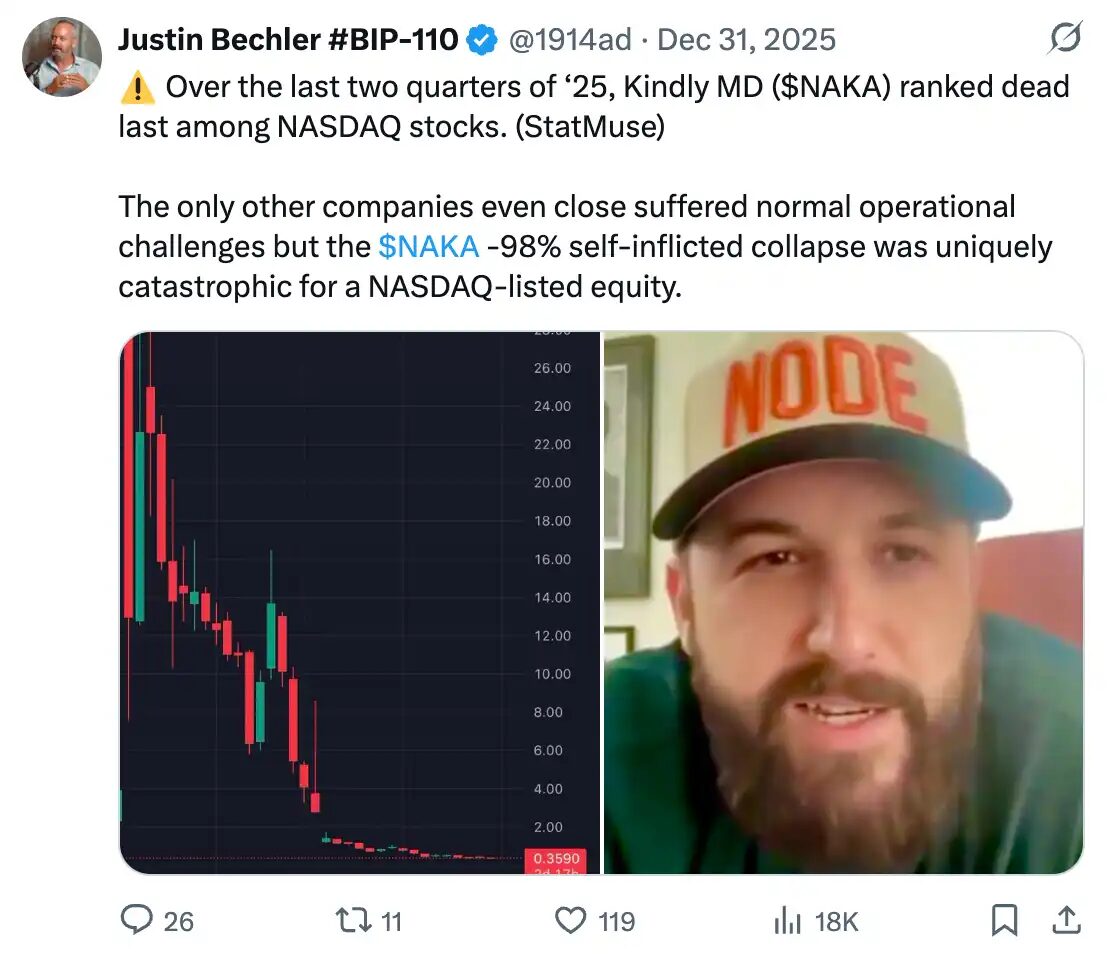
By September, NAKA had already fallen 96%.
PIPE investors who bought at $1.12 finally cashed out after the August merger, and they did so.
Bailey’s response was quite bizarre for a CEO of a listed company—he told those just trading for short-term gains to get out quickly.
And they did.
The stock continued to fall. It broke below $1, then $0.50, then $0.30. A company holding about 5,765 Bitcoin (worth over $500 million) now had a market cap under $300 million.

Market valuation of Nakamoto was even lower than its Bitcoin asset value on the balance sheet, illustrating how investors viewed the management team and corporate structure wrapped around these Bitcoins.
Debt Spiral
As the stock crashed, Bailey kept switching lenders like a gambler borrowing on the casino floor.
Initially, the capital structure included $200 million in convertible bonds from Yorkville Advisors, with a conversion price of $2.80. When NAKA’s stock fell below that, the convertible bonds became debt that could potentially swallow equity.
On October 3, Nakamoto borrowed $203 million in a term loan from Two Prime Lending to redeem Yorkville’s notes and interest.
Four days later, on October 7, they borrowed another $206 million in USDT at 7% interest from Antalpha to repay Two Prime. The loan term was only 30 days (with an option to extend 30 days). They swapped the convertible bonds for a term loan, then replaced that with a 30-day bridge loan.
The original plan was to convert this bridge loan into Antalpha’s $250 million, 5-year secured convertible bonds. The new bonds would pay off the bridge loan, which would pay off the term loan, which would pay off the old convertible bonds.
But that $250 million convertible bond was never issued under Antalpha’s terms.
On December 16, Nakamoto borrowed $210 million USDT from Kraken at 8% interest, with Bitcoin from its reserves used as 150% overcollateralization.
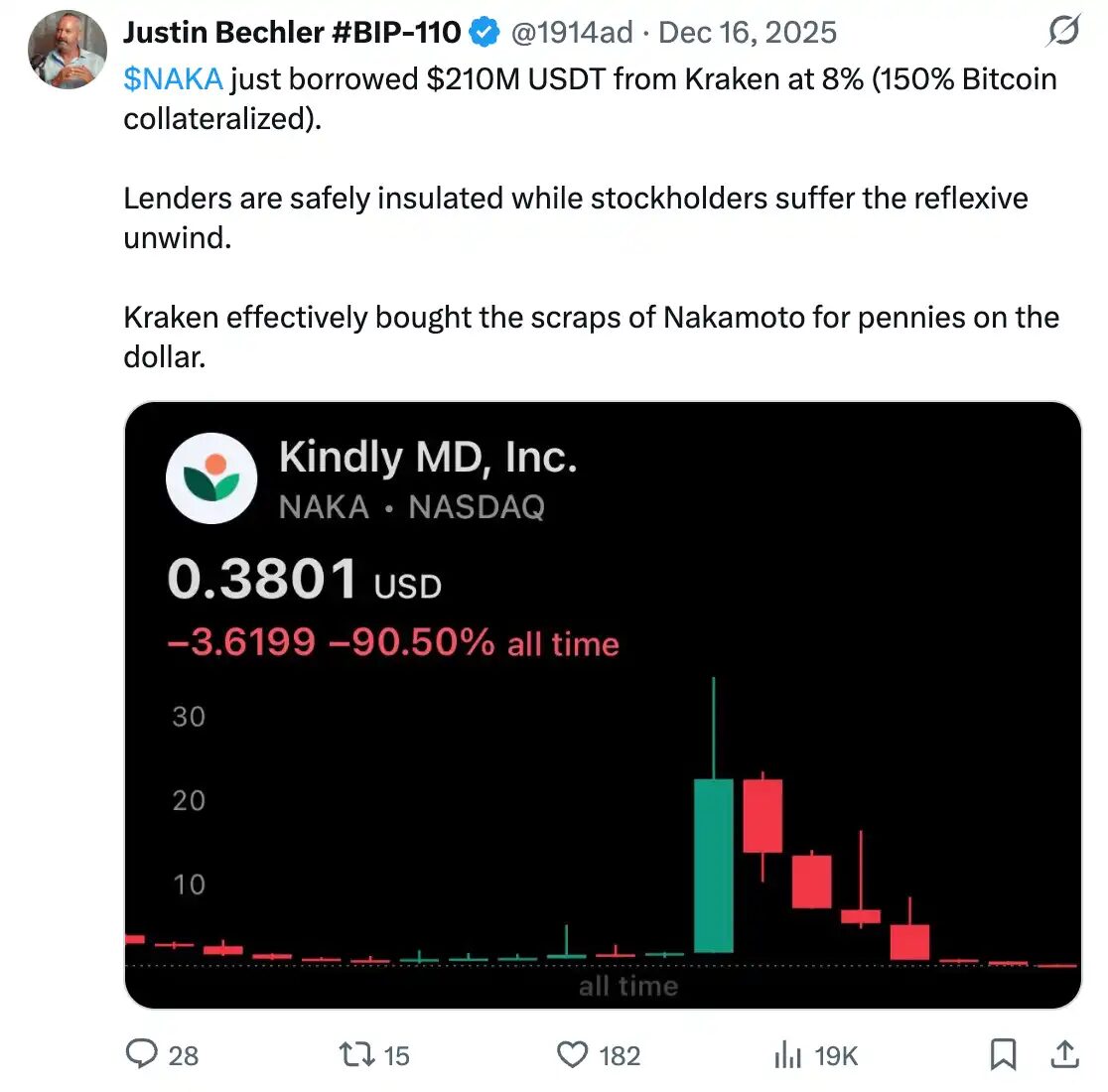
Let’s do the math: the lender holds $315 million worth of Bitcoin as collateral for the $210 million loan. If NAKA’s stock goes to zero, Kraken takes the collateral. If Bitcoin drops 33%, Kraken remains unharmed. At every stage of this game, the lender is tightly protected, while ordinary shareholders bear the full brunt of the reflexive collapse.
Every new loan tightens the noose.
Countdown
On December 10, Nasdaq notified Nakamoto that, due to the stock trading below $1 for 30 consecutive trading days, it faced delisting risk. The company must re-compliance by June 8, 2026—meaning closing above $1 for 10 consecutive trading days.
Current price: 29 cents.
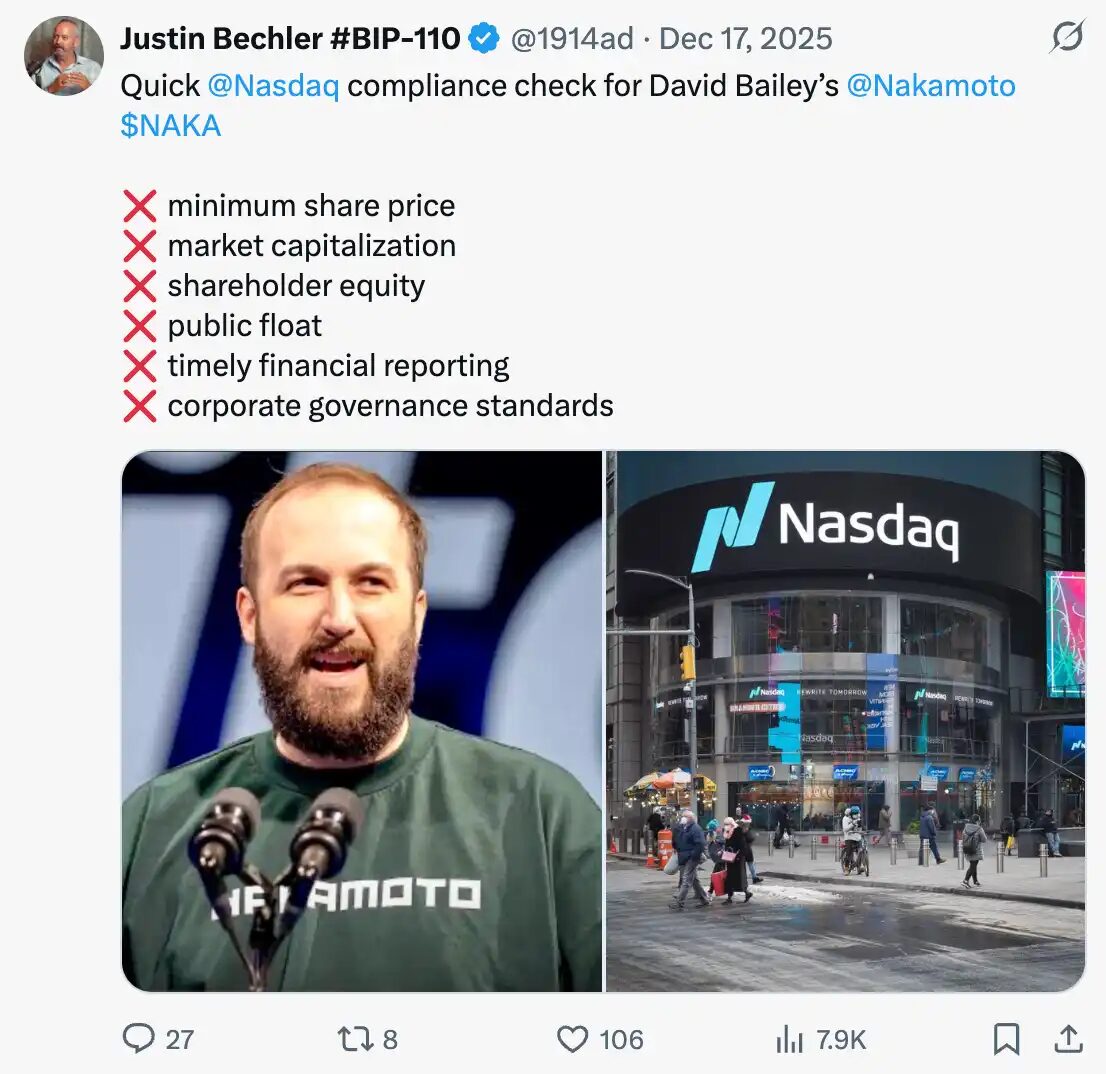
Once delisted, Nakamoto can no longer conduct ATM (market price) offerings, issue convertible bonds, or use its stock as acquisition currency. Everything Bailey assembled in this shell depends on maintaining a Nasdaq listing that is no longer sustainable.
Accounting Disaster
In November, Nakamoto filed a Form 12b-25 with the SEC, admitting it could not file quarterly reports on time due to accounting complexities from the merger. Initial data reveal the truth:
Nakamoto’s acquisition caused a $59.75 million loss (purchase price above net asset value)
Unrealized digital asset losses of $22.07 million
Realized Bitcoin sale losses of $1.41 million
Refinancing rounds resulted in $14.45 million debt repayment losses
Total quarterly loss around $97 million, offset only partially by $21.8 million in contingent liabilities accounting gains. A company that should have been a perfect Bitcoin reserve tool can’t even submit its books on time.
Heist
This brings us back to this morning.
Nakamoto announced it signed a final merger agreement to acquire BTC Inc. and UTXO Management. BTC Inc. owns Bitcoin Magazine and runs the Bitcoin conference. UTXO manages a Bitcoin-focused hedge fund.
Bailey is the chairman and CEO of Nakamoto, the buyer.
He is also the founder of BTC Inc. and UTXO, the sellers.
He is the buyer, the seller, and the approving CEO.
But weeks before the acquisition, he quietly handed the CEO role to Brandon Greene, creating a thin layer of separation between himself and the entities he’s about to buy with shareholder equity.
This morning’s transaction was entirely financed through Nakamoto’s stock, priced at $1.12 per share per the embedded call options in the original marketing agreement. Meanwhile, $NAKA is desperately trying to climb back to $0.29.
The stock valuation Bailey’s company received was nearly four times the current market price. Shareholders of BTC Inc. and UTXO will receive 363.6 million shares, valued at about $107.3 million at market price.
But these shares were issued at $1.12, meaning the deal was built when NAKA’s price was soaring, and the terms were never adjusted when the price collapsed.
Forget the fictional pricing in the contract. The real issue is that 363.6 million new shares just entered circulation. Whether the document says $1.12 or $0.29, existing shareholders are diluted by this volume. The $1.12 label is a courtesy to the sellers; the dilution is real.
No additional shareholder approval was needed, as the call options were embedded in the original merger documents, approved by shareholders when NAKA was trading at $20–$30.
Unaware retail investors authorized future high-premium buyouts of Bailey’s private businesses, while their stocks were vanishing into thin air.
Self-Interest Architecture
Looking at the bigger picture, the entire structure is almost breathtaking in its elegance.
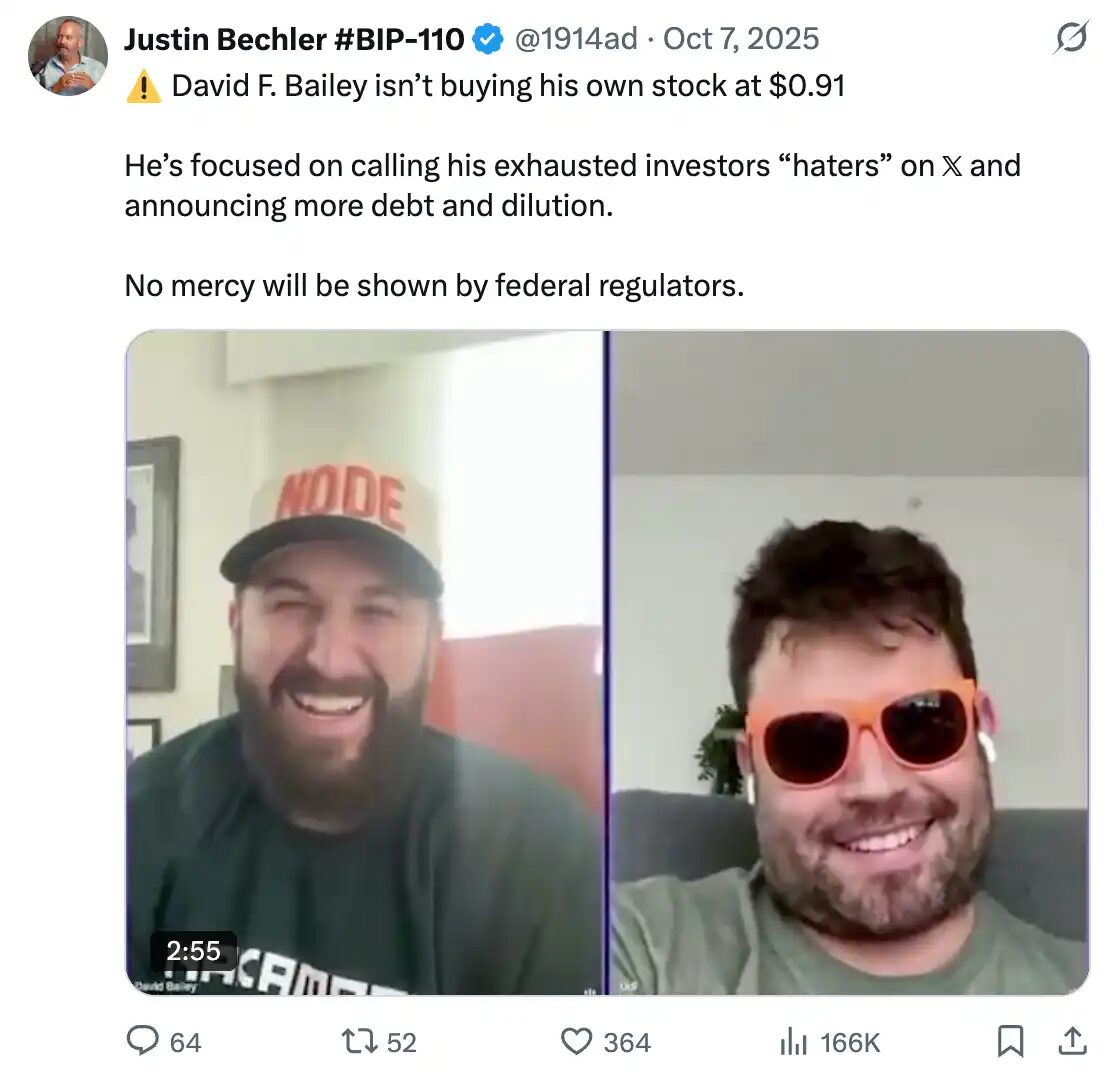
Bailey created Nakamoto Holdings. Merged it into a listed shell via KindlyMD, raising $710 million in the process. Driven by retail enthusiasm, the stock was pumped to 23x NAV. PIPE investors entered at $1.12, while the public paid 20 to 30 times that. The stock then crashed 99%.
During this period, the company changed lenders three times in a week, trying to manage $200 million in debt, originally structured to convert to equity when the stock was much higher.
Now, with the stock below 30 cents, Bailey is using this hollowed-out tool to acquire his private empire at terms agreed when the stock was at hundreds of dollars. The initial KindlyMD merger was a Trojan horse; the real payload was the acquisition of BTC Inc.
Bailey told us from the start. In the initial press release, he said Nakamoto would acquire BTC Inc., contingent on audits and the exercise of call options. The MSA was publicly filed, and the option terms disclosed. Everything was legally compliant and fully transparent—like all complex financial engineering, the truth was buried in unreadable documents.
This operator of Bitcoin Magazine, organizer of the world’s largest Bitcoin conference, positioning himself as a Bitcoin movement leader, built a listed company that destroyed 99% of shareholder value, then used it to buy back his own firms at a premium.
He compared himself to the Medici family. At least the Medici created value for Florence before taking their cut.
Nakamoto is what happens when influencer culture collides with the public stock market.
Exiting Liquidity
Bailey raised $710 million from over 200 investors across six continents. He promised them a future like Morgan, Medici, Rothschild—an empire built on Bitcoin. He told them Nakamoto would bring Bitcoin to the center of global capital markets. Their names would echo through history.
But what he delivered was a 99% loss.
He set PIPE at $1.12, while retail bought in at $28. Without investors understanding the authorization, he embedded call options into the documents to buy back his own company. Within a week, he rotated through three lenders, trying to prevent $200 million debt from crushing equity, accumulating $14 million in debt repayment losses. He sold Bitcoin from reserves that should have been held, at a loss. He couldn’t even file quarterly reports on time. And when the stock finally dropped to 29 cents…
When the wreckage was cleared and trusting retail investors were looted, he exercised the call options, using the investors’ remnants to buy his private empire at four times the market price.
Bailey owns 11 million shares at a cost of $1.12. Adam Back owns nearly 9 million shares. Balaji, Lopp, Yusko, Salinas, Wu Jihan—everyone’s entry price was beyond what teachers, truck drivers, or first-time investors could ever get. They are the ones shaping Bitcoin’s narrative. They run conferences, publish magazines, manage funds, tweet. They are the supply chain of faith, turning skeptics into believers, believers into bagholders.
Now, Bailey controls Bitcoin Magazine, the Bitcoin conference, and a hedge fund—all embedded in a listed company with only a small fraction of his Bitcoin holdings. All acquisitions were made with stocks worth four times the market price, approved before retail money even entered.
And he’s not done.
Nakamoto has filed for a $5 billion ATM (market price) stock offering with the SEC. Bailey now controls media, conferences, hedge funds, and a shelf registration allowing him to continue issuing stock collateralized by Bitcoin reserves until the last value is drained.
When did the Bitcoin community hand over the keys to conference promoters and influencer capitalists? Why are people still surprised when they drive away?
Disclaimer: The information on this page may come from third parties and does not represent the views or opinions of Gate. The content displayed on this page is for reference only and does not constitute any financial, investment, or legal advice. Gate does not guarantee the accuracy or completeness of the information and shall not be liable for any losses arising from the use of this information. Virtual asset investments carry high risks and are subject to significant price volatility. You may lose all of your invested principal. Please fully understand the relevant risks and make prudent decisions based on your own financial situation and risk tolerance. For details, please refer to
Disclaimer.


