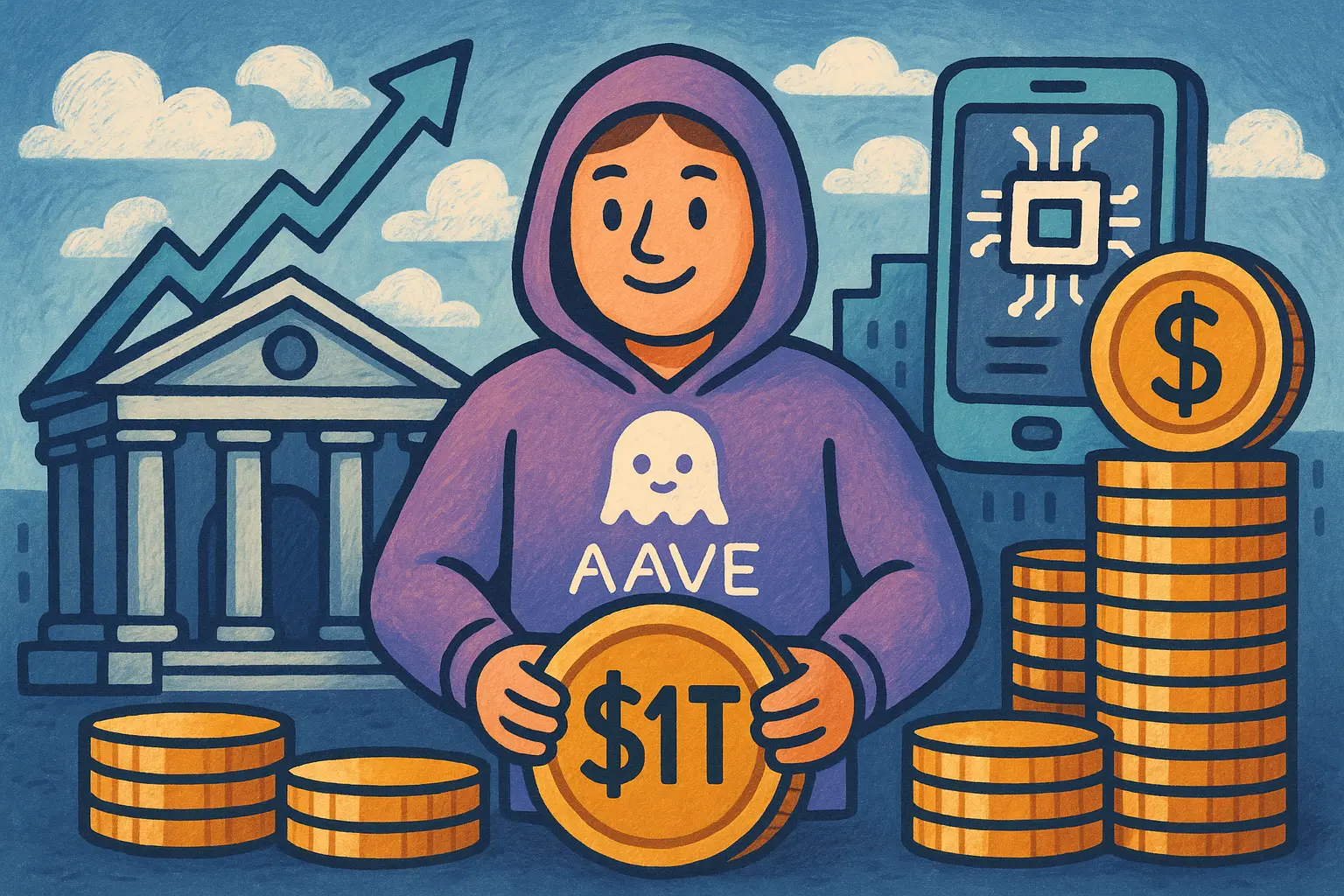
Decentralized lending protocol Aave announces that the total borrowed amount has surpassed $1 trillion, becoming the first DeFi protocol to reach this milestone. Aave Labs CEO Stani Kulechov stated on X platform Wednesday that this is a key milestone on Aave’s path to becoming the “world’s largest and most efficient liquidity network,” explicitly targeting banks and fintech companies as the core focus for the next phase of integration.
Behind the Milestone: Aave’s Scale Advantage and Cost Leadership
 (Source: Aave)
Aave’s leadership in the DeFi lending market is built on a continuously expanding scale moat, currently far ahead of competitors like Morpho, JustLend, SparkLend, Maple, Kamino Lend, and Compound Finance, all with total value locked (TVL) exceeding $1 billion.
Kulechov stated in a release: “Ten years ago, DeFi and Aave didn’t exist; they were just concepts. Today, Aave has become a pillar of on-chain lending, powering a new, open, globalized, and unstoppable financial system.”
Current Core Data of Aave
Total Borrowed Amount: Surpassed $1 trillion, a first in DeFi history
Total Value Locked (TVL): Over $27.2 billion
Fee Revenue in Past 30 Days: $83.3 million, about four times that of second-place Morpho
User Services: Provides core services of crypto asset staking, borrowing, and deposit interest
Foundation: Founded in November 2017 as ETHLend, renamed Aave in September 2018
Institutional Strategy and Future Vision: Integration with Banks, Fintech, and RWA
Aave’s next growth phase focuses on deep integration with traditional financial institutions. In August 2025, Aave Labs launched Aave Horizon, an institutional lending market deployed on Ethereum, allowing traditional finance companies and institutional investors to borrow stablecoins using real-world assets (RWA) as collateral. VanEck, WisdomTree, and Securitize are among the first participants.
Kulechov’s strategic vision is to make Aave the “default platform for builders, banks, and fintech companies, fundamentally improving liquidity and cost structures in global finance.” On February 15, he further stated that DeFi lending can benefit from tokenizing surplus assets like solar panels, energy storage batteries, and labor robots, with an estimated total value of such assets reaching $50 trillion by 2050.
This milestone also coincides with internal governance debates within the protocol. AAVE token holders are being asked to approve a proposal to allocate $42.5 million in stablecoins and 75,000 AAVE tokens to Aave Labs; in return, Aave Labs will transfer all revenue from branded products into the Aave DAO treasury under a DAO-funded operational framework. The proposal has sparked division within the community, centering on the boundaries of funding and decision-making power between Aave Labs and the DAO.
Frequently Asked Questions
What does the $1 trillion lending milestone mean for Aave?
Aave becoming the first DeFi protocol to surpass $1 trillion in total borrowed amount signifies that decentralized lending has moved from concept validation to a scalable global financial infrastructure. This figure demonstrates the competitive advantages of on-chain lending in liquidity, efficiency, and accessibility.
How does Aave Horizon serve institutional investors?
Aave Horizon is an institutional lending marketplace launched by Aave Labs, allowing traditional finance firms and institutional investors to borrow stablecoins using real-world assets (RWA) as collateral. It is designed to meet legal certainty and compliance needs for institutions, with VanEck, WisdomTree, and Securitize among the first to participate.
What is the core governance dispute between Aave DAO and Aave Labs?
The current controversy centers on a proposal to allocate $42.5 million in stablecoins and 75,000 AAVE tokens to Aave Labs. Supporters believe this aligns Aave Labs’ interests with the long-term development of the DAO; opponents worry that revenue control is overly concentrated in Labs, weakening the DAO’s decentralized governance.
Disclaimer: The information on this page may come from third parties and does not represent the views or opinions of Gate. The content displayed on this page is for reference only and does not constitute any financial, investment, or legal advice. Gate does not guarantee the accuracy or completeness of the information and shall not be liable for any losses arising from the use of this information. Virtual asset investments carry high risks and are subject to significant price volatility. You may lose all of your invested principal. Please fully understand the relevant risks and make prudent decisions based on your own financial situation and risk tolerance. For details, please refer to
Disclaimer.
Related Articles
Polkadot to Reset Tokenomics on March 12 With Major DOT Supply and Staking Changes
Polkadot will introduce a new monetary framework on March 12 that sets DOT’s supply cap at 2.1 billion and lowers emissions by 53.6%.
The overhaul will also create a Dynamic Allocation Pool and shorten the DOT unbonding period from 28 days to 24–48 hours.
On March 12, Polkadot will reset
CryptoNewsFlash1h ago
BlackRock Lowers ETHB Staking Fee in Updated SEC Filing
BlackRock reduced the proposed staking fee from 18% to 10% of ETH rewards in the updated ETF S-1 filing.
The iShares Ethereum Trust plans to stake its ETH holdings to generate additional yield for the fund.
Several firms including Fidelity Investments and Franklin Templeton are also
CryptoFrontNews3h ago
Aave Labs Proposes Dedicated Bug Bounty Program for Aave V4 With Sherlock
Aave Labs has published a proposal for a dedicated bug bounty program for a 24/7 channel to report security issues.
High-priority submissions require participants to stake at least 250 USDC, which is forfeited if the report is invalid or deemed spam.
Aave Labs has published a proposal to
CryptoNewsFlash4h ago
XRP Ledger XLS-65 Amendment Introduces Native Single Asset Vaults for DeFi
XLS-65 enables integration of single-asset vaults on the XRP Ledger, allowing users to pool XRP, IOU, or MPT and obtain proportional shares of MPT.
XRPL Commons backed the amendment after 257 Devnet tests, which covered exchange logic, access controls, and asset safeguards.
The XRP Ledger ha
CryptoNewsFlash4h ago
Curve Finance accuses a decentralized trading platform of unauthorized use of its code, violating open-source licenses.
Curve Finance accuses a decentralized trading platform of unauthorized use of its code, violating open-source license agreements. If the platform wishes to legally use its features, it can contact via licensing or partnership arrangements.
GateNews5h ago
21Shares Launches First US Spot Polkadot ETF on Nasdaq
21Shares listed the TDOT ETF on Nasdaq with a physically backed structure holding actual DOT tokens.
The ETF launched with about $11 million in seed capital and charges a 0.30% management fee, according to Eric Balchunas.
Polkadot plans a March update capping DOT supply at 2.1B tokens
CryptoFrontNews5h ago


