
The crypto company World Liberty Financial (WLFI), under the Trump family, released a new governance proposal on Wednesday, suggesting that token holders must stake WLFI for at least 180 days to participate in governance voting. The aim is to ensure that voting rights are held by “participants with long-term commitment to the protocol,” rather than speculators. Stakers who complete the staking and participate in at least two governance votes during the lock-up period can earn an annual percentage yield (APY) of 2%.
Core Mechanism Design of the Staking Governance Proposal
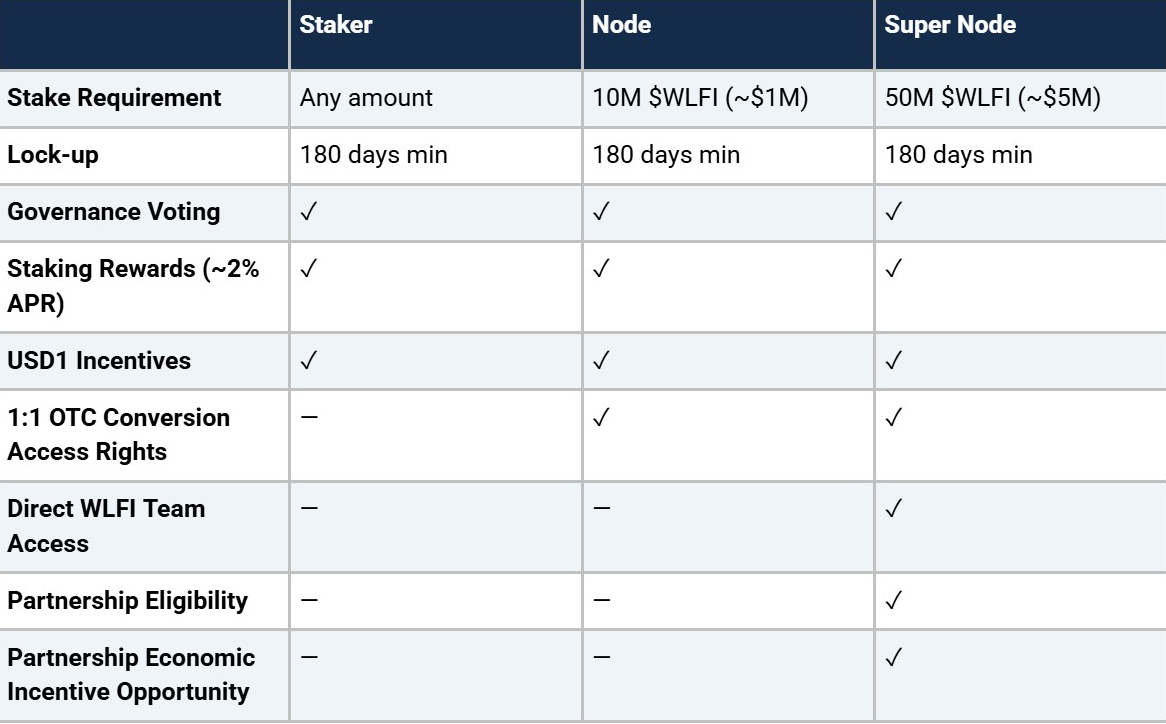
(Source: WLFI)
The core of this proposal is token locking to select governance participants with long-term commitment. The proposal details the following key design elements:
Key Points of the Staking Governance Proposal
Staking Requirement: To participate in governance voting, lock WLFI tokens for at least 180 days
Annual Percentage Yield (APY): Stakers who complete at least two governance votes during the lock-up period can earn 2% APY
Voting Power Calculation: Voting rights are dynamically calculated based on the amount staked and remaining lock-up time, with longer lock-up periods granting higher weight
Voting Threshold: Each proposal requires at least 1 billion tokens participating in voting and a majority approval
Compatibility with Existing Holdings: Users holding locked tokens can still vote normally, without affecting their current holdings
Super Node Qualification: “Super nodes” holding over 50 million WLFI tokens can access additional features
According to CoinGecko data, WLFI tokens currently have a circulating supply of over 27 billion tokens. The 1 billion token voting threshold accounts for approximately 3.7% of the circulating supply.
USD1 Incentive Strategy and Stablecoin Market Positioning
This proposal also promotes incentives for adopting USD1 stablecoin, extending WLFI’s long-term strategy to popularize USD1.
According to the proposal, users staking WLFI will receive “additional benefits related to USD1 usage”; users depositing USD1 on WLFI’s trading and lending platform WLFI Markets will receive unspecified “incentives” from DeFi protocol Dolomite. This integrated plan links WLFI token staking, USD1 deposits, and DeFi protocols into a complete ecological incentive cycle.
As of Thursday, DeFiLlama data shows the total stablecoin market cap surpassing $309 billion, with Tether USDT leading at over $183 billion (market share 59%), followed by Circle USDC at $75 billion. USD1’s current market cap is $4.7 billion, ranking as the fifth-largest stablecoin globally. While still far behind the top two, WLFI states it will continue to promote adoption through reward programs and institutional platform collaborations.
Three-Phase Launch Plan
If the proposal is approved, WLFI plans to implement it in three phases:
Phase 1: Launch staking rewards and USD1 deposit incentives to build a base of engaged users
Phase 2: Introduce 1:1 conversion functionality to further enhance USD1 liquidity and usability
Phase 3: Open opportunities for super node collaborations and revenue sharing frameworks to attract large holders to deepen ecosystem participation
Frequently Asked Questions
How does WLFI’s 180-day staking requirement differ from typical DeFi staking?
Most DeFi staking focuses on yield incentives with flexible lock-up conditions. WLFI’s proposal emphasizes “governance eligibility”: locking for 180 days is a prerequisite for voting rights, not just for earning rewards. This design aims to filter out short-term speculators and ensure that token holders participating in governance have a higher degree of long-term commitment.
What is the current market position of USD1 in stablecoins?
USD1 currently has a market cap of $4.7 billion, ranking fifth globally among stablecoins, far behind market leaders USDT ($183 billion) and USDC ($75 billion). WLFI’s incentive strategy aims to expand USD1’s use cases within DeFi and gradually narrow the market share gap.
What are the conditions for the proposal to pass?
According to the proposal, at least 1 billion WLFI tokens (about 3.7% of the circulating supply) must participate in voting, and the proposal must receive a majority of “yes” votes. With a circulating supply of over 27 billion tokens, reaching the quorum requires roughly 3.7% of tokens to participate, which is a critical threshold for the proposal’s implementation.
Disclaimer: The information on this page may come from third parties and does not represent the views or opinions of Gate. The content displayed on this page is for reference only and does not constitute any financial, investment, or legal advice. Gate does not guarantee the accuracy or completeness of the information and shall not be liable for any losses arising from the use of this information. Virtual asset investments carry high risks and are subject to significant price volatility. You may lose all of your invested principal. Please fully understand the relevant risks and make prudent decisions based on your own financial situation and risk tolerance. For details, please refer to
Disclaimer.
Related Articles
Ethereum Governance Solution Tally Announces Shutdown, Gradual Operations Halt Begins by Month's End
Ethereum governance solution Tally announced its shutdown after five years of operations, citing unfavorable market conditions and lack of business model support. CEO Bertram stated that the feasibility of token issuance could not be determined. Tally will gradually cease operations by the end of this month, but will work with enterprise clients to develop transition plans.
GateNews1h ago
PayPal Stablecoin PYUSD Expands to 70 Markets Globally, Now Available in Singapore and Colombia
PayPal announced that its USD stablecoin PYUSD has expanded to 70 markets globally, including Singapore and several countries in South America, allowing users to conduct real-time cross-border remittances at lower costs. PYUSD is regulated and offers reward programs, which enhances user asset retention incentives and accelerates capital flow, improving merchant operational flexibility.
ChainNewsAbmedia1h ago
PayPal Stablecoin PYUSD Expands to 70 Countries in Latin America and Asia-Pacific, Simultaneously Opens Retail Token Holding Yield Earning
Payment giant PayPal announced on March 17 that its stablecoin PayPal USD (PYUSD) is expanding to 70 markets globally, offering low-cost cross-border payment services. Users can hold PYUSD to earn rewards, and B2B settlement times are significantly reduced to just minutes, demonstrating PayPal's aim to leverage blockchain technology to disrupt the traditional payment system.
動區BlockTempo5h ago
CFTC approves! Phantom Wallet receives a "no-action exemption," allowing the integration of compliant derivatives trading
The U.S. CFTC issued a no-action letter to crypto wallet developer Phantom, permitting it to integrate regulated derivatives trading interfaces without registering as a broker. The exemption comes with three major compliance requirements, including risk and conflict of interest disclosures, marking a gradual blurring of lines between DeFi and traditional markets, with significant implications for clarifying regulation of non-custodial wallets.
動區BlockTempo7h ago
AI is no longer the exclusive domain of tech giants! Tether launches QVAC—has the moment arrived for everyone to have their own LLM?
Tether announced that its AI infrastructure, QVAC Fabric, has launched the world's first cross-platform BitNet LoRA fine-tuning framework, enabling large language models to be trained on consumer-grade hardware. This technology allows devices like smartphones to complete model fine-tuning, significantly reducing AI development costs, enabling AI decentralization, and making it possible to use AI anytime and anywhere in the future.
ChainNewsAbmedia9h ago
HSBC and Standard Chartered Near Hong Kong Stablecoin Licenses
Hong Kong regulators received 36 stablecoin license applications but plan to approve only a few issuers.
HSBC and Standard Chartered are expected among the first licensed HKD stablecoin issuers.
The licensing framework builds on a sandbox program launched in 2024 to test stablecoin
CryptoFrontNews9h ago


