Strawmap sketches seven forks by 2029, targeting faster finality, privacy upgrades, and quantum-resistant security.
Ethereum’s base layer could see up to seven major upgrades by 2029 under a new planning document from the Ethereum Foundation. Called the “Strawmap,” the proposal sets out a long-term vision for Layer 1 development. Researchers describe it as a coordination tool and not a fixed roadmap.
Strawmap Details Ethereum’s Multi-Year Scaling and Security Strategy
Ethereum Foundation presented the Strawmap as a long-term plan for future network upgrades. Justin Drake, a researcher within the EF Protocol team, shared the plan publicly. He framed it as a tool to guide discussion and support developers, researchers, and governance participants in pursuing shared goals.
Strawmap spans several years ahead instead of focusing only on the next upgrade. Most core devs typically focus on the next one or two upgrades. Meanwhile, the roadmap extends to 2029, with an estimate of one network upgrade every 6 months, or up to 7 forks in total.
Introducing strawmap, a strawman roadmap by EF Protocol.
Believe in something. Believe in an Ethereum strawmap.
Who is this for?
The document, available at strawmap[.]org, is intended for advanced readers. It is a dense and technical resource primarily for researchers,… pic.twitter.com/gIZh5I8Not
— Justin Drake (@drakefjustin) February 25, 2026
The Strawmap roadmap originated at an Ethereum Foundation workshop in January 2026. Participants discussed how to connect big long-term goals with technical limits and upgrade schedules. After those talks, the plan was shared publicly to invite feedback and wider discussion.
Guiding the entire plan are five main goals. These “north stars” show what Ethereum wants to achieve over the long term. The five main goals include:
- Fast L1 targets shorter slots and second-level finality to improve the user experience at the protocol level.
- Gigagas L1 sets a throughput ambition of 10,000 transactions per second, powered by zkEVM systems and real-time proof generation.
- Teragas L2 pushes scaling toward roughly 10 million transactions per second through higher data throughput and sampling methods.
- Post-Quantum L1 plans to introduce hash-based cryptography to withstand potential quantum-computing threats.
- Private L1 proposes shielded ETH transfers to allow stronger privacy directly on the base layer.
Strawmap presents all planned upgrades on a single visual timeline. Structure divides changes into three horizontal layers: consensus, data, and execution. Each part handles a different function of the network.
Most upgrades, or “forks,” include one major change to consensus and one to execution. That way, development moves forward step by step without adding too many changes at once.
Ethereum’s Roadmap Details Future Fork Structure
Upcoming upgrades already have official names, such as Glamsterdam and Hegotá. Other future forks carry placeholder labels like “I*” and “J*.” Naming conventions follow a star-based sequence for consensus layer upgrades, building on earlier forks such as Altair and Capella.
Each fork usually features one major upgrade on the consensus side and one on the execution side. These key changes are called “headliners.” They are the main focus of that upgrade cycle. Limiting them helps keep each fork realistic and easier to manage.
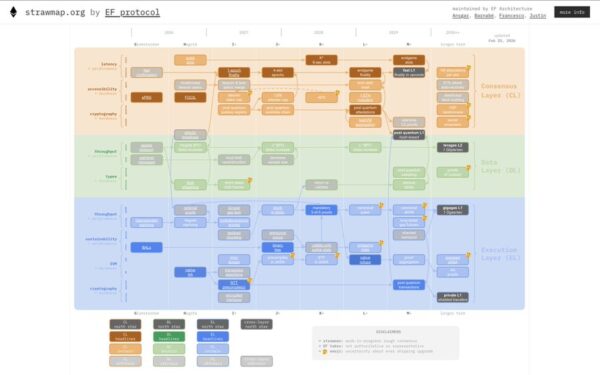
Image Source: Strawmap
Strawmap is not an official roadmap. Ethereum is decentralized, with many different voices involved. No single plan reflects everyone’s opinion. Even within the Ethereum Foundation’s protocol team, views can differ.
The term “Strawmap” combines “strawman” and “roadmap.” Strawman label signals a work in progress. Justin stressed that the document sketches one coherent path among many possible outcomes. It does not predict future decisions.
Updates are expected every 3 months as research and governance decisions advance. Faster development methods, including AI tools and formal verification, could shorten timelines. For now, the plan assumes traditional, human-led development.
In simple terms, Strawmap gives a long-term outline for Ethereum’s base layer. From here, community discussions will focus on how to balance scaling, privacy, security, and decentralization over the coming years.
Disclaimer: The information on this page may come from third parties and does not represent the views or opinions of Gate. The content displayed on this page is for reference only and does not constitute any financial, investment, or legal advice. Gate does not guarantee the accuracy or completeness of the information and shall not be liable for any losses arising from the use of this information. Virtual asset investments carry high risks and are subject to significant price volatility. You may lose all of your invested principal. Please fully understand the relevant risks and make prudent decisions based on your own financial situation and risk tolerance. For details, please refer to
Disclaimer.
Related Articles
Quantum computing impacts the security of encrypted wallets? Research suggests post-quantum cryptography may force trading platforms to rebuild wallet systems
With the development of quantum computing technology, blockchain security faces challenges. Currently, mainstream layered deterministic wallets may become ineffective in post-quantum cryptography, forcing custodial institutions to reconstruct their security models. Researchers have proposed new wallet architecture prototypes to adapt to the post-quantum environment, maintain private key security, and generate new public keys to ensure system stability.
GateNews13m ago
Whale Deposits $7.75M USDC to HyperLiquid, Opens 2x Leveraged ETH Long Position
Gate News bot message, a whale has deposited $7.75 million USDC into HyperLiquid and opened an ETH long position with 2x leverage. According to the report, this whale has previously generated over $11.8 million in profits across multiple positions.
GateNews23m ago
The story of Ethereum is being rewritten: when will the next revolution come as L1 zkEVM becomes final?
Written by: imToken
From a purely intuitive perspective, since 2025, the update frequency of the Ethereum core developer community has been exceptionally intense.
From the Fusaka upgrade, to Glamsterdam, and to long-term plans over the next three years focusing on kEVM, quantum-resistant cryptography, Gas Limit, and other topics, Ethereum has released multiple roadmap documents covering three to five years in just a few months.
This pace itself is a signal.
If you carefully read the latest roadmap, you'll find a clearer and more aggressive direction emerging: Ethereum is transforming itself into a verifiable computer, and the ultimate goal of this path is L1 zkEVM.
1. The Three Shifts in Ethereum Narrative Focus
On February 26, Ethereum Foundation researcher Justin Drake posted on social media, stating,
PANews24m ago
Last week, Ethereum spot ETF saw a net inflow of $23.56 million, with BlackRock's ETHA experiencing a weekly net inflow of $133 million.
According to Gate News, as of March 6th, Ethereum spot ETFs saw a net inflow of $23.56 million last week, with BlackRock's ETHA performing notably, with a weekly net inflow of $133 million. Grayscale Ethereum Mini Trust had a weekly net inflow of $84.18 million, while Fidelity's FETH experienced a net outflow of $218 million. Currently, the total net asset value of Ethereum spot ETFs is $11.28 billion.
GateNews1h ago
Trader pension-usdt.eth 3x long 1,000 BTC, 10 consecutive profits since March 1
Gate News Report, March 9th: According to Lookonchain monitoring, trader pension-usdt.eth opened a 3x leveraged long position on 1,000 BTC, worth $67.26 million, two hours ago. Currently, this trade has an unrealized profit of $970,000. Data shows that this trader has made 10 consecutive profitable trades since March 1st, with no losses, accumulating a total profit of $27.22 million, and a win rate of 85%.
GateNews1h ago
ETH Zurich Practical Test of AI Agent Blockchain Consensus Ability: Success Rate Only 41.6%
The ETH Zurich research team tested the Byzantine consensus capability of LLM Agents and found that even without malicious nodes, the effective consensus rate was only 41.6%. As the number of nodes increases, reaching agreement becomes more difficult, and the situation worsens further with the addition of malicious nodes. The study concludes that current LLM Agents are not yet reliable for secure consensus, and decentralized deployment should be approached with caution.
GateNews2h ago


