
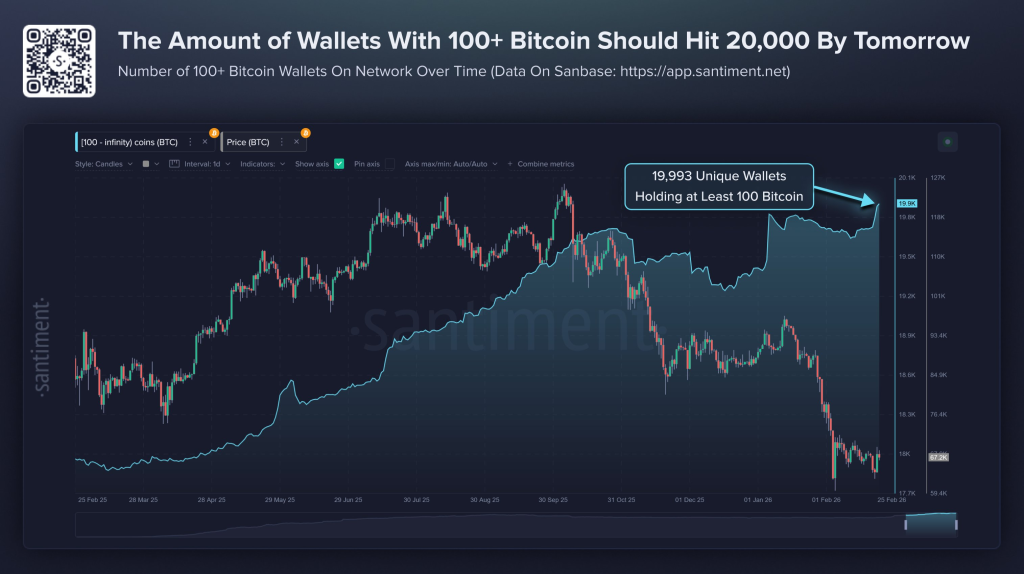
The Bitcoin price has been under pressure in recent weeks, with price drifting lower toward mid-60s range and sentiment turning bearish over and over again. Yet beneath the surface, a key on-chain metric is moving in the opposite direction. Blockchain analytics firm Santiment showed that the number of wallets holding at least 100 BTC is about to surpass a major milestone: 20,000 addresses.
Historically, changes in large wallet behavior have often preceded major trend changes. The question now is whether this latest surge in “whale” wallets marks the early stages of accumulation, or something more complex.
Whale Wallets Rising During BTC Price Weakness
Santiment’s chart shows the steady rise in wallets holding 100 or more BTC, even as Bitcoin’s price has been pulling back. At current levels, 100 BTC represents roughly $6–7 million, meaning these wallets are typically controlled by high-net-worth individuals, funds, long-term holders, or institutions.
The key detail is timing. The wallet count has been climbing during or shortly after price declines. Historically, that pattern has appeared during accumulation phases. When large entities increase exposure while price is weak, it often shows confidence in long-term value rather than short-term speculation.
Source: X/@santimentfeed
However, Santiment also points out an important nuance: while the number of 100+ BTC wallets is increasing, the overall percentage of supply held by top stakeholders has not surged dramatically. In other words, this is not simply a few mega-entities absorbing everything. Instead, it appears that more separate entities are reaching “whale” status.
That distinction is important. It implies distribution across a broader set of large holders rather than extreme consolidation at the very top.
Accumulation, But Not Decentralization
There is a dual narrative in this data. On one hand, the growth in 100+ BTC wallets indicates accumulation. Retail participants tend to sell into fear or during choppy markets, and historically those coins often flow toward stronger hands. Rising whale counts during downturns have frequently aligned with longer-term recovery phases.
On the other hand, this does not necessarily signal decentralization at the smallest levels. If wealth is migrating from smaller wallets to larger ones, concentration is still occurring, just in a slightly more distributed manner among whales.
Santiment frames this as a structural shift rather than an immediate price trigger. For this signal to become more powerful, growth in the number of large wallets would ideally be matched by a clear rise in total supply held by them. That would confirm deeper conviction rather than incremental redistribution.
For now, the takeaway is straightforward: despite recent volatility, large Bitcoin holders are not disappearing. They are growing in number. And historically, when that trend persists during price weakness, it has often laid the groundwork for the next recovery phase.
Will this turns into a major bullish catalyst? Well, it depends on what happens next, but the on-chain data is flashing a signal worth watching.
Read also: TAO vs. Other AI Cryptos: Why Bittensor Is Different (And Why It Could Be the Bitcoin of AI)
Disclaimer: The information on this page may come from third parties and does not represent the views or opinions of Gate. The content displayed on this page is for reference only and does not constitute any financial, investment, or legal advice. Gate does not guarantee the accuracy or completeness of the information and shall not be liable for any losses arising from the use of this information. Virtual asset investments carry high risks and are subject to significant price volatility. You may lose all of your invested principal. Please fully understand the relevant risks and make prudent decisions based on your own financial situation and risk tolerance. For details, please refer to
Disclaimer.
Related Articles
The US-Israel conflict pushes up oil prices, and Bitcoin remains stable due to resistance in the US market
Despite the rise in oil prices to $100 per barrel due to the US-Israel-Iran conflict, Bitcoin remains stable around $67,000, which is related to its close correlation with the US stock market. The US has low dependence on Middle Eastern oil, and the stock market's resilient performance has accordingly supported Bitcoin's price stability.
GateNews4m ago
BTC breaks $68,000, up 1.16% in the last 24 hours
Gate News Report, March 9th, according to Gate market data, the BTC/USDT trading pair is currently quoted at $68,004.1, successfully breaking through the $68,000 threshold, with a 24-hour increase of 1.16%.
GateNews6m ago
Oil price shocks sweep the globe, but Bitcoin remains steady at $67,000: Wall Street correlation becomes a key variable
The Middle East geopolitical conflict has led to a rise in international oil prices, while Bitcoin prices remain relatively stable, staying around $67,000. The US stock market has shown resilience, with increased correlation to Bitcoin, while Asian markets are more affected. As institutional funds enter the crypto market, Bitcoin is increasingly viewed as a risk asset. Additionally, although the US has a high level of energy independence, rising oil prices may still impact inflation through consumer spending.
GateNews6m ago
Research indicates that the transition to post-quantum cryptography could render encryption exchange wallet architectures ineffective
Project Eleven's latest research indicates that under post-quantum cryptography, the current address generation methods used by encrypted exchanges may become invalid. The study shows that systems relying on hierarchical deterministic wallets cannot operate under the new standards, and exchanges will be unable to generate new addresses from public keys.
GateNews9m ago
Quantum computing impacts the security of encrypted wallets? Research suggests post-quantum cryptography may force trading platforms to rebuild wallet systems
With the development of quantum computing technology, blockchain security faces challenges. Currently, mainstream layered deterministic wallets may become ineffective in post-quantum cryptography, forcing custodial institutions to reconstruct their security models. Researchers have proposed new wallet architecture prototypes to adapt to the post-quantum environment, maintain private key security, and generate new public keys to ensure system stability.
GateNews14m ago
Oscar-Nominated Actor Says Bitcoin Is Going to Die - U.Today
Terrence Howard recently stated on the PDB podcast that he believes Bitcoin is doomed, criticizing its reliance on fiat currency and its volatility. His comments drew mockery from the crypto community, highlighting his controversial understanding of both Bitcoin and mathematical concepts. He joins other Hollywood figures in voicing skepticism about cryptocurrencies.
UToday17m ago


