


OCC Expands Trust Bank Services, Ripple Opens U.S. Banking System Channel

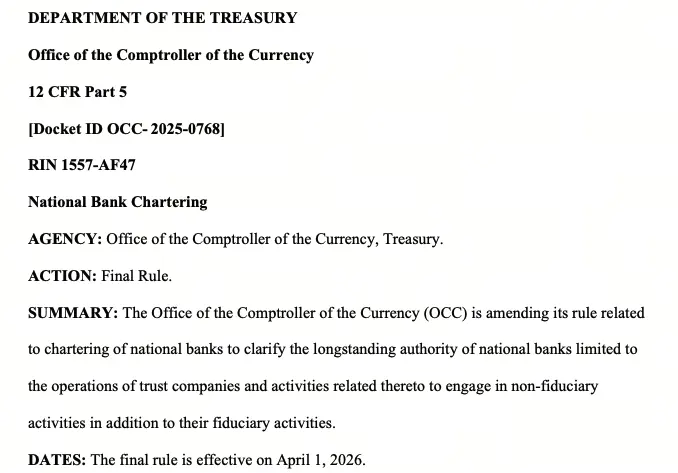
The Office of the Comptroller of the Currency (OCC) announced revisions to regulations related to national bank charters, officially permitting national trust banks to engage in non-trust activities while performing trust duties, thereby eliminating previous industry concerns about the compliance of such activities. For Ripple, Circle, and other companies that have conditionally received national trust bank licenses, this regulation opens a crucial pathway into the U.S. banking system.
OCC Revises Trust Bank Regulations: Key Policy Insights
 (Source: OCC)
The final OCC regulation confirms that national trust banks can conduct ancillary banking activities beyond solely trust services. Previously, there was industry concern: whether companies holding trust charters had the authority to engage in broader banking operations. The OCC’s final ruling explicitly answers this question — yes, they can.
Major crypto companies with conditional OCC trust bank licenses
Ripple: Expanding crypto asset custody services; recently partnered with Figment to extend custody to staking services on Ethereum and Solana.
Circle: USDC stablecoin issuer; leveraging this to strengthen its business presence within the U.S. banking compliance framework.
Paxos: Deepening its involvement in blockchain settlement; expanding institutional services through bank system integration.
This is a significant policy victory for the cryptocurrency industry, which has actively advocated for the finalization of these rules. Such integration further accelerates the convergence of cryptocurrencies and traditional finance (TradFi).
Federal Reserve’s Simplified Master Account Program: The Next Step for Crypto Access to Payment Systems
In addition to OCC policies, the Federal Reserve is advancing a “Simplified Master Account” plan, which, if implemented, would allow companies like Ripple and Circle limited access to the Fed’s payment system. Fed Governor Chris Waller proposed this plan, with plans to announce related regulations in Q4 of this year.
However, this plan faces clear resistance. The crypto industry and banking sector are at odds; banks believe crypto companies should not have direct access to the Fed’s payment system, and the Colorado Bankers Association has warned that such accounts could facilitate rapid fraud.
Fed Governor Michelle Bowman stated during a Senate Banking Committee hearing that the Fed is working with other banking regulators to develop regulations covering capital and liquidity requirements for stablecoin issuers (including those mandated by the GENIUS Act), clarifying which digital asset activities are permitted, and is open to providing regulatory feedback on new use cases. The regulatory framework for crypto companies entering the U.S. banking system is gradually taking shape, though final rules will take time to implement.
Frequently Asked Questions
Q: What does the OCC new regulation mean for Ripple?
A: The OCC allows national trust banks to engage in non-trust activities (including non-trust custody services), enabling Ripple, which has received conditional approval, to hold and manage customer crypto assets within a compliant framework without traditional fiduciary responsibilities. This provides a clear legal basis for Ripple’s entry into the U.S. banking system and expansion of institutional custody services.
Q: Besides Ripple, which other crypto companies benefit from the OCC new regulation?
A: Circle, Paxos, and Crypto.com have also received conditional approval for OCC national trust bank licenses, benefiting from this regulatory revision alongside Ripple, marking the first tier of crypto firms integrating into the regulated U.S. banking system.
Q: How are the Fed’s Simplified Master Account plan and the OCC regulation related?
A: Both are complementary pathways for crypto companies to access the U.S. financial system. The OCC regulation addresses the scope of trust bank activities; the Fed’s plan further allows these companies to directly connect to the payment system, though it faces greater resistance from the banking industry and is still under development.
Related Articles
Kyber Network surges 23%, as the cross-chain DEX upgrade triggers a surge in trading volume
Gate Fun launches community bullet screen feature to enhance user interaction experience
European Banking Union advances euro stablecoin plan, with giants like ING and UniCredit aiming for launch in 2026
Chainlink (LINK) Key Price Range Exposure: $8 Becomes the Bull-Bear Threshold, Breakthrough May Signal $10