While bitcoin has been idling well beneath the $70,000 threshold, onchain metrics reveal that long-dormant wallets established between 2010 and 2017 have stirred to life in February, shifting 1,908.21 BTC value at just over $125 million through 69 separate transactions.
Early Bitcoin Spending Activity Moderates Amid Lower Price Range
This year, bitcoin prices have fallen short of their 2025 form, when BTC commanded valuations north of the $100,000 mark. This development has tempered the pace of older UTXO spending, with data scraped from btcparser.com indicating that roughly 1,908.21 BTC from dormant wallets established between 2010 and 2017 changed hands this month.
Just two 2010-era spends were detected (1, 2), as a pair of block rewards were moved this month—one on Feb. 5 and the other on Feb. 10. Wallets established in 2011 registered only four movements, with 143.80 BTC shifting across those transactions. The most active cohort this month stemmed from 2014-vintage addresses, where 13 separate transfers accounted for 626.96 BTC in motion.
Meanwhile, a tranche of 506.74 BTC from 2016 marked the second-largest yearly total for February, while 341.01 BTC from 2013 circulated through 17 distinct transfers. Data from checkonchain.com indicates that wallets established before 2012 collectively shifted 4,086.02 BTC.
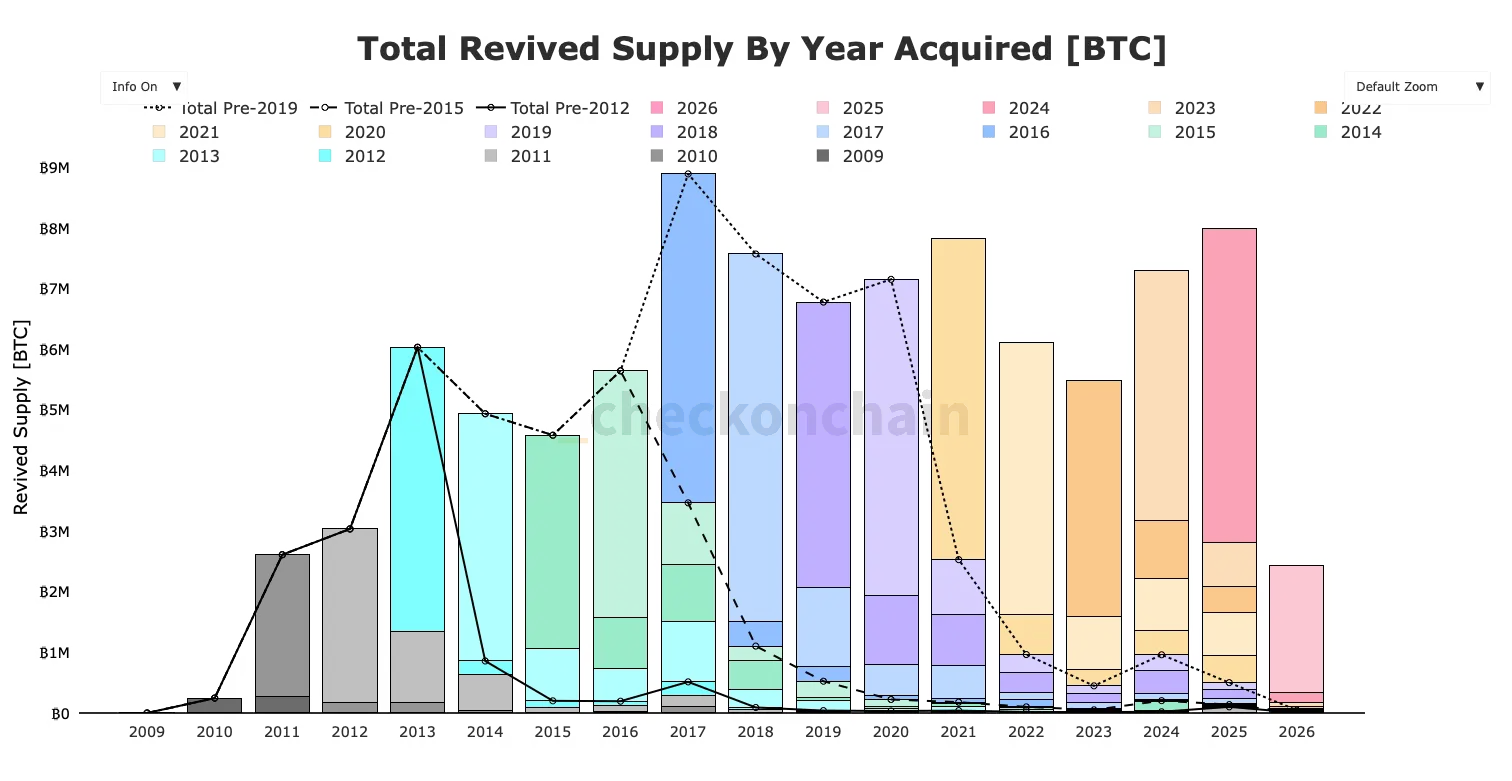 Source: checkonchain.com
That figure amounts to roughly 4.02% of the 101,539 BTC from pre-2012 wallets that changed hands in 2025. As for pre-2015 holdings, approximately 8,416.45 BTC have reawakened so far in 2026, accounting for 6.06% of the 138,809 pre-2015 coins shifted throughout 2025.
Source: checkonchain.com
That figure amounts to roughly 4.02% of the 101,539 BTC from pre-2012 wallets that changed hands in 2025. As for pre-2015 holdings, approximately 8,416.45 BTC have reawakened so far in 2026, accounting for 6.06% of the 138,809 pre-2015 coins shifted throughout 2025.
Expanding the lens to include pre-2019 wallets reactivated this year brings the cumulative total to 46,264 BTC moved so far in 2026. This implies that of the 46,264 BTC relocated, 37,847.55 originated from wallets established between 2016 and 2019. The pre-2019 cohort accounts for roughly 9.24% of the 500,841 BTC moved from addresses created during those years in 2025.
The numbers indicate that while ancient coins are certainly awakening, the magnitude remains fairly contained — at least for now — when measured against last year’s totals. Despite February’s brief flashes of movement, the reactivation rate still lags behind 2025’s tempo across nearly every vintage cohort, though it’s worth recalling that BTC prices stood considerably higher a year ago.
FAQ 🔎
- How much dormant bitcoin moved in February 2026?
A total of 1,908.21 BTC from wallets created between 2010 and 2017 shifted across 69 transactions in February 2026.
- Which year saw the most old-wallet activity?
Addresses created in 2014 recorded the largest movement, with 626.96 BTC transferred through 13 distinct transactions.
- How does 2026 dormant activity compare to 2025?
Pre-2012 wallets have moved about 4.02% of the 101,539 BTC spent in 2025, indicating a slower pace this year.
- What is the total amount of pre-2019 bitcoin moved in 2026 so far?
Roughly 46,264 BTC from wallets established before 2019 have been relocated in 2026 to date.
Disclaimer: The information on this page may come from third parties and does not represent the views or opinions of Gate. The content displayed on this page is for reference only and does not constitute any financial, investment, or legal advice. Gate does not guarantee the accuracy or completeness of the information and shall not be liable for any losses arising from the use of this information. Virtual asset investments carry high risks and are subject to significant price volatility. You may lose all of your invested principal. Please fully understand the relevant risks and make prudent decisions based on your own financial situation and risk tolerance. For details, please refer to
Disclaimer.
Related Articles
BTC Markets targets 16 trillion RWA Bitcoin, applies for Australian tokenized market license
Australian cryptocurrency exchange BTC Markets is applying for a market license to offer regulated tokenized real-world asset (RWA) trading. The exchange aims to transform into a tokenized market operator and predicts that the global tokenization market could reach $16 trillion by 2030. Dobbins pointed out that Australia could generate approximately $16.8 billion in economic benefits annually through the tokenization market and plans to promote tokenization applications in private markets and infrastructure investments.
MarketWhisper5m ago
Analyst Warning: If Bitcoin enters a cyclical correction, XRP price may drop to $0.70
Cryptocurrency market fluctuations have attracted attention. Analysts point out that if Bitcoin enters a correction, XRP may face a pullback risk, with a target price of around $0.70. Bitcoin's four-year cycle characteristics indicate that correction periods could impact altcoin performance. If XRP's price falls below the $1.20 support level, the market could see further downside. Meanwhile, XRP's application in cross-border payments may reduce its dependence on Bitcoin. Investors should monitor Bitcoin's cycle changes and technical support levels.
GateNews10m ago
The US-Israel conflict pushes up oil prices, and Bitcoin remains stable due to resistance in the US market
Despite the rise in oil prices to $100 per barrel due to the US-Israel-Iran conflict, Bitcoin remains stable around $67,000, which is related to its close correlation with the US stock market. The US has low dependence on Middle Eastern oil, and the stock market's resilient performance has accordingly supported Bitcoin's price stability.
GateNews21m ago
BTC breaks $68,000, up 1.16% in the last 24 hours
Gate News Report, March 9th, according to Gate market data, the BTC/USDT trading pair is currently quoted at $68,004.1, successfully breaking through the $68,000 threshold, with a 24-hour increase of 1.16%.
GateNews23m ago
Oil price shocks sweep the globe, but Bitcoin remains steady at $67,000: Wall Street correlation becomes a key variable
The Middle East geopolitical conflict has led to a rise in international oil prices, while Bitcoin prices remain relatively stable, staying around $67,000. The US stock market has shown resilience, with increased correlation to Bitcoin, while Asian markets are more affected. As institutional funds enter the crypto market, Bitcoin is increasingly viewed as a risk asset. Additionally, although the US has a high level of energy independence, rising oil prices may still impact inflation through consumer spending.
GateNews23m ago


