
Key Takeaways
-
Vitalik Buterin sold 1,869 ETH (~$3.67 million) in the last 48 hours, picking up pace after recent Aave withdrawals.
-
_During this period, ETH fell 5.7% from $1,988 to $1,875, echoing a prior larger sale where ETH dropped 22.7% ($2,360 → $1,825). _
-
Sales continue funding Ethereum ecosystem projects, privacy tools, and open-source work—Buterin retains over 240,000 ETH; moves use privacy tools like CoW Protocol.
Ethereum co-founder Vitalik Buterin has accelerated his ETH sales in recent days, sparking renewed speculation in the crypto community about potential market impact amid ongoing price weakness.
According to on-chain tracking from Lookonchain (posted February 23, 2026), vitalik.eth sold 1,869 ETH—valued at approximately $3.67 million—over the past two days. During this period, Ethereum’s price declined from $1,988 to $1,875, a drop of 5.7%.
This comes as part of a broader selling pattern in February 2026. Earlier reports indicate Buterin has offloaded thousands of ETH since early February, with cumulative sales exceeding $15–18 million at average prices around $2,000–$2,100 per ETH. For context, a prior batch of 6,958 ETH (worth ~$14.78 million) coincided with a steeper ETH decline from $2,360 to $1,825—a 22.7% fall—highlighting how high-profile movements can amplify volatility in thin markets.
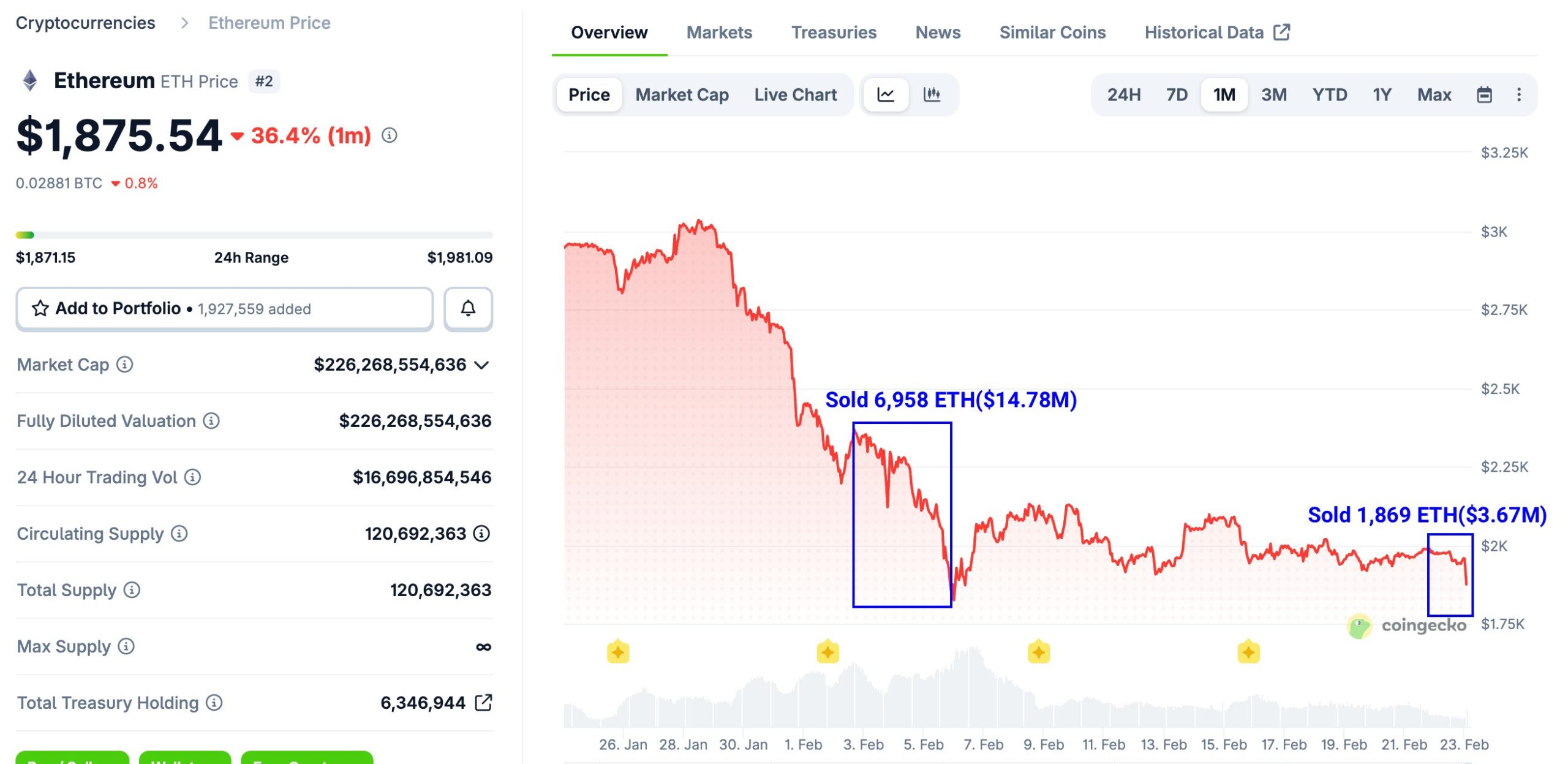
Source: @lookonchain (X)
Recent Activity and Broader Context
The latest acceleration in activity comes after Buterin withdrew 3,500 ETH (approximately $6.95 million) from Aave on February 22. Following the withdrawal, part of those holdings were gradually sold.
Over the past two days alone, he has offloaded 1,869 ETH worth around $3.67 million. During the same period, ETH’s price declined from $1,988 to $1,875, marking a 5.7% drop.
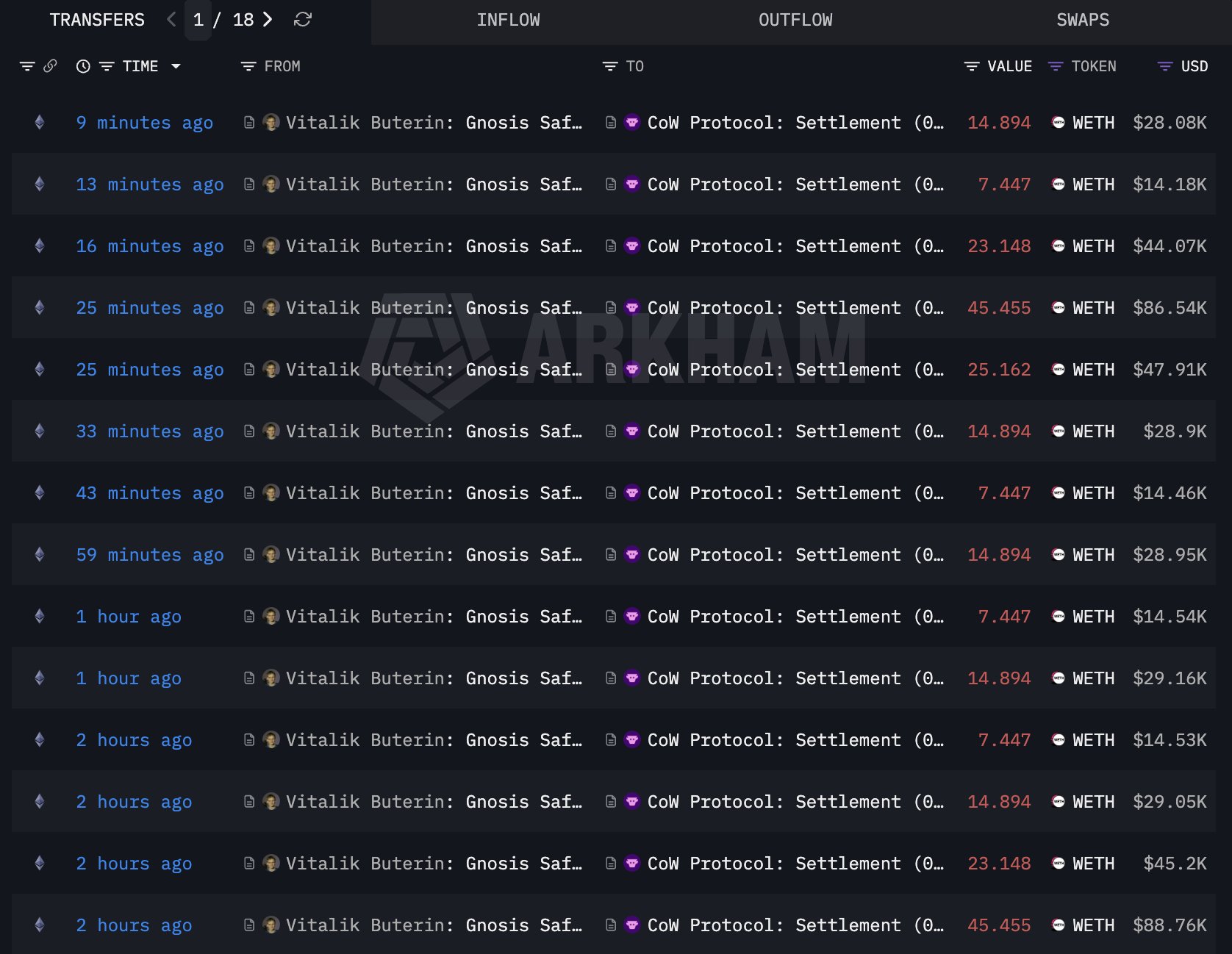
Source: @lookonchain (X)
Notably, some of these transactions were routed through privacy-focused trading platforms such as CoW Protocol, a move that can help reduce immediate market impact and slippage. In addition, portions of the ETH were swapped into stable assets, including GHO — Aave’s overcollateralized stablecoin — and USDC, suggesting a shift toward more defensive positioning amid short-term volatility.
Context on Buterin’s Holdings and Strategy
Buterin’s known ETH balance remains substantial. Recent estimates from Arkham (as of 23 February 2026) place his holdings above 224,000 ETH, currently valued around $418 million.

Source: Arkham
These transactions are typically not interpreted as bearish signals on Ethereum itself. Buterin has consistently framed such sales as strategic liquidity management to support long-term goals, including advancements in zero-knowledge proofs, decentralization, and emerging areas like AI-blockchain intersections. His recent X posts (from February 19–21, 2026) focus on governance innovations, protocol hardening, scaling upgrades (e.g., ePBS, gas repricings), and UX/security improvements—rather than market commentary.
Market Context
As of February 23, 2026, ETH trades near $1,860–$1,875 (with intraday lows around $1,856–$1,862 per snapshots), reflecting broader sentiment challenges including ETF outflows and macro headwinds. While Buterin’s volumes are noteworthy for visibility, they remain a tiny fraction of daily ETH liquidity (billions in USD traded).

Source: Coinmarketcap
These actions fit Buterin’s consistent pattern: strategic liquidity management to fund Ethereum’s long-term development without sudden disruption. While they add short-term sentiment pressure in a downtrending market, they do not indicate diminished confidence in the protocol.
Disclaimer: The views and analysis presented in this article are for informational purposes only and reflect the author’s perspective, not financial advice. Technical patterns and indicators discussed are subject to market volatility and may or may not yield the anticipated results. Investors are advised to exercise caution, conduct independent research, and make decisions aligned with their individual risk tolerance.
About Author: Nilesh Hembade is the Founder and Lead Author of Coinsprobe, with over 5 years of experience in the cryptocurrency and blockchain industry. Since launching Coinsprobe in 2023, he has been providing daily, research-driven insights through in-depth market analysis, on-chain data, and technical research.
Disclaimer: The information on this page may come from third parties and does not represent the views or opinions of Gate. The content displayed on this page is for reference only and does not constitute any financial, investment, or legal advice. Gate does not guarantee the accuracy or completeness of the information and shall not be liable for any losses arising from the use of this information. Virtual asset investments carry high risks and are subject to significant price volatility. You may lose all of your invested principal. Please fully understand the relevant risks and make prudent decisions based on your own financial situation and risk tolerance. For details, please refer to
Disclaimer.
Related Articles
Quantum computing impacts the security of encrypted wallets? Research suggests post-quantum cryptography may force trading platforms to rebuild wallet systems
With the development of quantum computing technology, blockchain security faces challenges. Currently, mainstream layered deterministic wallets may become ineffective in post-quantum cryptography, forcing custodial institutions to reconstruct their security models. Researchers have proposed new wallet architecture prototypes to adapt to the post-quantum environment, maintain private key security, and generate new public keys to ensure system stability.
GateNews31m ago
Whale Deposits $7.75M USDC to HyperLiquid, Opens 2x Leveraged ETH Long Position
Gate News bot message, a whale has deposited $7.75 million USDC into HyperLiquid and opened an ETH long position with 2x leverage. According to the report, this whale has previously generated over $11.8 million in profits across multiple positions.
GateNews41m ago
The story of Ethereum is being rewritten: when will the next revolution come as L1 zkEVM becomes final?
Written by: imToken
From a purely intuitive perspective, since 2025, the update frequency of the Ethereum core developer community has been exceptionally intense.
From the Fusaka upgrade, to Glamsterdam, and to long-term plans over the next three years focusing on kEVM, quantum-resistant cryptography, Gas Limit, and other topics, Ethereum has released multiple roadmap documents covering three to five years in just a few months.
This pace itself is a signal.
If you carefully read the latest roadmap, you'll find a clearer and more aggressive direction emerging: Ethereum is transforming itself into a verifiable computer, and the ultimate goal of this path is L1 zkEVM.
1. The Three Shifts in Ethereum Narrative Focus
On February 26, Ethereum Foundation researcher Justin Drake posted on social media, stating,
PANews41m ago
Last week, Ethereum spot ETF saw a net inflow of $23.56 million, with BlackRock's ETHA experiencing a weekly net inflow of $133 million.
According to Gate News, as of March 6th, Ethereum spot ETFs saw a net inflow of $23.56 million last week, with BlackRock's ETHA performing notably, with a weekly net inflow of $133 million. Grayscale Ethereum Mini Trust had a weekly net inflow of $84.18 million, while Fidelity's FETH experienced a net outflow of $218 million. Currently, the total net asset value of Ethereum spot ETFs is $11.28 billion.
GateNews1h ago
Trader pension-usdt.eth 3x long 1,000 BTC, 10 consecutive profits since March 1
Gate News Report, March 9th: According to Lookonchain monitoring, trader pension-usdt.eth opened a 3x leveraged long position on 1,000 BTC, worth $67.26 million, two hours ago. Currently, this trade has an unrealized profit of $970,000. Data shows that this trader has made 10 consecutive profitable trades since March 1st, with no losses, accumulating a total profit of $27.22 million, and a win rate of 85%.
GateNews1h ago
ETH Zurich Practical Test of AI Agent Blockchain Consensus Ability: Success Rate Only 41.6%
The ETH Zurich research team tested the Byzantine consensus capability of LLM Agents and found that even without malicious nodes, the effective consensus rate was only 41.6%. As the number of nodes increases, reaching agreement becomes more difficult, and the situation worsens further with the addition of malicious nodes. The study concludes that current LLM Agents are not yet reliable for secure consensus, and decentralized deployment should be approached with caution.
GateNews2h ago


