
Japanese Prime Minister Sanae Takaichi publicly stated on the X platform on March 2 that she and her office had no knowledge of the SANAE TOKEN named after her. The post received over 63 million views. After the statement was issued, SANAE meme coin nearly plummeted to $0.0058, a 58% drop. Japan’s Financial Services Agency (FSA) has intervened and found that the issuer lacked the necessary cryptocurrency exchange license.
Event Timeline: The Birth and Collapse of SANAE TOKEN
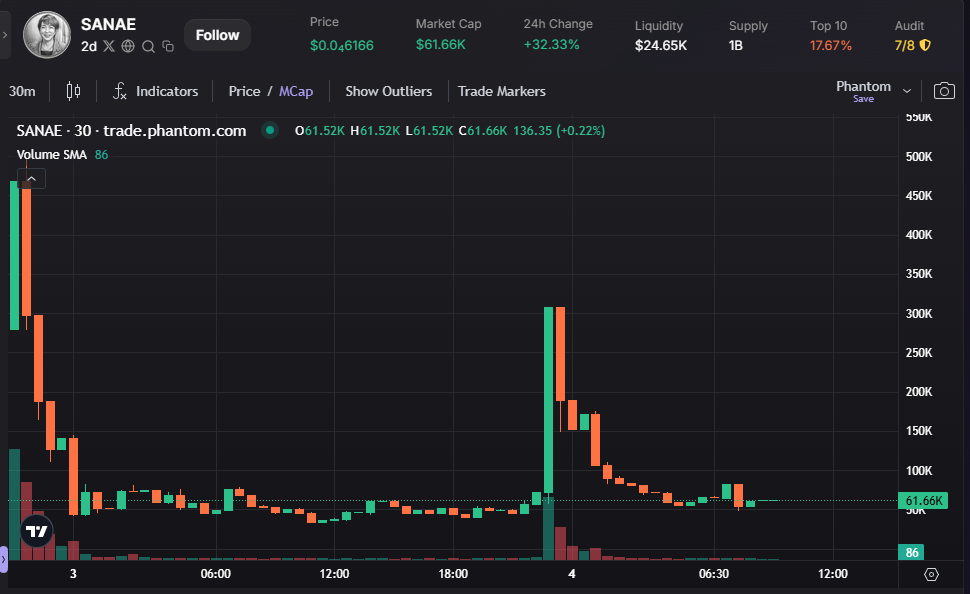 (Source: Phantom)
SANAE TOKEN was issued on February 25, 2025, on Solana by NoBorder DAO, a community led by serial entrepreneur Yuji Murokuchi, as part of the “Japan is Back” project. The project website displayed Prime Minister Sanae Takaichi’s name and illustration portrait. Murokuchi previously claimed on his YouTube show “REAL VALUE” that he had contacted Takaichi’s office, fueling speculation that the token might have official support, prompting some investors to buy in.
Takaichi’s public denial on March 2, 2026, changed the situation entirely. Following her statement, SANAE TOKEN’s market cap plummeted to about $62,000 by March 4, with only $25,000 in liquidity remaining.
The FSA’s investigation revealed deeper issues. The token was designed by a company called “neu,” whose CEO, Ken Matsui, issued a public apology on March 3, stating that all operations were handled by that company. Murokuchi reposted the statement, pledged to cooperate with media investigations, and said he would face the matter with facts rather than emotions.
Key Timeline of the SANAE TOKEN Collapse
- February 25, 2025: SANAE TOKEN launched on Solana, website features Prime Minister’s name and portrait
- March 2, 2026: Takaichi publicly denies involvement; post exceeds 63 million views; token drops 58%
- March 3, 2026: CEO of “neu” Ken Matsui issues public apology; FSA begins investigation
- March 4, 2026: Market cap drops to about $62,000; liquidity remains at $25,000
- Regulatory findings: “neu” was not registered with the FSA as a crypto exchange as of January and had not submitted any application
- Token structure issue: 65% of total supply held by operators
Global Political Meme Coin Crisis: SANAE Just the Latest
Japan’s SANAE TOKEN incident is not isolated but part of a recent wave of global political meme coin scandals. In the U.S., Donald Trump launched the $TRUMP token on Solana in January 2025, with 80% of the supply held by his family and partners, earning over $350 million. In Argentina, Milei promoted the $LIBRA token in February 2025, which reached a market cap of $4.5 billion before crashing 89% within three hours. Insiders reportedly cashed out about $100 million, and Milei is now under fraud investigation and impeachment calls.
Japan’s case may offer regulators a more effective enforcement path. Under Japan’s Payment Services Act, selling or exchanging crypto assets requires registration with the FSA. Violators face up to five years in prison or a fine of 5 million yen, regardless of token type. This means the FSA can act against unlicensed operators without classifying tokens as securities, unlike the U.S. framework that relies on securities designation, providing a model for global regulators.
Frequently Asked Questions
Why did SANAE TOKEN drop 58%?
Prime Minister Sanae Takaichi publicly denied on the X platform that she authorized the issuance of tokens bearing her name and portrait, breaking the public’s expectation of official endorsement and triggering a massive sell-off. The post’s over 63 million views amplified the impact of her denial, causing the token to lose market support almost immediately.
What is the focus of the FSA investigation?
The FSA is investigating whether “neu” operated without the necessary crypto exchange license. Under Japan’s Payment Services Act, selling or exchanging crypto assets requires registration with the FSA. Violators face up to five years in prison or a 5 million yen fine.
What does the SANAE TOKEN incident reveal about global meme coin regulation?
Japan’s approach shows that even without specific laws targeting political meme coins, existing crypto asset trading licensing systems can serve as effective regulatory tools. They can hold unlicensed operators accountable without relying solely on securities classification. This framework offers a valuable reference for other regulators facing similar issues.
Disclaimer: The information on this page may come from third parties and does not represent the views or opinions of Gate. The content displayed on this page is for reference only and does not constitute any financial, investment, or legal advice. Gate does not guarantee the accuracy or completeness of the information and shall not be liable for any losses arising from the use of this information. Virtual asset investments carry high risks and are subject to significant price volatility. You may lose all of your invested principal. Please fully understand the relevant risks and make prudent decisions based on your own financial situation and risk tolerance. For details, please refer to
Disclaimer.
Related Articles
Polkadot to Reset Tokenomics on March 12 With Major DOT Supply and Staking Changes
Polkadot will introduce a new monetary framework on March 12 that sets DOT’s supply cap at 2.1 billion and lowers emissions by 53.6%.
The overhaul will also create a Dynamic Allocation Pool and shorten the DOT unbonding period from 28 days to 24–48 hours.
On March 12, Polkadot will reset
CryptoNewsFlash38m ago
TradFi上涨提醒:VIX上涨超10.5%
Gate News bot message: According to the latest Gate TradFi data, VIX has risen by 10.5% in the short term, with current volatility significantly higher than recent average levels, indicating increased market activity.
GateNews48m ago
Bitcoin Slips to $68,000 as Middle East Conflict and US Jobs Data Trigger Sell-Off
Bitcoin surrendered its $70,000 support level, triggering a broader crypto market retreat that wiped out $329 million in leveraged positions. This downturn was fueled by a perfect storm of geopolitical and macroeconomic pressures.
Wiping out the ‘War Gains’
Bitcoin’s midweek resilience
Coinpedia1h ago
PEPE Hovers at Critical $0.053414 Support as $432M Volume Surge Tightens Breakout Watch
PEPE is trading at $0.053416, just above support at $0.053414, with significant trading volume up 22.14%. Resistance is at $0.053676. Despite a slight decrease in price, there’s increased market activity, suggesting potential volatility.
CryptoNewsLand1h ago
Traditional Finance Alert: XTIUSD Has Increased by Over 16%
Gate News bot message: According to the latest Gate TradFi data, XTIUSD has surged 16% in the short term, with current volatility significantly higher than recent average levels, indicating increased market activity.
GateNews2h ago
BTC drops below 68,000 USDT
Gate News bot message, Gate market display, BTC drops below 68,000 USDT, current price 67,985.2 USDT.
CryptoRadar2h ago


