Author: Vader Research; Source: Medium; Compiler: Shoto San, Translation Association, SeeDAO
What kind of players do you want in your game?
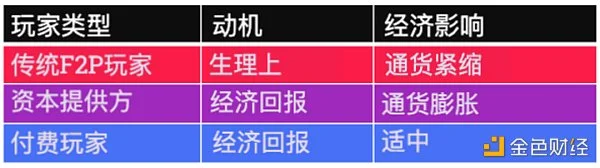
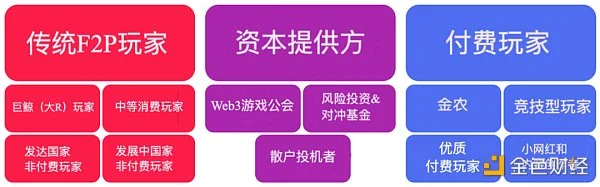 Web3 game allows in-game items to be traded on a permissionless, decentralized marketplace for real money money. This creates opportunities for speculation and money-making for those financially motivated participants, while also enabling game developers to incentivize certain player behaviors through financial rewards. Complex open-ended game economies lead to the emergence of new categories of actors, each with different motivations and behaviors – this article aims to classify these actor roles alongside existing F2P (free-to-play) actor roles.
# F2P Player (Free to play)
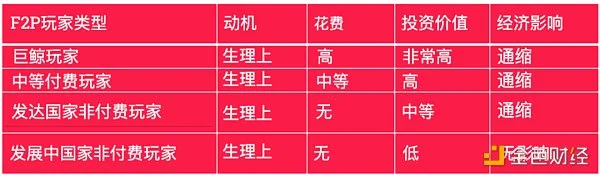 F2P players are traditional video gamers - they play games because they enjoy them, and Not with the expectation of financial reward. Some F2P players are more valuable to game developers than others because they spend more time and energy on in-game microtransactions, or because their attention is more valuable to advertisers.
F2P whale
F2P whales are the crème de la crème - they often spend huge sums of money in the game. Whales like to pay for power, social interaction, and related experiences. Most of the revenue of F2P games may be contributed by these people. Due to their extravagant consumption behavior, advertisers are willing to spend a lot of money to capture their eyeballs and sell various products and services to them. They can spend anywhere from $500 to $100,000 per month.
F2P medium spending players
F2P mid-spending players are the type of gamers that the long-term health of the gaming economy craves. Although they don’t spend as much money as Whale players, they probably spend relatively more time playing games than Whale players and still spend quite a bit of money. That money will likely be spent on battle passes, in-game microtransactions, and cosmetic cosmetics. They can spend anywhere from $5 to $100 per month.
F2P non-paying players from developed countries
This type of F2P non-paying players are players who do not spend money in the game, but are not limited by their disposable income. Their attention is valuable to advertisers, and they may be converted into paying players. The game’s total advertising revenue from non-paying players from developed countries may be $5-20 per month.
F2P non-paying players from developing countries
This type of F2P non-paying players are those who never spend money in the game. Additionally, their eyeballs are not very valuable to advertisers, as the average non-paying player from developing countries is seen as having little disposable income, and the likelihood of converting into a paying player is relatively low. The total advertising revenue generated by the game from the average non-paying player in a developing country might be $1 per month.
In short, the impact most F2P players have on the game economy is net deflationary. Because they are willing to spend more in the game than the game pays them. (If the game pays them anything).
#Capital Provider#
 Let us first clarify a fact. Any for-profit organization exists to make money—an organization has no emotions (and ethics). Founders, executives, and some shareholders may have emotions, but they also have a fiduciary duty to their share/token holders to maximize franchise value. Therefore, they always have to prioritize decisions that maximize profit/value over supporting ethical causes.
A brand may appear to support a moral cause (environment, peace, racial/gender equality, etc.), but in reality, it may be an elaborate PR campaign. Because executives conclude that the financial and social costs spent supporting a particular ethical cause will generate a positive return on investment, leading to higher customer/employee retention and profitability, resulting in higher franchises operating value.
Web3 Game Guild
Web3 Gaming Guilds have financial incentives and are designed to maximize revenue and franchise value through the allocation of funds, time, and labor. Guilds purchase in-game NFTs and lend them to gold farmers to earn income, and in order to gain capital appreciation, invest in early game tokens/NFTs. Although guilds spend as much as F2P whales, unlike F2P whales, they have no physical motivation and may not spend money on cosmetic items, broadband providers, or battle passes unless they can prove their investment can earn them. Positive financial returns.
The reason is simple: an association with VC support and whose tokens have been listed and traded has a fiduciary responsibility to institutional and retail token holders. It needs to maximize revenue and complete the task of completely diluting market value in the long term. Therefore, it cannot waste trust funds purchasing in-game cosmetics for the executive’s personal biological motivations.
A guild that makes millions of dollars in profit from a P2E game may buy items from the game - but this is a public relations strategy to show support for the game and prove that it is not just “hair-raising”. Thereby gaining more investment opportunities in early game tokens or NFTs.
As an exception, there are some guilds that are not value-extractive and have a deflationary impact on the game economy, and that is the zero-sum betting model. For example, Guild A and Guild B each bet $10; the winning guild wins $18, the game developer gets $2, and the losing guild gets nothing. With the help of various token projects, this model has grown in popularity, leading to various guilds investing heavily in their esports teams.
Another exception is that guilds can serve as acquisition channels for deflationary users (translation: players whose in-game consumption is greater than their income). Such guilds have both deflationary characteristics and value extraction properties - similar to Internet celebrities. In this way, the revenue a guild extracts from the game can reasonably be viewed as revenue they import through their own brand and distribution channels. There is an exception, as discussed by Carlos Perreira, where a guild can become a UGC creator/development agency/bootcamp.
Typically, guilds generate less advertising value for the game. Because, while guild owners have high disposable incomes, those who play games and watch ads are members of guild scholars, who tend to have lower disposable incomes and come from developing countries.
Crypto Venture Capital Institutions & Hedge Funds
Crypto venture capital and hedge funds are institutional investors; they have a financial incentive to aim for a higher exit price than entry price. Time horizons and asset preferences may vary; VCs may prefer early-stage private tokens/equities with maturities of 2-3 years, while hedge funds may prefer tradable tokens/NFTs with maturities of 1-180 days . Often, the institutions themselves are not very active in the game. Simply put, these are institutions that provide capital to the market and look for investment opportunities and market imperfections.
Retail Speculator
The economic motivations of retail speculators are similar to those of the institutions mentioned earlier. As part of chat groups, communities/forums, DAOs, retail speculators either act collectively or become lone wolves.
NFT and IDO whitelist hunters are always looking for major investment opportunities in the GameFi field. They conduct extensive research on various projects and spend hours in the Discord channel just to get the whitelist of the first NFT for popular games. .
Ponzi supporters figure out where they can get huge investment returns and happily participate in it; the projects they have invested in may be Axie Infinity, Thetan Arena, OHM, Luna, and STEPN. They seem to know where the profits will come from. While enjoying the excitement and high returns, they are convinced that the market will run and dance.
Ambitious traders bet on various tokens and NFTs, vowing to make a fortune from the price difference between entering and exiting the market.
Although mostly financially motivated, individuals may not be the most rational investors. Because they are already willing to invest large sums of money in risky crypto projects, they may also have a high propensity for gambling. A game with a well-designed economic model can turn economically motivated retail speculators into players who bring deflation to the game economy.
#profit player#
Game Golden Farmer
The financial motivations of gold farmers are pure - they play the game to make money. Their decision-making process for whether to play a certain game is a formula: how much money they can make per hour, how much effort it requires, and what the probability is of making money. If they are guaranteed to earn $5 an hour by opening Didi, but it’s not certain that they can earn $3 an hour by playing Axie – they may choose to open Didi. F2P players will beat the core levels of the game and are willing to put the physical/financial rewards back into the game for the entirety of the playthrough. Gold farmers, on the other hand, are interested in extracting value from the economic model by obtaining financial rewards as quickly as possible in order to cash out.
Institutional gold farmer groups are a bigger problem for the game’s economic system because they are more organized and efficient than individual gold farmers. They might pay fixed wages to child laborers in low-income countries, or deploy sophisticated bots. They will continue to extract value from the game economy until it is no longer profitable.
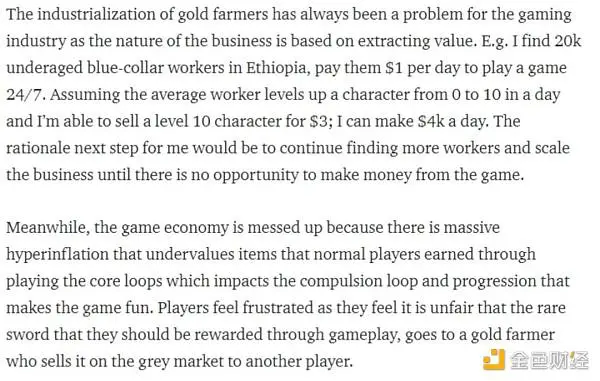 Source: What killed MMO games?
Competitive player
Competitive players are highly skilled and consistently at the top of game leaderboards. They don’t necessarily have a financial motive, nor are they just playing the game to make money. Most of them start out as F2P players, but as they improve their skills and perform well in the game, they move up the rankings and start making money by winning tournaments or being game streamers.
As they begin to build a reputation, these individuals may be poached by esports teams and begin working for them in exchange for a steady paycheck and additional benefits. However, as with any professional sport, the average revenue of such a player will be limited by the size of the audience and consumer behavior willing to attend the event.
NBA and football players make millions of dollars every year because there is a large audience willing to spend hundreds of dollars a month on satellite television to watch them. However, the scale of spending by spectators at a badminton or squash match is different - so professional badminton players earn much less than professional football players.
The same applies to eSports - even though top eSports tournaments may have more viewers than the FIFA World Cup, the average consumption per eSports viewer is much lower than that of a football viewer.
That said, competitive players don’t necessarily have an inflationary impact on the game’s economy, as their presence attracts new players and additional engagement from existing players (either through streaming or playing together). One model that allows competitive players to truly bring deflation to the gaming economy is the zero-sum betting model, in which competitive players are willing to stick to the game and bet based on their gaming skills.
Micro-influencers and content creators
Micro-influencers and content creators represent powerful game distribution channels. Internet celebrities attract and retain players through numerous activities. They build communities whose members are confident and engaged in their leaders. The result is that influencers promote new games/products to their audience, resulting in very high conversion rates. Unlike esports players who earn income primarily from tournaments funded by game developers, influencers typically earn income by advertising new games/products/services. The performance of influencers promoting games is relatively easy to measure, so the market will continue to reward influencers who have a positive (deflationary) impact on the game economy.
Premium paying players
White-collar paying players are a new player type we describe in detail in the article “Nightclubs and Web3 Games.” They are highly social, and their presence increases retention and spending by players who interact with them. That’s why even though they might be paid, their overall impact is deflationary.
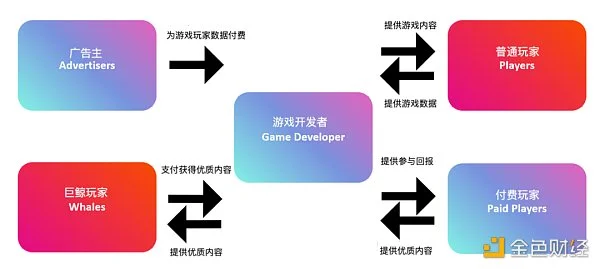
Source: Nightclub and Web3 Games
# in conclusion#
In addition to making a fun game with strong core levels, great art, and balanced rules, the biggest challenge for Web3 games will be to maintain an open economy and optimize the distribution of economic incentives while keeping players/community happy to maximize LTV (user lifetime value).
An open, permissionless economy will inevitably attract financially motivated players who aim to make more by investing less in the game. Web3 game developers should carefully evaluate and consider the type of players their games will play for. Therefore, the game’s economy and rules should be designed to reward or punish certain types of players and behaviors.
- This classification method is based on qualitative analysis, observation and user research. As more behavioral data on and off-chain players or speculators is collected from existing and upcoming Web3 games, we will be able to better understand and classify different player archetypes.
- Deflation means that this player class brings more money into the game economy than it captures. Inflation means that this player class extracts more money from the game’s economy than it brings in.


