Author: wenchuan, PermaDAO
When we look at Layer 2, we think of Ethereum’s Layer 2 such as OP, Arbitrum, and Base, and when we look at Arweave, we think of storage projects such as Filecoin and Storj. When we see everPay, we think it’s just a payment protocol.
And if, we combine them?
everPay is a millisecond-level, 0 gas cross-chain token payment protocol under everVision, which is developed based on the Storage-based Consensus Paradigm (SCP) derived from Arweave, which can achieve real-time transactions, and its TPS can theoretically be infinitely scalable, with transparent, credible, efficient, fast and other characteristics. Transactions are packaged in batches, with millions of transactions costing only $1, and the protocol provides free transfers, no entry requirements, and any developer or merchant can integrate the everPay protocol through APIs.
Many nouns are piled up together, and confusion is inevitable, so we will analyze them individually and break them one by one.
Product & Business Status
As a cross-chain payment protocol, everPay implements the following features:
One-click buy
Buy USDC with fiat currency, which is supported by a third-party Legend Trading, currently supports 7 fiat currencies: USD, EUR, AUD, GBP, CHF, JPY, CAD. Legend Trading is a U.S.-compliant financial institution serving more than 800 institutional clients in more than 150 countries around the world, with a monthly trading volume of more than $1 billion. At the same time, it also provides an underlying fiat currency channel for Alchemy Pay.
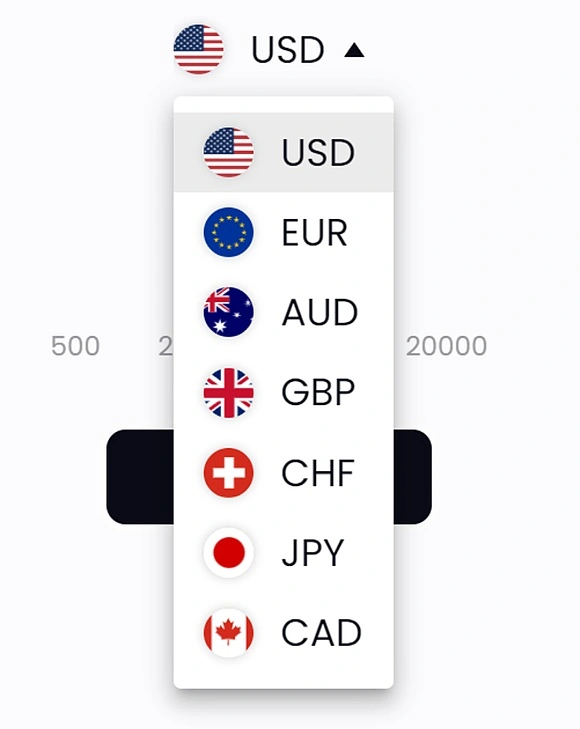
Image source: everPay
Asset Cross-Chain
Support depositing multi-chain assets into everPay and withdrawing from everPay. Currently, Ethereum, Arweave, Moonbeam, Conflux, BSC and PlatON are supported on 6 chains and 29 tokens, and most of the supported tokens are project tokens within the Arweave ecosystem.
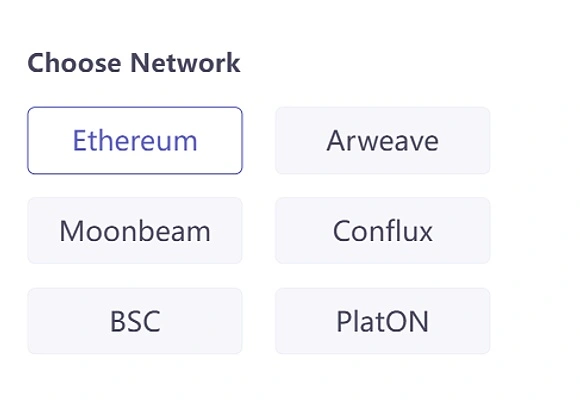
Image source: everPay
As you can see from the table sorted by market capitalization in the chart below, the main assets in everPay are stablecoins, AR, and ETH. **
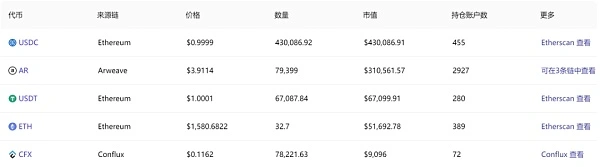
At present, the total lock-up amount of each chain exceeds $1.1 million, and the main lock-up amount comes from Arweave and Ethereum. **

Image source: everScan

Image source: everScan

Image source: everScan
Wallet
Real-time payment, millisecond-level arrival speed, and 0 gas fee provide an on-chain transaction experience close to that of traditional payment products such as Alipay, which are the main features of everPay.
everPay’s current transaction volume has exceeded the 20 million mark, and this is only a month and a half after breaking through 10 million, so you can foresee the potential of everPay.

Image source: everScan
everPay currently has more than 16,000 users, and its account types are divided into three categories: ETH addresses, AR addresses, and email addresses (implemented by EverID), of which **ETH addresses account for 89% and are the main source of users. **
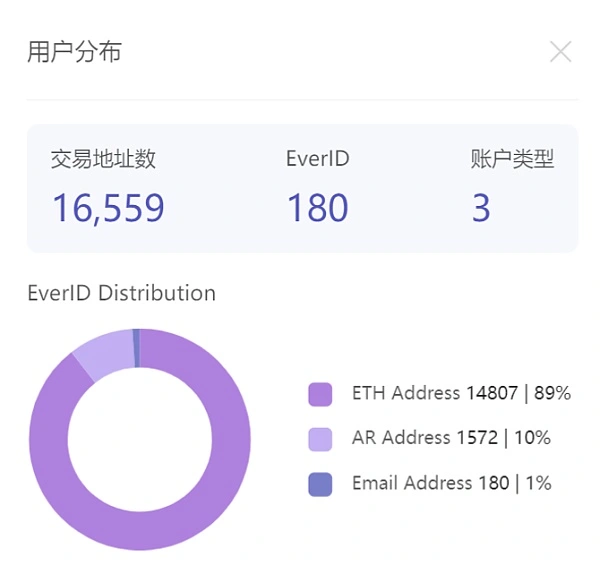
Image source: everScan
Swap
Simple token swaps are supported, and the underlying technology is backed by Permaswap. Permaswap is a chainless DEX, and everPay is a product of everVision.
NFT Auction
Mainly in cooperation with the Arweave ecosystem project party. The proceeds from the auction will be distributed to users, artists, and everPay NFT holders. Holders of everPay NFTs can participate in Permaswap mining.
EverID
EverID is the latest product launched by everPay, which is an identity account system for managing digital assets in the network, which allows users to quickly create everPay asset accounts through Crypto wallet addresses, email addresses and other ways, aiming to lower the threshold for users to enter Web3 and save them from having to spend time managing keys. It is currently in beta.
Protocol Architecture
The everPay protocol mainly revolves around cross-chain, deposit, and withdrawal of assets, and adopts the asset lock-up + minting/destruction model, which corresponds to Mint, Transfer, and Burn in its business logic. For cross-chain verification, it is carried out by the three roles in the protocol: Coordinator, Detector, and Watchmen.
Coordinator: Responsible for the verification and on-chain listing of transactions.
Checker: Automatically downloads and verifies on-chain data, generating global status and balances.
Watchmen: Multisig governance members, generate proposals and sign proposals, and proposals can only be executed if they have been signed by a majority (>51%) of watchmen.
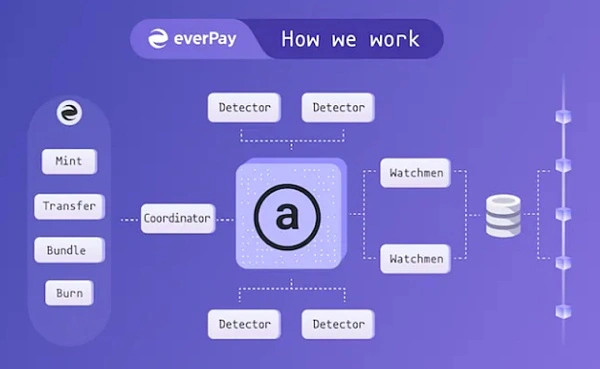
Let’s look at everPay’s asset cross-chain process through two processes: Mint and Burn:
As
To make a payment with everPay, you need to deposit the original chain assets into the everPay protocol. When an Ethereum user wants to deposit ETH into everPay, the user needs to send ETH to everPay’s lock-up address in Ethereum, and then the coordinator will verify whether the user has sent ETH, whether the Ethereum chain has been finally confirmed, and whether the ETH is in the lock-up address mint done.
Burn
The user wants to transfer the assets in everPay back to Ethereum, i.e., withdraw. Users need to confirm that there is enough ETH in everPay first, and the withdrawal transaction needs to be packaged and submitted to the Arweave network in batches, and the watchman will independently verify the transaction and generate a proposal after listening to the withdrawal transaction. When the proposal is signed by more than 51% of the watchers, the lock-up contract on Ethereum will execute the withdrawal transaction, transfer the assets to the user’s Ethereum address, and burn off the assets in the user’s everPay.
In the above two processes, we see the role of the coordinator and the watchman, but what about the detector? In fact, anyone can become a detector by downloading everPay’s off-chain smart contract, and the detector can obtain the final state of everPay, whose data comes from the Arweave network, which cannot be tampered with and traceable.
Security Assumptions
The essence of everPay is a cross-chain payment protocol, involving cross-chain products/protocols, the most concerned issue is security, once attacked, it is easy to lose user assets, so cross-chain is a track with a high ceiling and a low floor.
How does everPay keep you secure?
The security assumption of asset cross-chain is usually 51% attacks and honest nodes, that is, it is assumed that most of the validators in the protocol are honest validators, and if a malicious attacker wants to launch an attack, at least 51% of the validators need to be “bought” in order to pass the consensus vote. In the Burn process above, we can see that everPay’s final multisig also requires at least 51% of the watchman’s signatures. It should be noted that there is a risk of multi-signature in asset management through multi-signature, which is also the biggest disadvantage of most cross-chain projects.
However, for everPay, it has a unique advantage at the consensus level.
Consensus in everPay is guaranteed based on the Storage-based Consensus Paradigm (SCP). SCP is a new blockchain application development paradigm proposed by outprog, the founder of everVision, and its ideas came from Arweave’s SmartWeave and Ethereum’s Rollup. The core idea is that as long as the storage is immutable and the transactions on it are traceable, then the application will be computed regardless of the same result. This means that consensus does not have to be obtained through distributed computation.
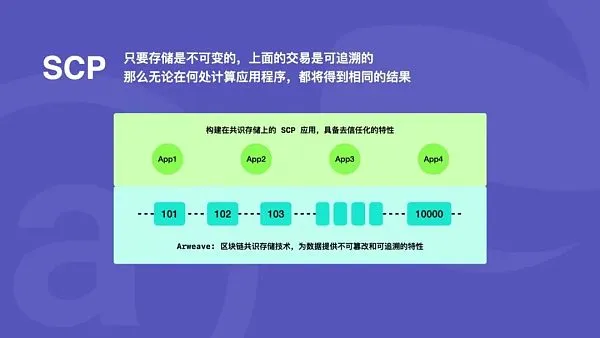
Source: Slides from outprog’s presentation at Arweave Day in Asia 2023
**SCP separates compute and storage, the blockchain only stores data, the computation is performed by the off-chain client/server, and the generated state is also stored by the off-chain client/server. Ethereum compares itself to the “world computer”, while under the SCP paradigm, the storage implemented with Arweave is similar to the “world hard disk”, and all the original transaction data is stored in the Arweave network, which is immutable and traceable. Based on Arweave and SCP, anyone can download the data from everPay and verify it. In other words, the three roles in everPay, Coordinator, Detector, and Watchman, running the same verification component, can all load blockchain data to check the status of transactions. If there is a conflict between the coordinator and the detector’s saved state, there is fraud on one side. The eternal existence of the original data ensures the verification of consensus. Moreover, SCP uses off-chain smart contracts, which are not limited to programming languages, reducing the learning cost for developers.
The logic of off-chain computation is easy to analogy with Ethereum’s Rollup, which is why SCP-based everPay can be considered Arweave’s Layer 2.
Modularity splits the blockchain into a data availability layer, a consensus layer, a settlement layer, and an execution layer, and we can borrow this form to see more clearly what exactly Arweave and SCP have achieved. In contrast to what Celestia and the Sovereign Rollups want to achieve and are already underway, Arweave and SCP are already a step ahead, and developers can dapp development on Arweave and SCP right away.
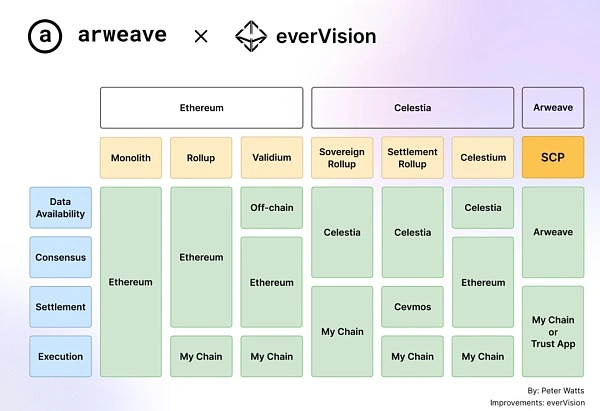
everPay + EverID = ?
Web3 has been waiting for the arrival of mass adoption, and mass adoption is facing billions of Web2 users, who are not as familiar with the underlying logic of a set of blockchains such as public keys, private keys, and mnemonics like Web3 native users. And the first step into Web3: wallet registration, can block most users. Based on this logic, AA (Account Abstraction) is proposed to deprecate EOA accounts and use smart contract accounts for on-chain operations. But the logic behind this is still the same, the smart contract account is still mapped to a blockchain address, compared to EverID, the way to lower the user login threshold is different.
EverID uses the FIDO2 protocol, which is already well established in Web2, and its account stack can integrate with various applications and services and authenticate users by using biometrics (such as fingerprint or facial recognition) or physical security keys. To put it simply, the user’s electronic devices (mobile phones, computers) have a unique chip in them, and the protocol interacts with this chip, and the chip is able to generate a pair of keys, in which the public key can be collected by the protocol, while the private key can only be held/known by the device. Every time a user logs in, the device needs to be “signed with the private key” to confirm that the correct device is logged in through the email/mobile phone number, etc. In this way, users can register an account through email and mobile phone number, and do not need any password, they can easily log in.
In the crypto payment track, the most concerned issues are deposits and withdrawals and fiat currency purchases. As a protocol focusing on real-time payment, I personally believe that everPay should focus on cross-border payment, which is the area with the greatest advantages of crypto payment, without the settlement process of the bank, which greatly improves the efficiency of cross-border transfers.
At present, PermaDAO has realized the distribution of member contribution incentives through everPay, and members are all over the world, but they can receive AR in real time. Along this path, perhaps everPay can explore more DAO payments and become a DAO payment tool; Combined with EverID, a set of on-chain credit systems may be formed, and a group of high-quality Web3 user groups can be accumulated through the contribution records of the DAO and the assets of users, and then integrate Defi projects…
In the last cycle, users were complaining about the lack of performance of various chains, easy downtime, low TPS, and not fast enough transactions. At this point, the infrastructure improvements are significant, but there aren’t enough applications to onboard users. Mass adoption is the expectation of the entire Web3 industry, and without users, everything is empty talk. **When we have a high-quality infrastructure like real-time payment everPay and easy access to EverID, we just need to wait for the application to explode and bring a new landscape. **


