Original author: Day, Vernacular Blockchain
In the previous article, we introduced Bitcoin sidechain and UTXO+ client verification in Bitcoin Layer 2. Today we will introduce the remaining 2, Roullp and Taproot Consensus.
01 Roullp
Roullp was originally a Layer 2 scalability solution on Ethereum, used to improve the performance and throughput of blockchain networks. Roullp migrates most transaction data and calculations to the outside of the chain, and only records summary or aggregated information of transactions on the chain, thereby reducing the burden on the main chain and improving overall performance. The core idea of Roullp is to combine the security of the chain with the efficiency of the chain.
**There are some challenges and limitations in implementing the Rollp solution on Bitcoin. **Bitcoin itself does not support smart contract verification, so the introduction of the Rollp solution on Bitcoin requires other methods of verification, **such as introducing client verification or self-built DA layer. This makes the security of Bitcoin Layer 2 projects highly dependent on client verification or self-built DA layer, rather than Bitcoin’s own security. **
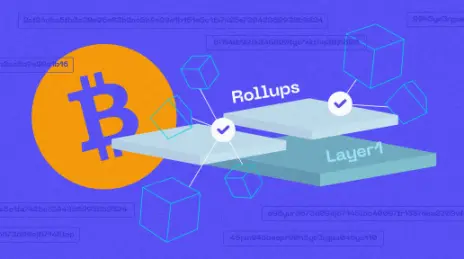
Image source: Internet, please delete if infringed
In addition, the originality of Bitcoin does not match the essence of the Rollp solution**,** because the Rollp solution mainly comes from Ethereum’s second-layer solution and is designed for the characteristics of Ethereum. Bitcoin only plays a role in storage and does not participate in the verification process, so there is a certain difference in originality from the Rollp solution.
**In addition, the Rollp solution also faces challenges in the decentralization of Bitcoin Layer 2. **This involves the decentralization of asset management and second-layer ledgers. Currently, most Ethereum sorter nodes are centralized and run by the Layer 2 project itself, which also makes the Bitcoin Layer 2 project face some problems in terms of decentralization.
Although it is technically feasible to implement the Rolllp solution on Bitcoin, it faces challenges in terms of Bitcoin’s nativeness, decentralization, and security. **The BTC Layer 2 projects currently on the market also have defects and limitations to varying degrees, so the development and widespread adoption of such projects still require further development and verification. **Next, let’s talk about some of the representative projects:

**Merlin Chain is a Bitcoin Layer 2 solution that integrates the ZK Rollup network, decentralized oracles, and on-chain BTC fraud prevention modules. **Merlin Chain aims to improve the efficiency and scalability of Bitcoin transactions and make the Bitcoin ecosystem more active. Merlin Chain uses ZK-Rollup technology to compress a large number of transaction proofs to improve transaction efficiency and scalability.
On Merlin Chain, the sorter node is responsible for collecting and batching transactions and generating compressed transaction data, ZK state roots, and zkEVM proofs. The compressed transaction data and ZK proofs are then uploaded to Taproot on Bitcoin’s Layer 1 through a decentralized Oracle network. Taproot is available to the entire network as a public resource to ensure transparency and security.
Although Merlin Chain has been criticized for its weak technology, from the perspective of ecology, community activity, and implementation level, Merlin Chain is the most popular BTC Layer 2, with the current locked funds exceeding 3.5 billion US dollars.
**B² Network uses zero-knowledge proof and ZK Rollup technology to improve the performance and scalability of the Bitcoin network and is compatible with Ethereum’s smart contract functions. **The solution records transaction data and verification proofs on the Bitcoin mainnet and ensures the correctness of the data through a challenge-response mechanism.
**The architecture of B² Network consists of two main parts: Rollup layer and DA layer. **In the Rollup layer, the user’s transactions and related verification proofs are processed and recorded, and the user’s status is also stored in this layer. Then, these transactions and verification proofs are transferred to the DA layer for storage and verification.
**The DA layer includes decentralized storage, B² nodes, and the Bitcoin network. **At this layer, a copy of the Rollup data is permanently stored and the verification proof is verified. However, since the Bitcoin mainnet itself cannot directly verify the data of the DA layer, **B² Network uses a special method that writes the summary (Commitment) of the verification proof to the Bitcoin mainnet and sets a time-locked challenge, similar to the OP’s fraud proof. **
A major problem with B² Network is that the Bitcoin mainnet cannot directly verify the data of the DA layer, so a challenge-response mechanism is needed to solve this problem, which may affect the decentralized nature and security of the system.
B² Network recently launched the B² Hub, which will provide services for other ZK Rollups and provide data availability layer (DA) functions. In addition, it has strategically cooperated with Babylon to realize the Restaking and LSD functions of BTC Layer 2.

**Bison is a native ZK Rollup solution based on Bitcoin, designed to increase transaction speed and enable advanced features on the Bitcoin network. **Developers can use ZK Rollup to build innovative DeFi solutions such as DEX/CEX, lending services, and automated market makers. Unlike the Ethereum Virtual Machine (EVM) used by other Layer 2 solutions, **Bison uses Cario VM (the same as StarkNet) and builds its ecosystem mainly around inscriptions. **
**In terms of technical solutions, Bison is essentially still a sovereign Rollup, which is verified through its own nodes. **The DA (Dispute Assistant) only saves and publicizes the verification results in the form of inscriptions to the Bitcoin main network, and cannot fully inherit the value of Bitcoin.
Whether Bison can develop in the future is closely related to whether the inscription ecosystem can rise again.
02 Taproot Consensus
Taproot Consensus is a Layer 2 solution based on Bitcoin native technology. It includes three core components: Schnorr Signature, MAST Contract and SPV Node Network.
**Schnorr Signature is a highly efficient Bitcoin signature algorithm with better privacy protection. **Schnorr Signature can expand the number of Bitcoin multi-signature addresses to 1,000, thereby achieving decentralization of multi-signature addresses.
MAST Contract provides coded multi-signature management, which does not rely on human signatures but is driven by code.
**The SPV Node Network consists of Bitcoin light nodes, allowing users to conveniently and securely verify Bitcoin payments without saving the full blockchain data. **
Taproot Consensus relies on Bitcoin light node network consensus to drive multi-signatures, achieving decentralized Bitcoin cross-chain and management.
After looking up some information, I found that Taproot Consensus should be considered a new second-layer track created by the BEVM project itself, so they are the only representative project.
- Representative project: BEVM

**BEVM is a Bitcoin Layer 2 that uses BTC as Gas and is compatible with EVM. Its goal is to improve Bitcoin’s scalability, reduce transaction fees, and foster a more secure and decentralized financial ecosystem. **
The core design of BEVM is based on BTC’s Taproot upgrade in 2021, and uses the Musig 2 aggregate signature algorithm to achieve decentralized BTC cross-chain. The Musig 2 aggregate signature algorithm is brought by the Taproot upgrade, which allows 1,000 Bitcoin light node addresses to form a decentralized asset network. Through this network, the transfer of BTC assets is processed, thereby ensuring the security of assets on BTC Layer 2; **BEVM is fully compatible with EVM, and applications such as DeFi and GameFi that can run on the EVM ecosystem can be seamlessly migrated to Bitcoin Layer 2, and users can directly use BEVM ecosystem applications in mainstream crypto wallets (such as Metamask, OK Wallet, etc.). **
At the end of last month, BEVM completed a financing of tens of millions of US dollars, with a post-investment valuation of 200 million yuan. Recently, BEVM and BN Wallet have cooperated to launch a cooperative activity.
03 Summary
The above is the progress of the mainstream projects of Bitcoin Layer 2. Looking at the overall situation, we can actually find that **the development of Layer 2 is very similar to that of Ethereum Layer 2. Both are solving the same problem, introducing smart contracts based on the native nature of Bitcoin (security is linked to Bitcoin) and decentralization. **In order to achieve the goal, certain compromises will be made in some aspects.
There is another problem, that is, the projects supported by domestic and foreign institutions are different. The two sides do not support each other and are each playing their own game. Relatively speaking, they are quite fragmented.
Original link


