Author: Prem Reginald
Translation: Plain Language Blockchain
Inspired by Donald Trump’s victory in the presidential election, the Cryptocurrency market in 2024 presents a vertical rise trend. As a platform for decentralized applications (dApps) and Smart Contracts, the demand for L1 solutions has risen significantly, and major L1 blockchains are fiercely competing for the top position. However, they face strong challenges from Layer 2 (L2) solutions, which are committed to significantly lowering transaction costs and competing with mature blockchains such as Ethereum in terms of transaction speed.
1. Which Layer 1 tokens perform the best?
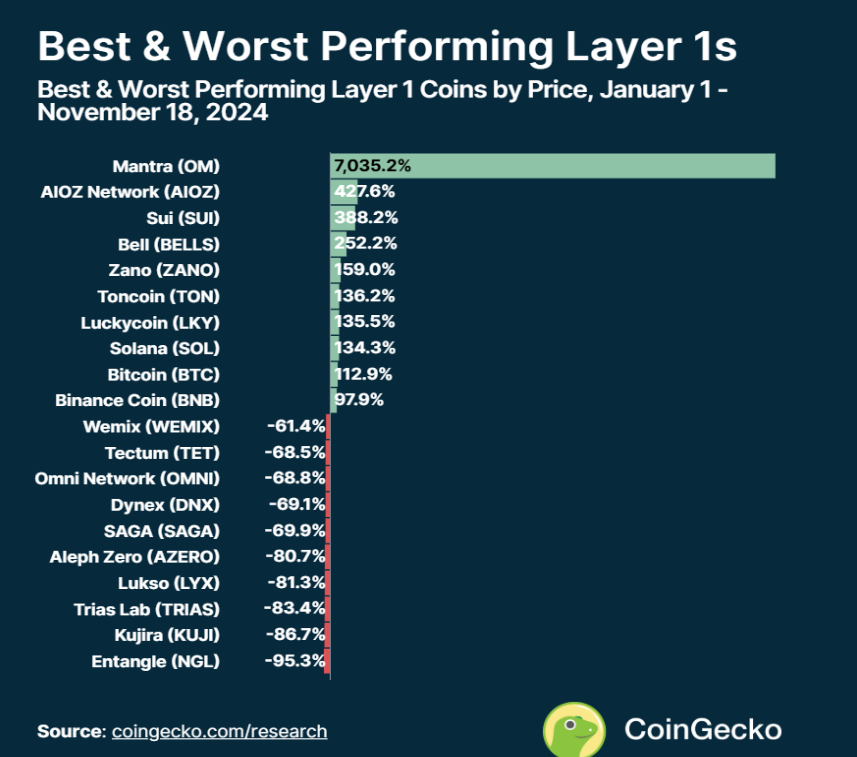
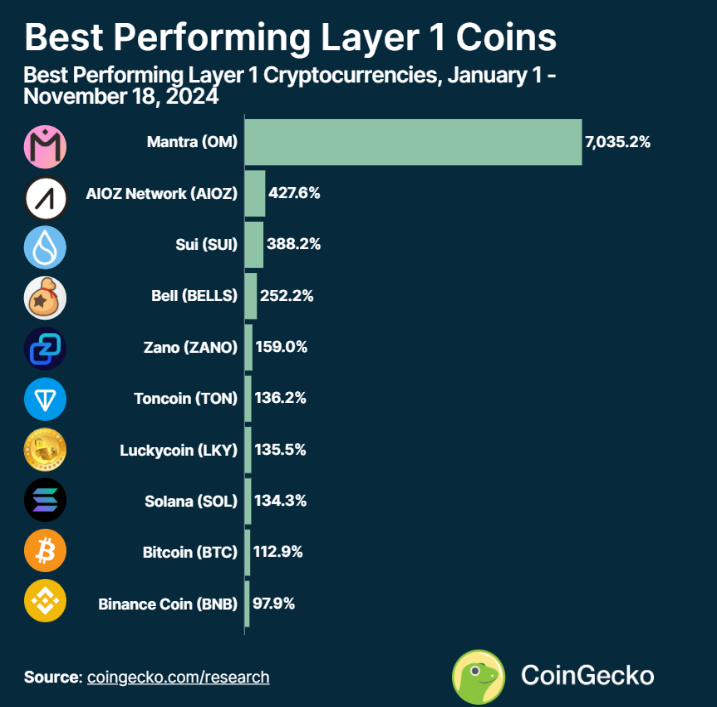
In the top-performing Token, Mantra (OM) has achieved an unprecedented rise, with a value surge of 7,035.2%. This surge is partly due to Mantra’s collaboration with Digital BankZand, based in the United Arab Emirates. By complying with the regulations of the Dubai Virtual Asset Regulatory Authority (VARA), Zand has tokenized Real World Assets (RWA). In addition, there is a continuous rise in demand for RWA products, and traditional Financial Institutions are also introducing money market funds and bonds to the blockchain.
2. Other Outstanding Tokens
AIOZ Network (AIOZ) is another standout player that has risen 427.6% YTD. The platform’s Decentralization content distribution network has gained increasing adoption due to ongoing ecosystem optimization. Sui (SUI) also ranks in the top three with a YTD rise of 388.2%, benefiting from the rapid development within its ecosystem, including the launch of innovative dApps that leverage its high scalability and developer-friendly features.
Other performers worth following include:
Bellscoin (BELLS): rise252.2%
Zano (ZANO): rise159%
Toncoin (TON): rise136.2%, successfully hosting dApps through integration with Telegram and launching a ‘click to earn’ game.
3. The price increase of the top ten Layer 1 Tokens by Market Cap is relatively moderate
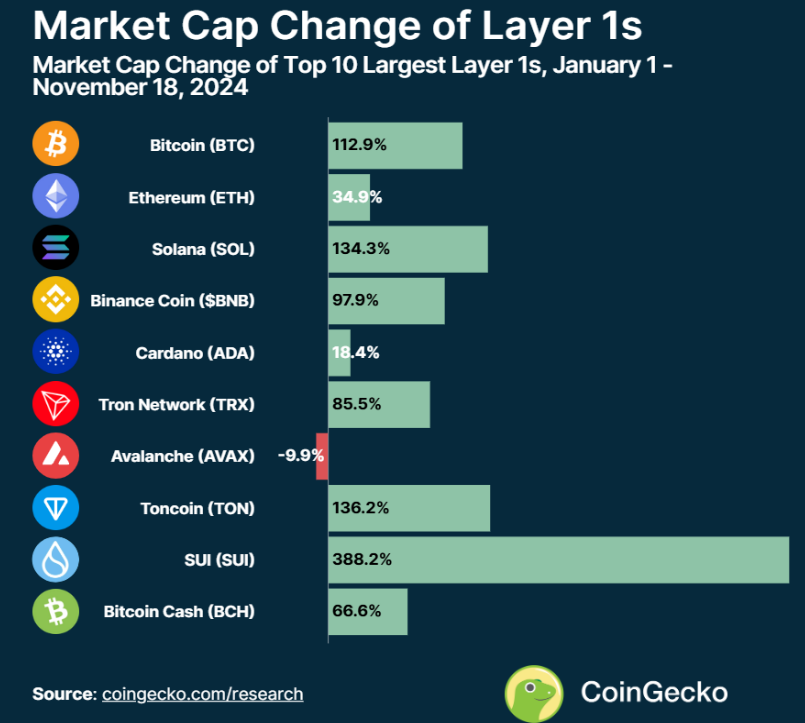
Despite the amazing performance of small and medium Market Cap Layer 1 Tokens, larger market cap tokens such as Bitcoin, Ethereum, and Solana remain solid investment choices.
BTC (BTC) achieved a 112.9% annual rise.
Ether (ETH) rose by 34.9%, but underperformed similar TOKENs. With the rise of new Layer 2 and other blockchains, the dominant position of Ether (ETH) has been declining year by year, despite the launch of a Spot Ether (ETH) ETF in the United States. However, Ether (ETH) still outperformed the S&P 500 index, which pumped by 24.8% in 2024.
Solana (SOL): Rising from the Ashes
Solana (SOL) has risen from the shadow of the 2022 FTX bankruptcy and has risen by 134.3% so far this year. Most of its increase occurred in 2023, when it surged from $15 to $120, driven by the memecoin frenzy. This trend has also extended to other blockchains, such as Tron Network (TRX), which has risen by 85.5% this year.
At the same time, Toncoin (TON) recorded an amazing 136.2%rise, mainly due to its ability to host dApps on the popular social messaging app Telegram. The ‘click to earn’ game mode has become extremely popular on Telegram, further driving its rise.
Sui: The Most Eye-catching Performance
SUI has shown the most eye-catching performance this year, with a rise of 338.2%. This increase is mainly attributed to the growing investor interest, the rise of on-chain activities, and the practicality improvement brought by significant dApp expansion. In addition, Circle’s USDC has been integrated into the network, while a trend of funds transferring from the ETH network to SUI is also observed.
4. The biggest drop
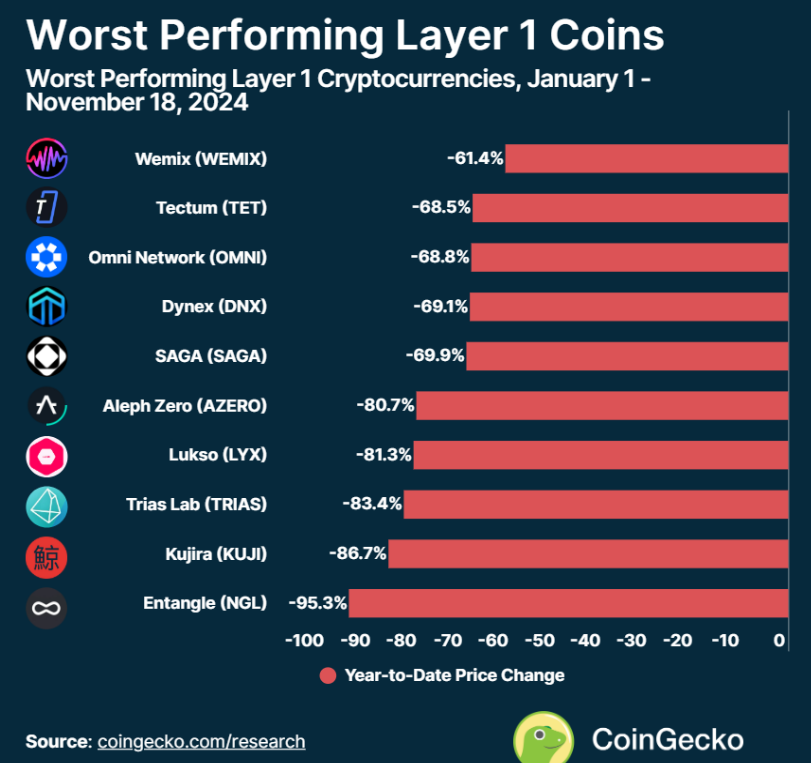
On the other hand, some TOKENs have plummeted as much as -96% this year.
Entangle (NGL) performed the worst, with a YTD decline of -95.3%.
Following closely behind are Kujira (KUJI) and Trias Lab (TRIAS), which fell by -86.7% and -83.4% respectively.
NGL was issued at a high valuation in March 2024, and the price has since continued to decline. Kujira’s performance, on the other hand, has been affected by the team’s high-risk leveraged Liquidity position, which has backfired during market Fluctuation periods.
5. How will the Layer 1 Token perform in terms of issuance in 2024?
Various Layer 1 Cryptocurrencies launched in 2024 have different performances, reflecting the challenges of breaking through in a competitive market.
Aleo (ALEO) was launched in September and has since dropped by -58.1% since issuance.
Saga (SAGA), launched in April, has faced similar challenges and has dropped by -69.9% year-to-date.
Also launched in April, Omni Network (OMNI) dropped by -68.8%.
Zeta Chain (ZETA) has dropped by -57.3% since the issuance in February.
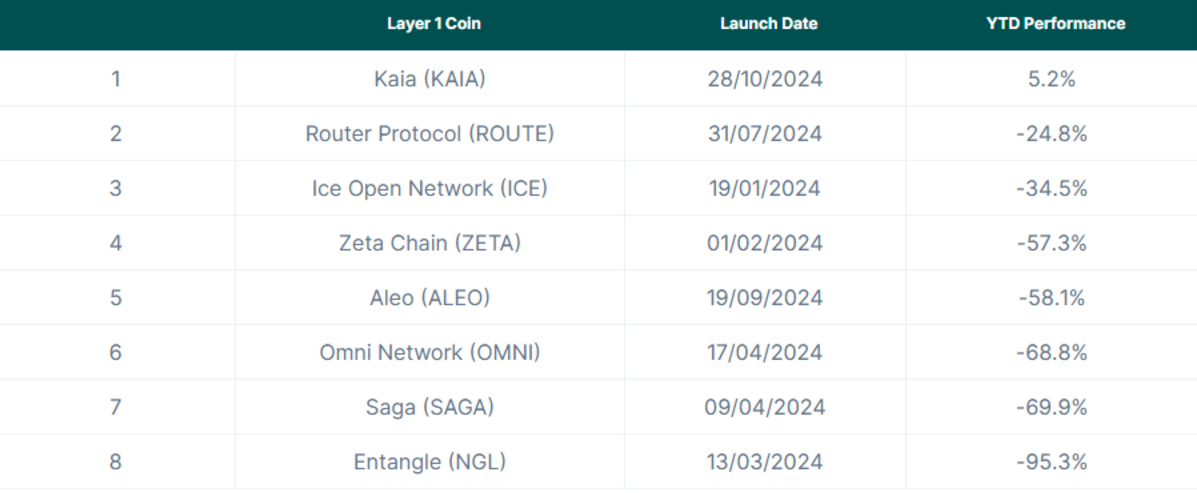
The performance of Router Protocol (ROUTE) and other new projects
Router Protocol (ROUTE) was launched in July with a 24.8% price decline, while Ice Open Network (ICE) has experienced a relatively smaller drop of 34.5% since January. Meanwhile, Kaia (KAIA), which entered the market as late as the end of October, achieved a slight rise of 5.2%. These performances reflect the volatility of new Layer 1 projects and the importance of continuous innovation and user adoption in gaining market recognition.
6. Top Ten Layer 1 Projects Ranked by Price Performance
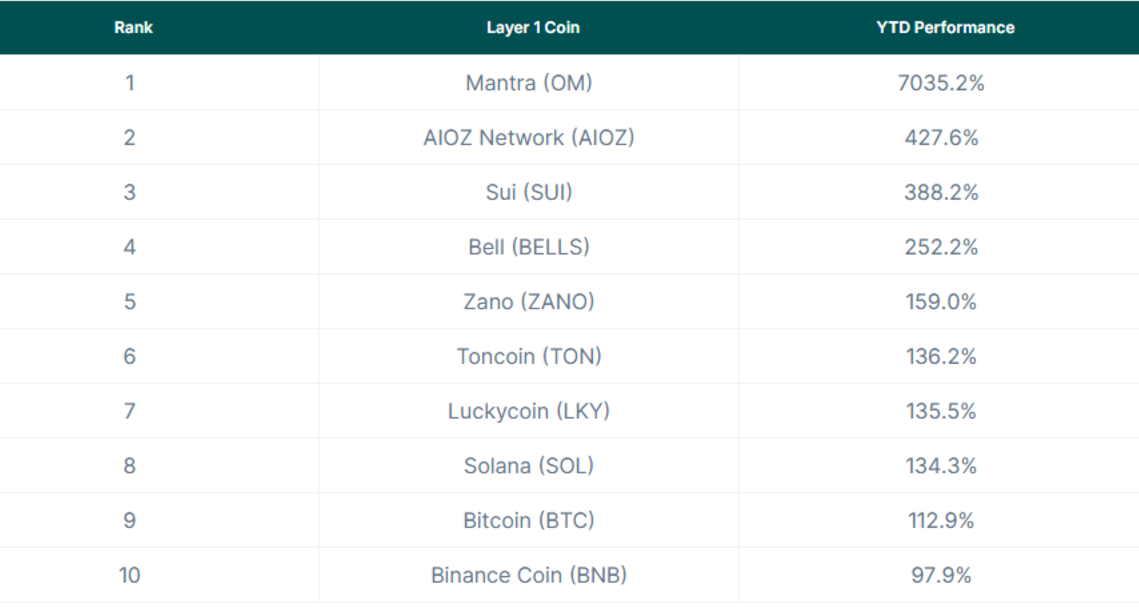
Note: YTD is the abbreviation of Year-to-Date, which means “this year to date”. It is usually used to describe the performance of a certain indicator (such as income, change in value, or performance) within the time period from the beginning of the year (usually January 1) to the current date.
7. Conclusion
In 2024, the Layer 1 blockchain field presents a diversified performance. Mantra, with a whopping 7035% year-to-date (YTD) increase, is far ahead thanks to its strategic partnerships and cutting-edge blockchain application cases. Meanwhile, veteran players like BTC, Solana, and Toncoin demonstrate their strong vitality in the ever-changing market. At the same time, newly issued tokens face enormous challenges and often struggle due to high valuations at the beginning.
As the competition between Layer 1 and Layer 2 solutions intensifies, the follow on scalability, usability, and compliance will determine the emergence of the next wave of winners, which is particularly important in this ever-changing crypto market.
Note: This research analyzes the price performance of the top 100 cryptocurrencies sorted by market cap in the Layer 1 category on CoinGecko. The YTD returns data covers the period from January 1, 2024, to November 18. These data reflect a snapshot of the market and the performance differences of various currencies in a broader market environment.
Source: Plain Blockchain


