Guest message:
The process that every cryptocurrency investor must go through:
To look at a mountain is to see a mountain.
The mountain is not a mountain.
The mountain is still the mountain
At first, when trading coins, you only focus on the narrative, and pay special attention to the actions of smart money and the market maker wallet. After that, when you understand all the rules of this game, you return to the first day and pay extra attention to the narrative, hotspots of funds, and the consensus of investors.
This process has to be understood by oneself, it is extremely painful but will eventually become clear, keep it up!
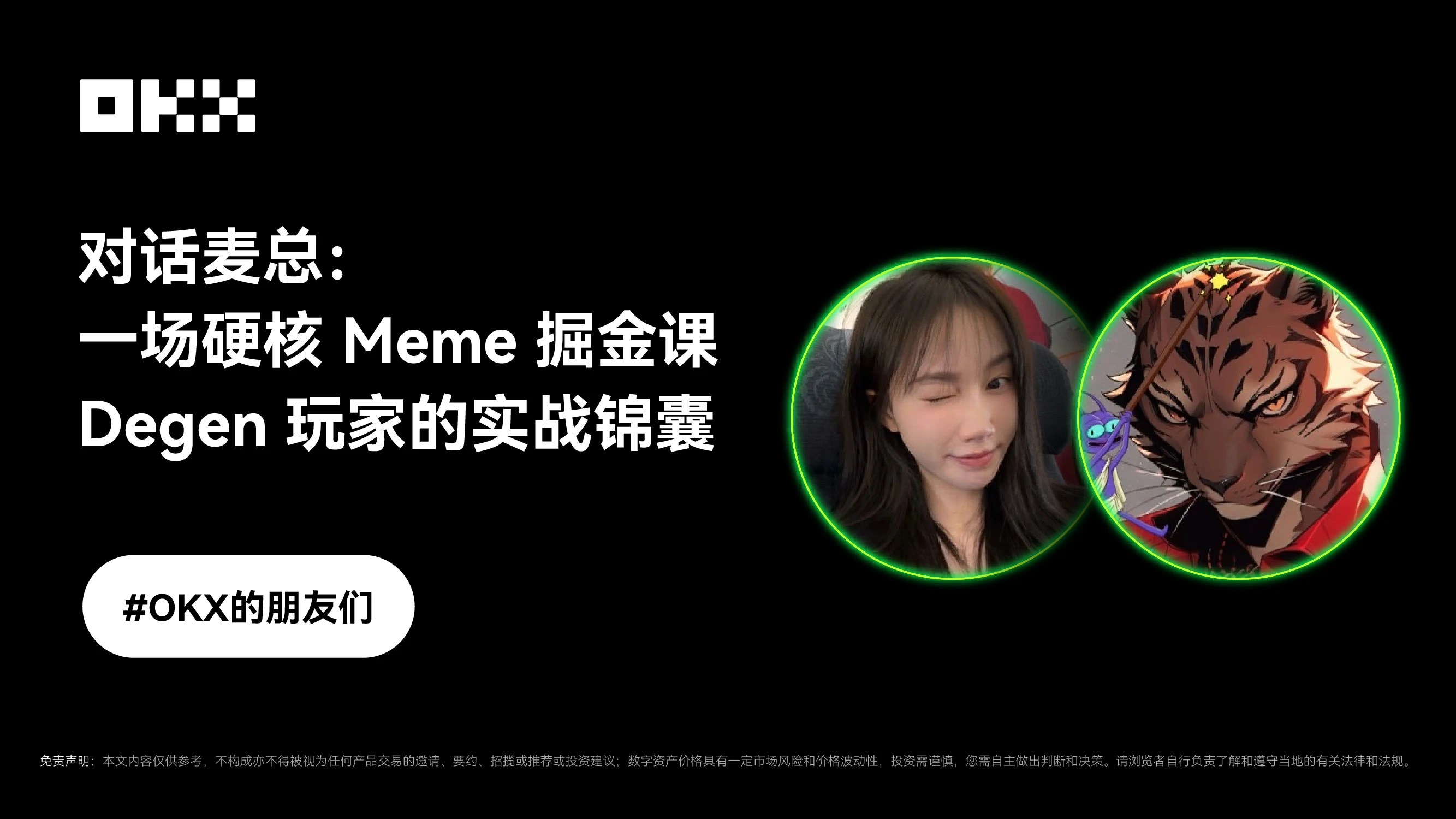
Mr. Mai (@Michael_Liu 93) is a veteran investor who has crossed over from traditional finance to Web3. After graduating in 2016, he worked in a Canadian investment bank for two years and worked in mergers and acquisitions. After being exposed to blockchain in 2017-2018, he gradually shifted from the traditional VC perspective to cryptocurrency trading. At present, he runs a fund focusing on the secondary market of Bitcoin, and is also a well-known KOL in the meme coin track, with his in-depth insight into the market and high-quality content sharing, he has accumulated more than 60,000 Twitter followers in just half a year.
OKX specially invited him as the first guest of the 2025 “Friends of OKX” series, where he shared his deep thoughts on the Meme track and gave advice to beginners. Through an analysis from the perspectives of traditional finance and cryptocurrency, he presented us with a more comprehensive market outlook.
The ‘Friends of OKX’ series is a special column specially planned by OKX, hosted by Mercy, the official community ambassador of OKX (@Mercy_okx), aiming to explore the career stories, industry insights, and experience lessons of KOLs from different backgrounds, for new users to learn and reference.
From Traditional Finance to the Advancement of Web3
**Mercy_okx(@Mercy_okx): Can you share your experience of getting into Web3 with everyone?
**Honest Mr. Mai (@Michael_Liu 93):**I entered the financial industry after graduating in 2016, first working in a Canadian investment bank for two years, and then doing mergers and acquisitions. One of the earliest encounters with blockchain was by chance. When I was researching the corporate services sector, I participated in a conference call with the Credit Suisse investment research team, and they discussed blockchain technology. I had actually heard about Bitcoin when I was in college, but I was more skeptical of cryptocurrencies at the time. It wasn’t until 2017-2018 that I came into contact with the application of Ethereum and blockchain in the field of enterprise services, and I began to be interested in this field, and I also began to invest in some early public chain projects. However, at that time, I was still looking at blockchain from the perspective of a traditional VC, and it was only in 2020-2021 that I officially switched from the traditional space to cryptocurrency, and now I am mainly running a Bitcoin secondary market fund.
**Mercy_okx: What is the logic behind the transition from initially doing VC to focusing on Meme coin trading?
Honest Maizong: I am someone who likes to chase new opportunities. Wherever there is a wealth effect, I will go there. Currently, the market opportunities are clearly in the secondary market, either buying Bitcoin for beta returns or participating on the chain. However, when I first entered the on-chain trading, I also went through a period of adaptation. I found that many friends who sent me private messages complained that on-chain trading is difficult to grasp and they lost money as soon as they entered. In fact, I also lost money for the first six months and was ‘cut’ by others every day. This is because even if there is a stable profit-making ability in the secondary market, one must be re-educated by the market when entering the on-chain market. Therefore, I suggest that everyone should accept this process with an open mind, because it is necessary tuition.
The experience of VC before is very helpful to me now. In essence, it is all about the financial market, all about human nature’s game, and many of the logics of market making and retail investors’ selling are similar.
Meme Coin Market Depth Insight
**Mercy_okx: How did you start building your personal IP? What do you think is the key factor in growing from a few thousand to over 60,000 fans in a short period of time?
Honest Maizong: I think I’ve been quite lucky and have caught onto several hotspots. Firstly, I realized early on that personal IP and influence are crucial in the Meme field. This is because Meme is essentially a game of propagation, and if you are a super spreader or an information hub, you can be closer to other information hubs. In all financial markets, information asymmetry is always the most valuable.
When I first started doing this, I wanted to develop in the direction of MEME. At the beginning, I mainly shared some of my expertise in the secondary market, such as how to operate as a market maker in the secondary market, including some retail investors chasing after TON, Dog, and hamster at that time. I analyzed the market-making and harvesting techniques behind these projects. These contents have resonated with many people, and the number of followers of the account has increased from hundreds to thousands.
Later, I started to write some experience sharing on MEME. Later, Solana quickly broke out, and I also caught this wave of market. Although I caught it relatively late, like Sister Hui and others have been playing on Solana early, but I still caught some good opportunities, such as the earliest $ai16z, $ban, and now the AI concept, I think I also caught it right. I am personally good at finding where the hot money is, because my trading style is to trade with the hot money.
Mercy_okx: How do you view the development trend of the current Meme coin market? What changes has the rise of AI concepts brought?
Honest Mai: The dividends in this round on the chain are unstoppable. Essentially, they are absorbing the liquidity from the secondary market. Why is the liquidity on the chain being drawn away by DEX? In fact, this is a transformation of a business model.
Let me use an analogy to explain: The original model is like this - I have an idea to build a car, so I first seek VC financing and then sell the car to users on the secondary market through an exchange. The retail investors on the secondary market are actually consumers, who exchange USDT for project tokens. When the market liquidity is good, if the project produces a ‘Porsche’, the consumers on the secondary market who buy it may see an increase in value. However, when the market liquidity is poor and there are many car manufacturers, and the initial pricing is high, those who buy on the secondary market will become trapped consumers instead of investors.
And now the model has become-I have an idea, first financing from the market, and then step by step to develop the product. Because retail investors have the opportunity to participate very early, for example, they can invest in the project only at the blueprint stage, and get returns after the product is developed. This is actually snatching the cake that VCs used to eat. Just like the original project party had to finance round after round: angel round, A round, B round, now it has become a direct Fair Launch, whether the product is good or not, whether the market approves it, it is directly reflected in the price.
The rise of the AI concept has brought about great changes, attracting a large amount of institutional funds. The valuations of ai16z and Swarms would not have reached this scale without institutional funds. In addition, AI projects have changed the business models on the chain, and they really have product demonstrations. Different types of investors will enter at each stage - in the earliest stage, P young talents may think that a market value of 500,000 can be invested, and later, with the appearance of the team and the formation of the product, more institutional investors will be attracted. This gives clear buying logic for each stage, which is a model that institutional investors like very much.
**Mercy_okx: What is unique about the meme coin market compared to the traditional primary and secondary markets? **
Honest Mai: The biggest characteristic is that it’s often easy to go back to zero when buying in. Meme has a wide variety of gameplay. In the secondary market, it’s essentially a single-player game of wits against the market makers. But Meme coins are more like an MORPG, where everyone can show their talents.
For example, as a P soldier, you may focus on the market every day to seize the opportunity in the domestic market. If you are good at analyzing chips, you may go after the early strong dealer plates. You can also be a builder, such as recently suggesting a friend in the group who is not good at playing AI, to let him chat with the Hackathon team, see who is preparing to issue coins, establish a relationship in advance, and they may give you some early opportunities after they issue coins and collect chips.
The key is to explore the angle of making money that suits you. Just like the secondary market, some people play spot, some play contracts, and within spot, there are also scalping and holding. Everyone needs to find the most suitable way for themselves.
Mercy_okx: What do you think is the most important factor to consider when evaluating the potential of a Meme coin project?
Honest Maizong: I think the advent of the AI trend has actually brought about significant changes in the evaluation logic of MEME coins. In the previous era of memes, project parties and market makers were hidden. If you don’t know the developers or first-tier market makers, it’s hard to determine whether a project is a high-volume trading, strong-manipulation, or conspiracy scheme. At that time, you could only analyze some clues from on-chain addresses, such as how high a project party’s previous trading can reach.
But when it comes to AI, the evaluation becomes closer to the methodology of VC. Because most of them are well-known teams, you can do real due diligence - directly contacting community members, researching the team background, and this information is all written in their personal profiles.
When evaluating a project, I mainly look at three aspects:
-
Narrative potential: Does the product align with current market trends;
-
Team strength: Not only should we look at their professional abilities in the AI field, but also at their operational capabilities in Web3, including control, marketing, and community operations;
-
Market Space: For example, if an AI framework has already achieved a valuation of 2 billion, if a new team with a strong technical background appears to do a similar direction, this is an opportunity for market replication.
This is actually very similar to the logic of traditional VC investment in early-stage projects. Just like ZhenFund is known for “investing in people”, there may not be much to see in the early stage of a project other than the founder. But no matter at which stage you participate, the most crucial thing is to look at the people, because the potential of a project depends not only on the product itself, but also on whether the team can create market sentiment, operate the project, and deliver consistently. Especially in the AI track, we need to find teams that understand both the product and the Web3 gameplay, so that such projects are most likely to succeed.
**Mercy_okx: There are many sub-tracks of AI-related tokens now, including computing power, infrastructure, pure MEME, Agent technology framework, Launchpad platform, and so on. How do you weigh product logic, narrative, and market sentiment when evaluating different types of projects? Do different categories have different evaluation criteria?
Honest Maizong: Let me use an example of a framework project to explain. This so-called framework project can be understood as a benchmarking public chain, with various applications on top, such as TradeFi or games. Why is the market so enthusiastic about $Virtual and $ai16z? Because they are doing the underlying framework, and the market has given them a valuation similar to that of public chains.
In the AI application track, we believe that in addition to the framework, the most valuable direction is TradeFi+AI for two reasons:
-
Liquidity entry point: In the cryptocurrency market, it is most important to find out where the liquidity is. TradeFi is the easiest application track to access liquidity, and this product is very valuable if it can get a share of the transaction fees.
-
User interaction frequency: In the field of cryptocurrency, the most common activity for users is trading. Therefore, the AI application with the highest interaction frequency is likely to be in the TradeFi+AI direction.
Practice has also proven this point, such as projects like Stoic, Berg, etc., whose market value has quickly risen from 2-3 million dollars to tens of millions within two weeks. This is because the market replicates successful logic.
In contrast, those projects that are purely conceptual, purely storytelling, or purely Meme-based, with a few exceptions, do not have high market recognition. Because the AI track has entered the 4.0 stage, it is no longer possible to raise funds simply by proposing a concept. The market is more concerned about the implementation of products and viable business models.
Infrastructure projects like $swarms can achieve high valuations because they function like public chains and can capture all transaction liquidity within the ecosystem. This is also why the price of $Virtual should be higher than $ai16z, as it not only provides a technical framework but also taps into actual liquidity. In the future, $ai16z is likely to also move towards liquidity, because in Web3, the true moat includes not only technology but also liquidity ownership.
This is different from the AI competition in Web2. The AI in Web2 is more like an arms race, competing in terms of financial strength and hardware reserves, while in Web3, liquidity has become an extremely critical factor.
Mercy_okx: What are the characteristics of the Meme coin ecosystem on different public chains?
Honest Maizong: Both retail investors and project parties have their own characteristics. Let’s talk about Solana first. Its pace is particularly fast. Retail investors may lose everything after a nap, and project parties may lose their coins after a nap. It is difficult to maintain a market value of 5-10 million on Solana relying on natural flow. It leaves very little room for error for project parties.
There are many rug pools on BSC, and there are also many startups. However, if you encounter good developers and teams, there will be more opportunities. However, because of the lack of natural traffic, you basically have to rely on yourself to attract users. Therefore, projects that can succeed on BSC usually have strong financial backing.
Base’s feature is its close connection with the official team and project team, and strong support. For example, Jess (Head of Base Ecology) often helps the project team make calls. Moreover, there are many technical teams on Base, creating some good products. As a retail investor, one advantage of Base is that there are relatively few projects, so the pressure of choice is smaller. It is also possible to focus on projects with official endorsement, which is relatively more secure.
Newcomer’s Guide
Mercy_okx: For beginners who have just entered the market, what do you recommend for reasonable capital allocation and building a sustainable investment system?
Honest Maizong: The primary suggestion is not to buy VC coins on the secondary market. If you don’t understand trading, it is recommended to allocate Bitcoin as a store of value, and also appropriately allocate mainstream coins such as Solana and Ethereum. If you want to speculate on Meme coins, it is recommended to buy blue-chip Meme coins that have already been verified in the secondary market, such as Doge and Pepe.
Regarding fund allocation, I suggest that beginners who want to participate in on-chain trading only use 10% of the total capital to participate. For example, if you have 100,000, just use 10,000 to play on-chain, and maybe invest a few hundred dollars in each currency to start trying. Never go all in. The best way is to be an observer first, and when you can consistently generate profits in this market, gradually expand the scale of funds.
Before finding a stable profitable method, it is recommended not to pursue the profits of the spot market. I have seen many friends crazily “bottom fishing” in the spot market, but often end up being harvested. It is recommended to observe projects with a market value of 5-10 million, and try investing 0.05-0.1 ETH each time. When you find that you are generally making money on MEME, then consider increasing your position. This is not a gambling game. If you treat it as gambling, you will definitely lose miserably.
Mercy_okx: How to build information acquisition channels?
Honest Maizong: The most important thing is not to pay attention to the matrix number. Instead, focus on the few large and trustworthy KOLs in the industry. Pay special attention to their initial recommendation (Call) instead of their follow-up recommendations, because the market changes too quickly and the odds for later calls may have already changed.
In addition, you need to find a group of trusted and complementary partners to communicate with. In this market, teamwork is often more likely to succeed than going it alone. Everyone may have their own strengths, and complementing each other can go further.
Suggestions and Prospects for OKX
Mercy_okx: What is your overall impression of OKX?
Honest Maizong: OKX’s team is very cutting-edge and has a very close interaction with the community. Including the product team and KOL operation colleagues, they are very close to the market. They have also done a relatively good job in on-chain tools and wallets, and have provided free services from the beginning, demonstrating a very good strategic vision. They have also responded quickly to the transformation of this wave of on-chain market, which is considered far-sighted among all exchanges. I cannot evaluate the response speed to issues at the moment, as I have not encountered relevant situations. However, overall, OKX’s attitude towards serving users is very serious.
This article is for reference only. This article represents the author’s views and does not represent the position of OKX. This article does not intend to provide (i) investment advice or recommendations; (ii) offers or solicitations to buy, sell, or hold digital assets; (iii) financial, accounting, legal, or tax advice. We do not guarantee the accuracy, completeness, or usefulness of such information. Holding digital assets (including stablecoins and NFTs) involves high risks and may experience significant fluctuations. You should carefully consider whether trading or holding digital assets is suitable for you based on your financial condition. For your specific circumstances, please consult your legal/tax/investment professionals. Please be responsible for understanding and complying with applicable local laws and regulations.


