Increasing the gas limit is fundamentally to improve the scalability of Ethereum.
Author: Seongwan Park
Compiled by: Glendon, Techub News
The Ethereum community has recently focused on a hot topic: increasing the Gas limit. The idea of raising the Gas limit seems reasonable, as it meets the demand for higher transaction throughput and reflects the natural growth trend of network capacity over time. Many researchers and community members strongly support this, believing that Ethereum is well prepared for this change and see it as a timely move to directly enhance Ethereum scalability.
The proposal has also attracted widespread attention within the community, with community-created websites such as pumpthegas.org aimed at popularizing the basic knowledge of Gas limit increase and how validators can change their node settings. Another website, Gaslimit.pics, actively tracks the progress of validators’ support for a higher Gas limit - data shows that as of December 21, 2024, 25% of Ethereum validators have adjusted their client configurations to show support. Once more than 50% of validators agree to raise the Gas limit and modify their client configurations, the Gas limit of Ethereum will begin to increase and eventually stabilize at the new target value.
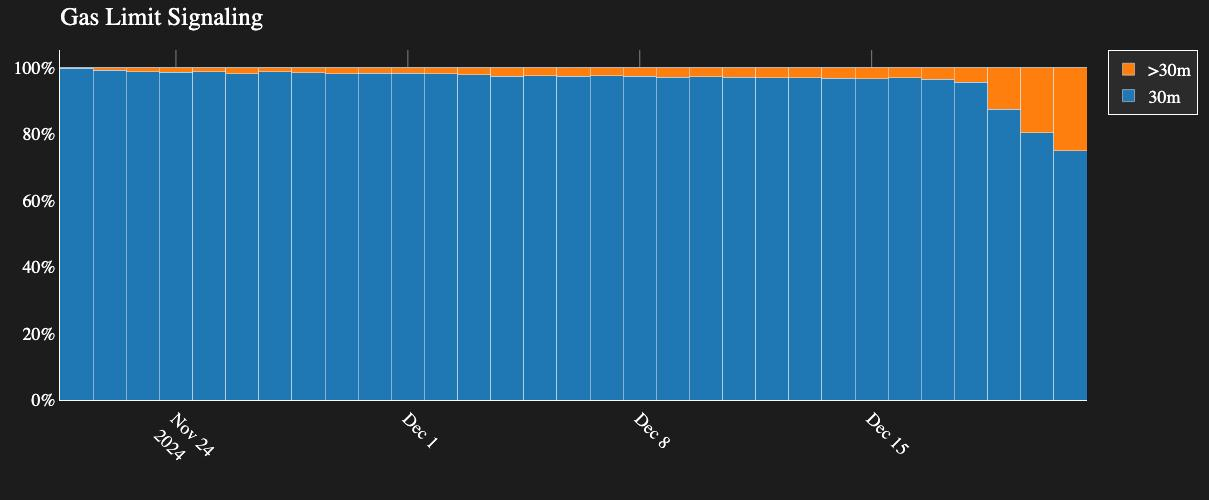
It is worth noting that the proposal is different from the Ethereum-centric roadmap with rollup, i.e., different from recent scalability improvements (such as EIP-4844 and EIP-7691), which focus on rollup extension and blob transactions, while raising the Gas limit is a method of L1 level extension (Techub News note, the Ethereum block Gas limit refers to the maximum number of operations that can be included in a block, and this limit is measured by the Gas value).
Although this discussion has excited some members of the community, it has also raised concerns among researchers about the potential risks to the core values of Ethereum, such as decentralization and security. Critics warn that in the worst case scenario, larger block sizes may put pressure on the consensus layer and increase hardware requirements for validators, potentially threatening network stability.
Are these concerns groundless? This article explores the brief history of the proposal to increase the Ethereum Gas limit, potential impacts, the technical and some considerations involved in the ongoing discussion.
A Brief History of the Proposal to Increase the Ethereum Gas Limit
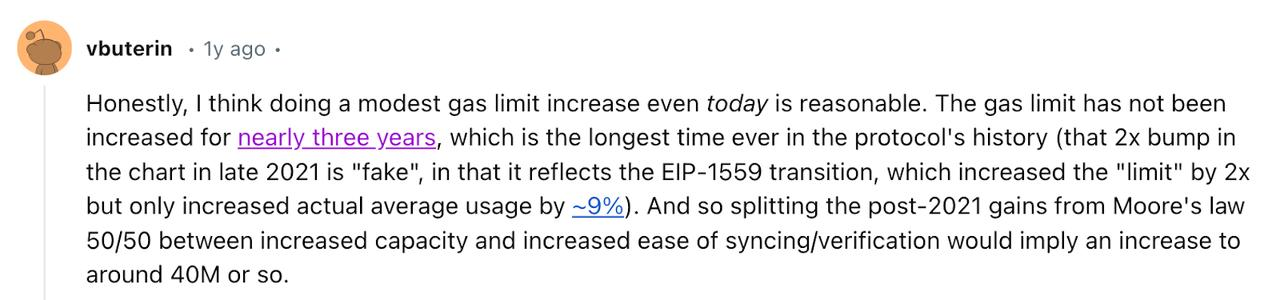
In fact, the idea of raising the Ethereum Gas upper limit has been discussed for a while. At the January 2024 Ethereum AMA, Ethereum co-founder Vitalik Buterin suggested raising the Gas upper limit to 40 million (currently, Ethereum’s Gas upper limit is 30 million), which is in line with Moore’s Law and reflects the steady improvement of hardware capabilities.
It is worth mentioning that since April 2021, Ethereum has not adjusted its gas limit despite significant hardware improvements during this period. Therefore, many community members now believe that Ethereum is time to consider these developments.
Just recently, a proposal has set the ambitious goal of doubling the gas limit to 60 million. Of course, 60 million is mainly seen as a long-term goal, rather than an immediate one. In December 2024, Toni Wahrstätter suggested a more cautious approach, advocating for an initial increase in the gas limit to 36 million (a 20% increase) as a safer first step.
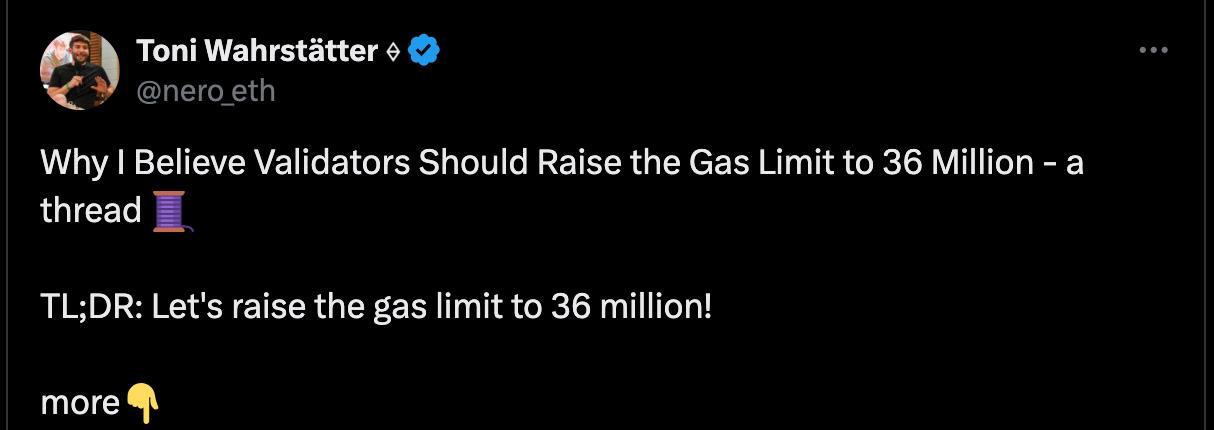
Therefore, the current increase in the Ethereum Gas limit to 36 million is seen as an initial milestone, and any further increase will follow a gradual, phased approach.
How to adjust the block Gas limit?
The block Gas limit can be gradually increased without the need for forking or changing network rules. Instead, validators achieve backward compatibility by modifying their configuration options and making regular, flexible adjustments according to community consensus.
Contrary to popular belief, the block Gas limit of Ethereum is not fixed at 30 million. Block proposers can make slight adjustments within certain limits. Specifically, the Gas limit of a block can be changed within 1/1024 of the previous block’s Gas limit. For example, if the current block’s Gas limit is 30 million, then in the next block, it can be increased to ‘30,000,000 + 30,000,000 ×(1 / 1024)= 30,029,296’.
The following code shows the default behavior of an Ethereum node in the Geth client: if the Gas limit of a new block is within an acceptable range relative to its parent block, it will be considered valid.
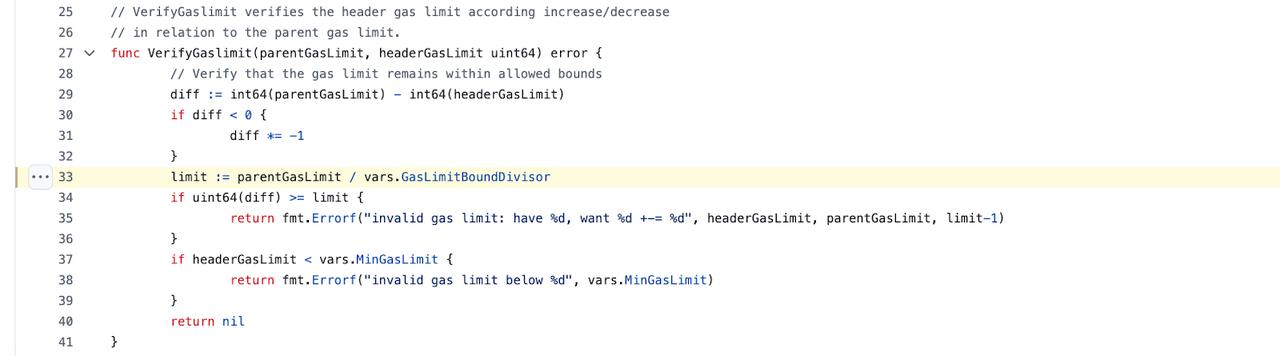
If the proposers of consecutive blocks agree to increase the upper limit, the Gas upper limit can continue to increase. For example, in an ideal situation (assuming validators reach consensus), it takes about “log(1.2) / log(1025/1024) = 187 blocks” or 38 minutes to reach the first milestone of 36 million (20% growth). Once more than 50% of the validators agree, the increase can be quickly implemented.
What impact will increasing the Gas limit have?
Let’s first look at some relatively predictable impacts of increasing the Gas limit. The increase in block capacity will make it easier to handle current blockchain demands, thereby reducing Gas fees.
In the short term, according to the EIP-1559 mechanism, the reduction of Gas fees may lead to a decrease in ETH burning, temporarily increasing the net issuance of Ethereum. A similar trend also appeared after EIP-4844, when the data availability (DA) fees for rollup were significantly reduced, leading to a decrease in ETH burning. An increase in the Gas limit may also produce the same effect, further exacerbating short-term inflation.
However, in the long run, the reduction in fees may encourage more network activity as more users can afford transaction fees. This increased activity could drive the network effect of Ethereum, attracting more DApps and promoting wider adoption. As Ethereum becomes an integral part of DApp and DeFi systems, the frequency of ETH as a currency may increase. The resulting increase in ETH usage could in turn drive further growth in network activity, creating a positive feedback loop for the Ethereum ecosystem.
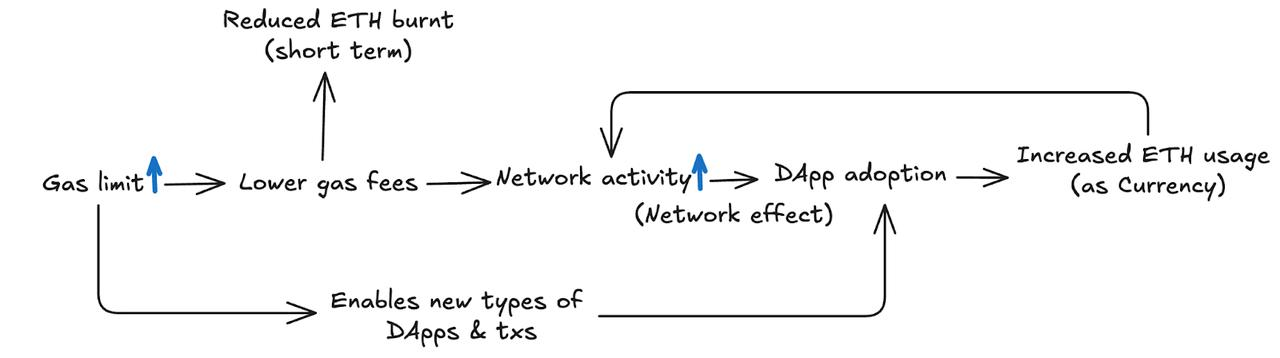
After the increase of the gas limit, it will be possible to build new DApps.
In addition to reducing gas and improving the transaction process, increasing the gas limit per block may also unlock new opportunities. While a moderate increase to 36 million may not necessarily bring significant changes, a larger leap to 60 million may enable new types of DApps and transactions that were previously limited by the 30 million gas limit. Some operations that almost fill or exceed the current 30 million gas limit may be executed more efficiently or become feasible for the first time after the change.
For example, transactions that require a large amount of gas (such as NFT batch minting, large-scale token airdrops, or DAO activities) usually approach or exceed the current gas limit of 30 million. These transactions are often spread across multiple blocks, resulting in inefficiency, transaction delays, and potential vulnerabilities. A specific example shown in the figure below is an NFT batch minting transaction that consumes over 28 million gas.
![]###https://img.gateio.im/social/moments-6ae9c7fb0164c43b4efbdc35fabc192d(
Transaction hash: 0xf99bdd89f7e3186e63d71a4a3ffb53cb5cd1c3190ce3771c966f2a82b3346bee
After increasing the block gas limit to 60 million, such operations can be completed within a single block, ensuring atomic execution. This guarantees that the entire operation either succeeds or fails, avoiding partial completion, ensuring fairness for participants, and reducing opportunities for manipulation.
In addition to optimizing existing use cases, a higher Gas limit may also pave the way for innovative DApps that require computationally intensive operations. For example, with the increase in Gas limit, on-chain AI applications such as small-scale model training or inference may become feasible. Similarly, more complex smart contracts such as fully on-chain games or sophisticated governance mechanisms can thrive in a higher-capacity environment. These advancements have the potential to expand the capabilities and appeal of Ethereum, making the ecosystem more diverse.
Therefore, in many cases, doubling the Gas limit may bring more benefits, as it can reduce fragmentation and unlock some new possibilities.
What does increasing the gas limit mean for the ‘impossible triangle’ dilemma in blockchain?
Increasing the gas limit is fundamentally to improve the scalability of Ethereum. In the context of the ‘impossible triangle’ dilemma in blockchain, achieving higher scalability often comes at the cost of sacrificing decentralization or security. This is why the proposal to increase the gas limit has raised some questions, as people are concerned that it may lead to centralization by increasing the requirements for validators, or weaken security by reducing the stability of the consensus layer.
![])https://img.gateio.im/social/moments-b3664ead428d77759799810c891d5d2f(
However, supporters argue that this is not a sacrifice of decentralization or security in order to improve scalability. Instead, they describe it as using the hardware performance improvements described by Moore’s Law to increase the total capacity of the blockchain. Under this view, the “impossible triangle” dilemma of the blockchain may expand, as modern hardware allows for a larger total capacity without compromising Ethereum’s core attributes.
To assess whether this is true, it is necessary to carefully examine the potential risks of raising the Gas limit. Considerations for decentralization may include increasing validator hardware requirements, as well as the complexity of MEV strategies. In terms of security, we should consider increasing the worst-case block size, transaction execution time, which will affect the rate of forks or missed slots.
) Gas Upper Limit Increase and Block Size
The increase in the gas limit in a single block can accommodate more call data, which will affect the worst-case block size. Currently, the maximum block size that can be achieved by filling the block with meaningless call data is about 1.8MB, and using six blobs, the total data size propagated in a single slot can reach 2.58MB. A higher gas limit will increase the worst-case block size, which may cause problems for the peer-to-peer (P2P) layer used by network nodes for communication.
This situation may put pressure on the consensus client at the P2P layer. When the Gas upper limit exceeds 40 million, the block size in the worst case scenario may exceed the limits built into the default client behavior, causing some clients to fail to propose or propagate blocks correctly. Therefore, it is crucial to address these limitations before significantly increasing the Gas upper limit.
We hope that EIP-7623 can provide a solution by adjusting the price of call data (calldata) in data availability transactions, which can reduce the worst-case block size from 2.58MB to approximately 1.2MB. Therefore, we believe that adopting EIP-7623 will be necessary to ensure the consensus stability of any future increase in Gas limit.
Similarly, the actual block size (usually the block size filled with transaction data) is related to the probability of reorganizing or missing slots. Analysis of slot data (###10351782) shows that for smaller blocks, there is little difference in the distribution of block sizes between including slots and reorganizing/missing slots. However, as the block size increases (e.g., over 0.25MB), the likelihood of reorganizing or missing slots increases.
![]#9526972 至 #https://img.gateio.im/social/moments-722e7a6c74e4931c444cd3c101e49416(
![])https://img.gateio.im/social/moments-618ef6d87295894d876c7ffa8069954e(
This correlation may stem from factors such as increased transaction execution time or default P2P behavior, rather than just the block size itself. While the observed relationship highlights potential risks, no causal relationship has been established.
In conclusion, although the increase in block size will affect the stability of the slot, the worst-case block size is particularly important for ensuring the robustness of the P2P layer. Future increases in the Gas limit must be accompanied by changes proposed in EIP-7623 to effectively mitigate these risks.
) Gas Limit Increase and Execution Time
The increase in the gas limit allows more transactions to be included in the block, which also increases the execution time of the transactions. Whether this increase is critical depends on the forks or missed slots, which represents the stability of the overall consensus.
The figure below shows that as more Gas is used in the block, the execution time tends to increase. It is expected that a 20% increase in the Gas limit will slightly prolong the execution time, but the specific impact is difficult to predict. The execution time is not always directly proportional to the maximum Gas limit or Gas usage. However, if we make a conservative proportional assumption based on the chart, it seems reasonable to increase the execution time by 400-500 milliseconds.
![]###https://img.gateio.im/social/moments-79decb3846ec330c19e13cb93e1d959f(
Now, let’s explore the relationship between execution time and fork or missing slot.
![])https://img.gateio.im/social/moments-bd4db5198f3f2e90e3487068645848f4(
![])https://img.gateio.im/social/moments-704a1c1498dbf08f505966618d0c644d(
The red box in the figure emphasizes that slots with execution time exceeding 4000 milliseconds are more prone to reorganization or omission compared to slots with shorter execution time. Although most reorganizations or omissions occur between 1000 and 3000 milliseconds (indicating a weak correlation between execution time and reorganization probability within this range), the blocks in the red box show that when the execution time exceeds 4000 milliseconds, the probability of reorganization is significantly higher. Another chart shows that the reorganization or omission rate of slots with execution time exceeding 4000 milliseconds is more than three times higher than that of slots below 4000 milliseconds, further emphasizing the significant impact of very high execution time on stability.
Will increasing the gas limit affect the hardware requirements for validators?
When increasing the Gas limit, validators are primarily concerned with the storage size of running validator nodes. As of December 2024, a validator node has approximately 1.5-1.6TB of storage space for maintaining all historical and state data. Increasing the Gas limit will accelerate the growth of historical and state data.
In 2020 and 2021, running a validator node requires a 2TB solid state drive (SSD). However, when historical and status data reaches 1.8TB, validators using a 2TB SSD need to replace it with a 4TB SSD. Although the price of a 4TB SSD is now almost the same as that of a 2TB SSD three years ago, at about 250 US dollars, the replacement itself implies maintenance costs and technical difficulties.
![])https://img.gateio.im/social/moments-3f2f608c96dd31bb9841daf25cbfe6e2(
A gas limit of 36 million may not be a big issue. But if the gas limit is increased to 60 million or more, validator nodes will have to continuously change hardware, thus accumulating maintenance costs, threatening the decentralization feature.
When EIP-4444 is adopted (aiming to release the client before May 2025), the growth of historical data may stop, providing more space for the increase of the gas limit. However, without EIP-4444, the growth of historical data may be the next bottleneck for increasing the gas limit.
Storm Slivkoff’s analysis of state growth indicates that state growth is also a potential bottleneck, but the current growth rate (approximately 2.62 GiB per month) is manageable, and modern hardware can support growth for ten years. Memory requirements increase with the size of the state, and raising the Gas limit to 60 million will accelerate this process, potentially requiring an additional 2-4.7GiB of RAM per year. While the current configuration of 64GiB RAM provides sufficient buffer space, continuous growth may lead to more frequent upgrades.
The anticipated improvements, such as Verkle trees and state expiry, will alleviate this burden, but careful monitoring remains crucial.
What does increasing the gas limit mean for MEV?
Another factor that may affect decentralization is the impact of the increase in gas upper limit on validator MEV (maximum extractable value) revenue. As the importance of MEV becomes increasingly prominent, people are beginning to worry about the income gap between complex validators who use advanced MEV strategies and smaller independent stakers. This income gap could exacerbate centralization pressure, as validators with more resources and expertise will dominate. To address this issue, the Ethereum community is actively discussing mechanisms such as proposer-builder separation (PBS) and MEV burning, aimed at balancing validator income.
In theory, increasing the gas limit allows more transactions to be included in a single block, which could exacerbate the income gap related to MEV. Although MEV Boost has partially mitigated this issue by enabling independent stakers to capture some MEV rewards, there is still no consensus on the data regarding the income gap for validators. This is due to the challenges in defining MEV transactions and accurately tracking earnings, especially in complex scenarios involving centralized exchanges (CEX) and decentralized exchanges (DEX) with intricate MEV strategies. However, these scenarios are relatively rare as most MEV comes from top-of-the-block strategies.
On the other hand, a higher Gas limit also enables more complex and resource-intensive MEV strategies to become possible. Although rare, there are indeed MEV bots executing highly complex trades, consuming almost the entire block’s Gas limit. For example, a bot transaction using over 18 million Gas was observed, executing multiple swaps and liquidity operations within one block. With the increase in Gas limit, such strategies may become more common, potentially widening the gap between mature validators and small participants.
Conclusion
The discussion around increasing the Ethereum Gas limit provides an exciting opportunity to drive scalability, lower transaction costs, and create new possibilities for DApps currently constrained by the existing limits. However, this topic also raises deep concerns about decentralization, validator requirements, and network stability. The growth of state and historical data, extended execution times, and MEV discrepancies highlight the need for careful consideration and monitoring of empirical data.
Ultimately, the key to successfully increasing the Gas limit lies in how Ethereum cleverly balances these complex factors. Solutions such as EIP-7623, the Proposal-Builders Separation (PBS), and MEV destruction have demonstrated the network’s proactive attitude in addressing potential risks, and with careful planning and execution, a higher Gas limit also holds the potential to unlock the next stage of Ethereum’s growth.


