Author: Michael Tabone, CoinTelegraph; Translation: Deng Tong, Jinse Finance
Bitcoin exchange trading products may have fundamentally changed the concept of the cryptocurrency ‘altcoin season’.
Over the years, the cryptocurrency market has been following a familiar rhythm, the dance of capital rotation that is almost predictable.
However, signs of structural collapse have emerged in this once taken-for-granted cycle.
Spot Bitcoin exchange-traded fund (ETF) has broken records, attracting $129 billion in capital in 2024. This provides unprecedented access to Bitcoin for retail and institutional investors, but also creates a vacuum, sucking capital out of speculative assets. Institutional participants now have a secure, regulated way to access cryptocurrency without the risks of the altcoin market. Many retail investors also find ETFs more attractive than chasing the next 100x token. Renowned Bitcoin analyst Plan B even exchanged his actual BTC for spot ETFs.
This transformation is happening in real time, and if capital remains locked in structured products, the altcoin will face a reduction in market liquidity and relevance share.
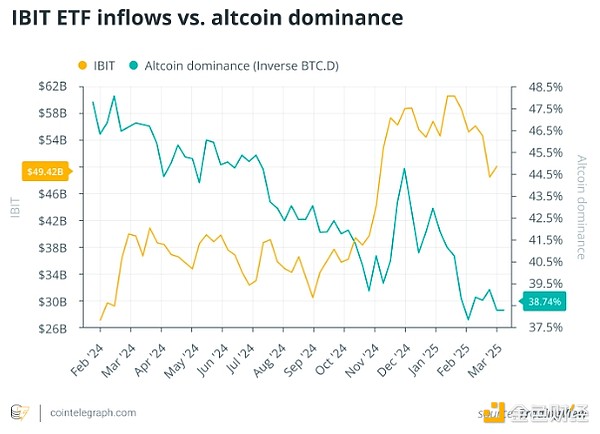
Has the era of altcoins come to an end? The rise of structured cryptocurrency investments
The Bitcoin ETF provides an alternative for chasing high-risk, low-market-cap assets, as investors can access leverage, liquidity, and regulatory transparency through structured products. Retail investors used to be the main drivers of altcoin speculation, can now access Bitcoin and Ethereum directly.
Institutional investors have greater incentives to avoid the risks of altcoins. Hedge funds and professional trading desks once pursued higher returns from low-liquidity altcoins, now they can deploy leverage through derivatives, or invest through ETFs on traditional financial tracks.
With the ability to hedge through options and futures, the motivation to bet on altcoins with poor liquidity and low trading volume has greatly diminished. The record $2.4 billion outflow in February and arbitrage opportunities created by ETF redemptions further confirm this, forcing the cryptocurrency market to have unprecedented discipline.

The traditional ‘cycle’ begins with Bitcoin, then enters the altcoin season. Source: Cointelegraph Research
Will venture capital give up on cryptocurrency startups?
Venture capital (VC) companies have always been the lifeblood of the rotating season, injecting liquidity into emerging projects and weaving grand narratives around emerging tokens.
However, as leverage is easily accessible and capital efficiency is a top priority, venture capital firms are reconsidering their approaches.
Venture capital firms seek to achieve as much return on investment (ROI) as possible, but typical ranges fall between 17% and 25%. In traditional finance, the risk-free rate of return serves as the benchmark for all investments, typically represented by the yield on U.S. government bonds.
In the field of cryptocurrency, the historical growth rate of Bitcoin serves as a benchmark for expected returns. This effectively becomes the industry version of the risk-free rate. Over the past decade, Bitcoin’s 10-year compound annual growth rate (CAGR) has averaged 77%, far exceeding gold’s 18% and the S&P 500 index’s 11% among traditional assets. Even in the past five years, whether in a bull market or a bear market, Bitcoin has maintained a 67% CAGR.
Based on this, venture capitalists investing in Bitcoin or Bitcoin-related companies at this growth rate will see a total return on investment of about 1,199% over five years, meaning the investment will increase nearly 12-fold.
Despite the continued volatility of Bitcoin, its long-term excellent performance makes it a fundamental benchmark for evaluating risk-adjusted returns in the crypto space. With arbitrage opportunities and reduced risk, venture capital firms may make safer choices.
In 2024, the number of venture capital transactions decreased by 46%, despite a rebound in overall investment in the fourth quarter. This indicates that investment will shift towards more selective and higher-value projects, rather than speculative financing.
Web3 and AI-driven crypto startups continue to attract attention, but the days of indiscriminate financing for every token with a white paper may be numbered. If venture capital further shifts towards structured investment through ETFs rather than direct investment in high-risk startups, the consequences could be severe for new altcoin projects.
At the same time, a few altcoin projects that have entered the institutional field, such as Aptos, which recently submitted an ETF application, are the exception rather than the norm. Even cryptocurrency index ETFs designed to provide broader investment opportunities struggle to attract significant capital inflows, highlighting that capital is concentrated rather than diversified.
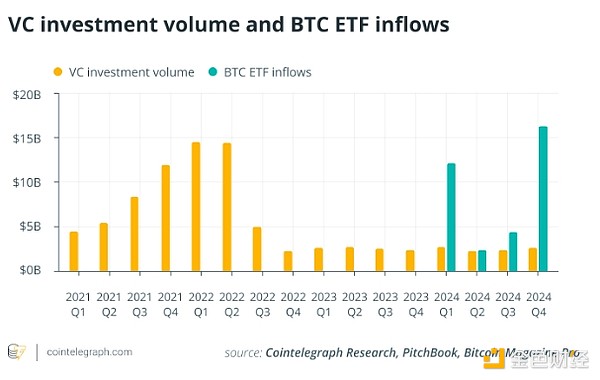
Overcapacity issues and new market realities
The situation has changed. The saturation problem has been caused by the large number of altcoins vying for attention. According to Dune Analytics, there are currently more than 40 million tokens in the market. 120 million new tokens are issued on average each month in 2024, and over 5 million tokens have been created since early 2025.
As institutions tend to structure their exposure and lack the speculative demand driven by retail investors, liquidity has not flowed into altcoins as it did before.
This brings up the brutal truth: most altcoins can’t survive. CryptoQuant CEO Ki Young Ju recently warned that most of these assets are unlikely to survive without a fundamental shift in the structure of the market. “The days when everything was going up are over,” **Ju said in a recent X post.
In an era where capital is locked in ETFs and perpetual contracts instead of freely flowing into speculative assets, the traditional strategy of waiting for Bitcoin’s dominance to weaken before turning to altcoins may no longer apply.
The cryptocurrency market is no longer what it used to be. The era of easy, cyclical altcoin rebounds may be replaced by an ecosystem where capital efficiency, structured financial products, and regulatory clarity determine the flow of funds. ETFs are changing the way people invest in Bitcoin and fundamentally altering the liquidity distribution of the entire market.
For those who have built their assumptions on the prosperity of altcoins after every Bitcoin rebound, it may now be time to reconsider. With the maturation of the market, the rules may have changed.


