AI Agent, as an important branch of artificial intelligence, is gradually moving from concept to reality and showing great application potential in various industries, including the Web3 industry.
Written by: pignard.eth, ZAN Team
On March 6, a universal AI Agent product named Manus, released by the Chinese startup Monica, went viral on domestic technology media and social networks. On its first day online, the invitation codes were in high demand, with one code even priced at 50,000 on Xianyu. However, many industry KOLs managed to obtain invitation codes in advance, leading to a flood of experience interpretation articles.
Manus, as a general AI Agent product, has the ability to autonomously complete tasks from planning to execution, such as writing reports and creating spreadsheets. It not only generates ideas but can also think independently and take action. With its powerful ability to think independently, plan, and execute complex tasks, it delivers complete results directly, demonstrating unprecedented versatility and execution capability.
The explosive popularity of Manus has not only attracted attention within the industry but also provided valuable product ideas and design inspiration for the development of various AI Agents. With the rapid advancement of AI technology, AI Agents, as an important branch of artificial intelligence, are gradually transitioning from concept to reality, demonstrating enormous application potential across various sectors, including the Web3 industry.
Background Knowledge
AI Agent, or Artificial Intelligence Agent, is a computer program that can autonomously make decisions and execute tasks based on the environment, input, and predefined goals. The core components of an AI Agent include a large language model (LLM) as its “brain,” enabling it to process information, learn from interactions, make decisions, and take actions; observation and perception mechanisms that allow it to sense the environment; reasoning and thinking processes that involve analyzing observations and memories while considering possible actions; action execution as an explicit response to thinking and observation; and memory and retrieval, which store past experiences for learning purposes.
The design pattern of AI Agent starts from ReAct and has two development paths: one focuses more on the planning capabilities of AI Agents, including REWOO, Plan & Execute, and LLM Compiler. The other focuses more on reflective capabilities, including Basic Reflection, Reflexion, Self Discover, and LATS.
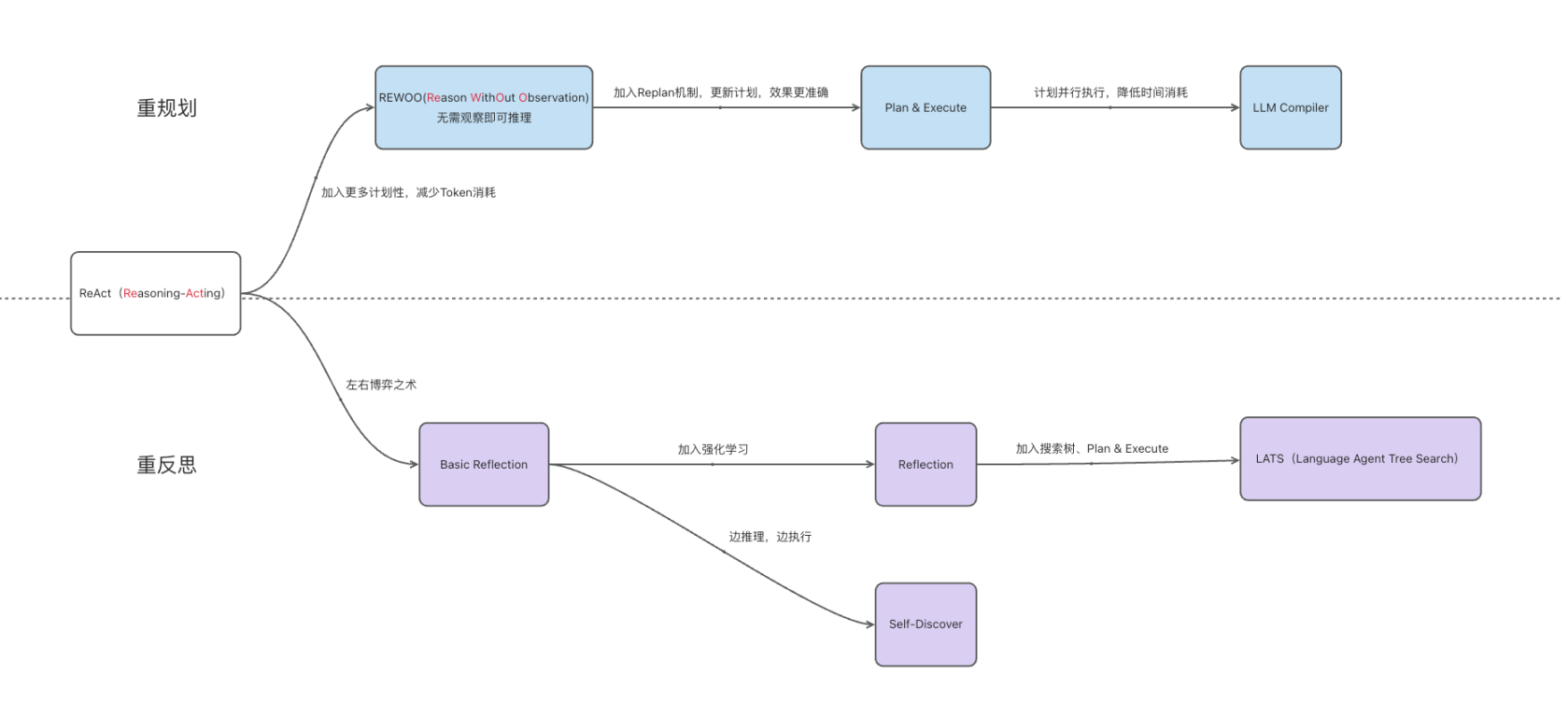
The ReAct mode is the earliest AI Agent design pattern and is currently the most widely used, so here we mainly introduce the concept of ReAct. ReAct refers to solving diverse language reasoning and decision-making tasks by combining reasoning and acting within a language model. Its typical process is shown in the figure below and can be described by an interesting loop: Think (Thought) → Act (Action) → Observe (Observation), abbreviated as the TAO loop.
- Thinking: When faced with a problem, we need to engage in deep thought. This thinking process is about how to define the problem, identify the key information needed to solve the problem, and outline the reasoning steps.
- Action: After determining the direction of thought, the next step is the moment of action. Based on our thoughts, we take corresponding measures or execute specific tasks, hoping to push the problem towards a solution.
- Observation: After taking action, we must carefully observe the results. This step is to verify whether our actions are effective and whether we are getting closer to the answer to the problem.
- Iterative Loop
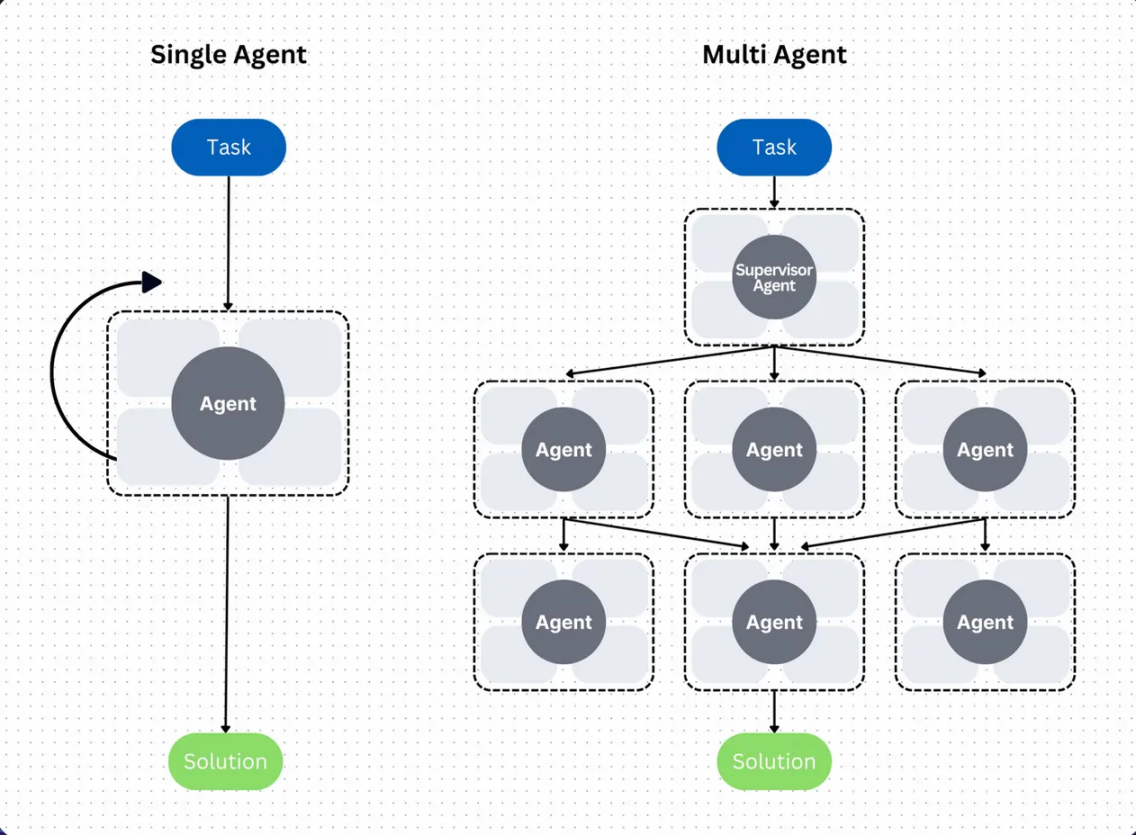
AI Agents can also be categorized based on the number of agents into Single Agent and Multi Agent. The core of Single Agent lies in the collaboration between LLM and tools, and during the task completion process, the Agent may have multiple rounds of interaction with the user. Multi Agent, on the other hand, assigns different roles to different Agents, completing complex tasks through collaboration among Agents. However, compared to Single Agent, the interaction with users will be less during the task completion process. Currently, most frameworks focus on the Single Agent scenario.
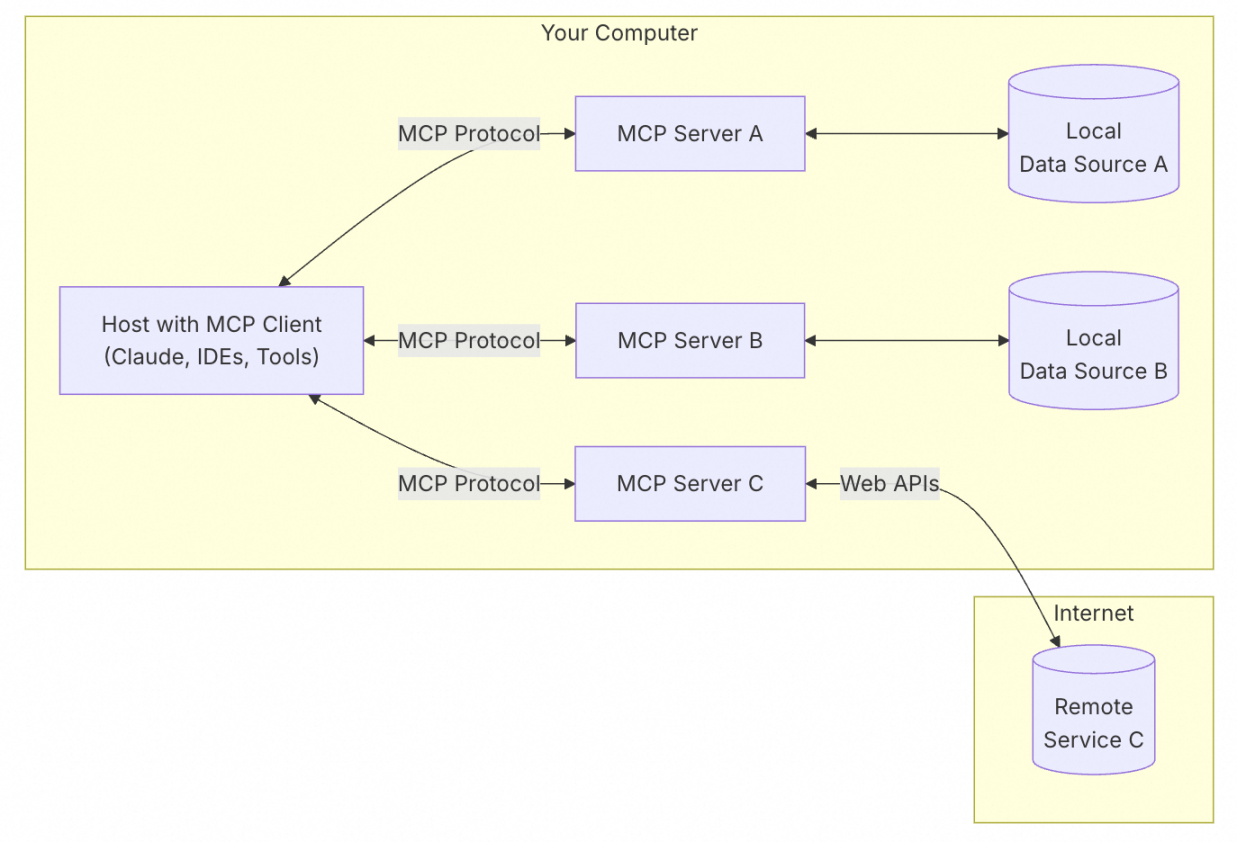
Model Context Protocol (MCP) is an open-source protocol launched by Anthropic on November 25, 2024, aimed at addressing the connection and interaction issues between LLMs and external data sources. One can think of LLM as an operating system and MCP as a USB interface, supporting the flexible insertion of external data and tools, allowing users to read and utilize these external data and tools.
MCP provides three capabilities to extend LLM: Resources (knowledge expansion), Tools (executing functions, calling external systems), Prompts (pre-written prompt templates). The MCP protocol adopts a Client-Server architecture, with the underlying transmission using the JSON-RPC protocol. Anyone can develop and host an MCP Server and can go offline and stop the service at any time.
Current Status of AI Agents in Web3
In the Web3 industry, the hype around AI Agents peaked in January of this year and has since declined significantly, with the overall market value shrinking by more than 90%. Currently, the major discussions and market value are still centered around exploring Web3 frameworks for AI Agents, namely the “launch platform model represented by Virtuals Protocol”, the “DAO model represented by ElizaOS”, and the “business company model represented by Swarms”.
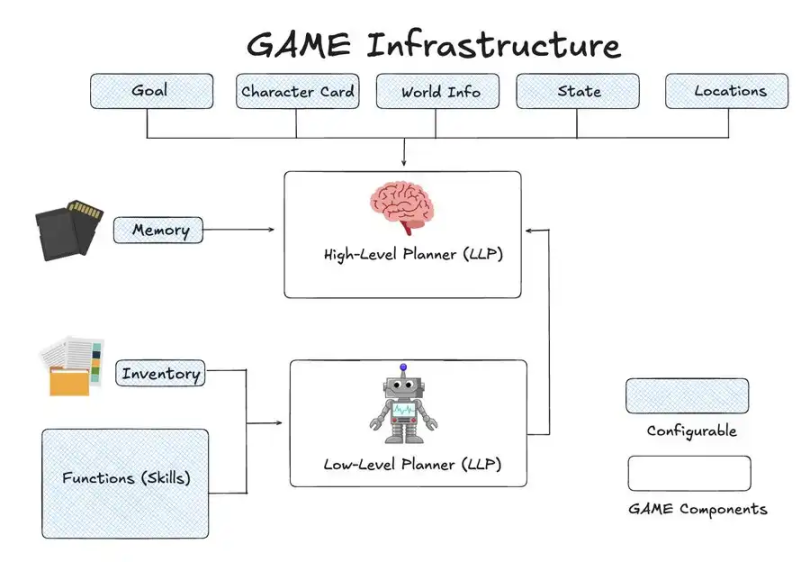
The launch platform is one that allows users to create, deploy, and monetize AI Agents, similar to pump.fun in memes, but targeted at AI Agents. Virtuals Protocol is currently the largest launch platform, with over 100,000 Agents issued on it, and the highly popular “crypto KOL” AIXBT is based on Virtuals. The Virtuals Protocol includes a modular Agent framework called G.A.M.E, and the core positioning of G.A.M.E is to provide developers with an efficient and open framework, making the development and launch of AI Agents as simple as building a website with WordPress.
DAO stands for Decentralized Autonomous Organization. ElizaOS (formerly ai16z) was founded by @shawmakesmagic on the daos.fun platform, with the initial concept of using AI models to simulate the investment decisions of the well-known venture capital firm a16z and its co-founder Marc Andreessen, and to incorporate suggestions from DAO members for investment. It later developed into a DAO focused on AI Agent developers with the Eliza framework at its core. The Eliza framework is built using TypeScript, providing a flexible and scalable platform for developing AI Agents that can interact across multiple platforms while maintaining a consistent personality and knowledge.
Swarms, initiated by the current 20-year-old @KyeGomezB in 2022, is an enterprise-level Multi-Agent framework. Swarms enables multiple AI Agents to collaborate like a team through intelligent orchestration and efficient cooperation, thereby addressing complex operational demands. Initially, Swarms was merely a Web2 AI Agent project. According to the founder, Swarms has over 45 million agents operating in production environments, serving the world’s largest financial, insurance, and healthcare institutions. It officially transitioned from Web2 to Web3 only after the issuance of the token $SWARMS in December 2024.
From the perspective of economic models, currently only the launch platform can achieve a self-sustaining economic closed loop. Taking Virtuals as an example:
- Agent Creation: The creator launches a new AI Agent on the Virtuals platform;
- Bonding Curve Settings: The creator pays 100 $VIRTUAL tokens to create a bonding curve for the new agent’s tokens, paired with $VIRTUAL.
- Liquidity Pool Creation: Once the binding curve limit is reached, the agent “graduates” and creates a liquidity pool pairing an agent token with the $VIRTUAL token, adhering to the fair launch principle without insiders: no pre-mining or internal allocations, fixed total supply, and liquidity locked for a longer duration.
In addition to the launch fee charged by the AI Agent, each transaction of the proxy token will also incur a transaction fee, and the AI Agent accessing the LLM through the Virtuals API will incur inference fees. Currently, both ElizaOS and Swarms are planning to build their own launch platforms.
Of course, the launch platform also has issues. This kind of asset issuance requires the assets being issued to have “attraction” in order to form a positive feedback loop. Currently, the vast majority of AI Agents launched are essentially Memes, lacking intrinsic value support. Once they lose market attention, they quickly plummet to zero. In the current quiet market environment, the launch platforms are even unable to attract creators, so the economic model essentially cannot operate.
MCP’s Web3 Exploration
The emergence of MCP has brought new exploratory directions for AI Agents in the current Web3, with two most intuitive directions:
- Deploy the MCP Server to the blockchain network, solving the single point issue of the MCP Server while having censorship resistance.
- The MCP Server has the capability to interact with the blockchain, such as conducting DeFi transactions and management, lowering the technical barrier.
The first direction places very high demands on the underlying blockchain’s storage system, data management capabilities, and asynchronous computing capabilities, and can select blockchains like 0G. 0G is a modular AI blockchain with a scalable and programmable DA layer suitable for AI dapps. Its modular technology will enable frictionless interoperability between chains while ensuring security, eliminating fragmentation, and maximizing connectivity, creating a decentralized AI ecosystem.
The second direction is similar to a variant of DeFAI, but currently the backend of DeFAI consists of a series of Function Calls wrapped in its own tools. UnifAI creates a unified DeFAI MCP Server, avoiding the need to reinvent the wheel. UnifAI is a platform that allows autonomous AI agents to execute on-chain and off-chain tasks within the Web3 ecosystem. It features UniQ for task automation, a marketplace for agent services, and infrastructure for tool discovery.
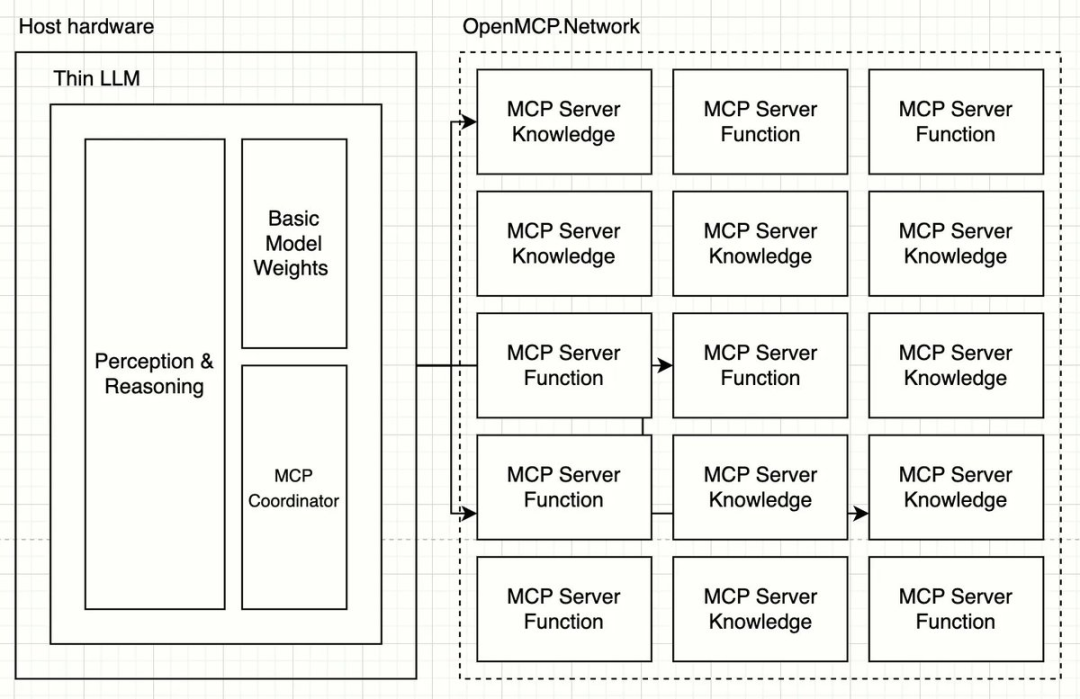
In addition to the two directions mentioned above, the founders of LXDAO and ETHPanda, @brucexu_eth, proposed a scheme to build an OpenMCP.Network creator incentive network based on Ethereum. The MCP Server needs to be hosted and provide stable services, users pay for LLM providers, and LLM providers distribute actual incentives to the invoked MCP Servers through the network to maintain the sustainability and stability of the entire network, inspiring MCP creators to continue creating and providing high-quality content. This network will require the use of smart contracts to achieve automation, transparency, trustworthiness, and censorship resistance in incentives. Signature, permission verification, and privacy protection during operation can be implemented using Ethereum wallets, ZK, and other technologies.
Although theoretically, the combination of MCP and Web3 can inject decentralized trust mechanisms and economic incentives into AI Agent applications, the current zero-knowledge proof (ZKP) technology still struggles to verify the authenticity of Agent behavior, and there are efficiency issues in decentralized networks, making this not a viable short-term solution.
Summary
The release of Manus marks an important milestone for general AI Agent products, and the world of Web3 also needs a milestone product to break the skepticism that Web3 has no practicality and is only hype.
The emergence of MCP has brought new exploration directions for Web3 AI Agents, including deploying the MCP Server to blockchain networks, as well as the MCP Server’s capability to interact with blockchains, or building a creator incentive network for MCP Server.
AI is the grandest narrative in history. For Web3, the integration with AI is inevitable. We still need to maintain patience and confidence, and continue to explore.


