Author: Jae, PANews
Compared with the external pressure of a bear market, Aave’s internal world has instead seen a “black swan” first.
Aave, which has long held the throne among lending protocols, is now experiencing the most intense ecosystem shock since its launch. There has been no hacker attack, no code vulnerabilities—what’s happening is simply power getting out of control and interests turning against each other.
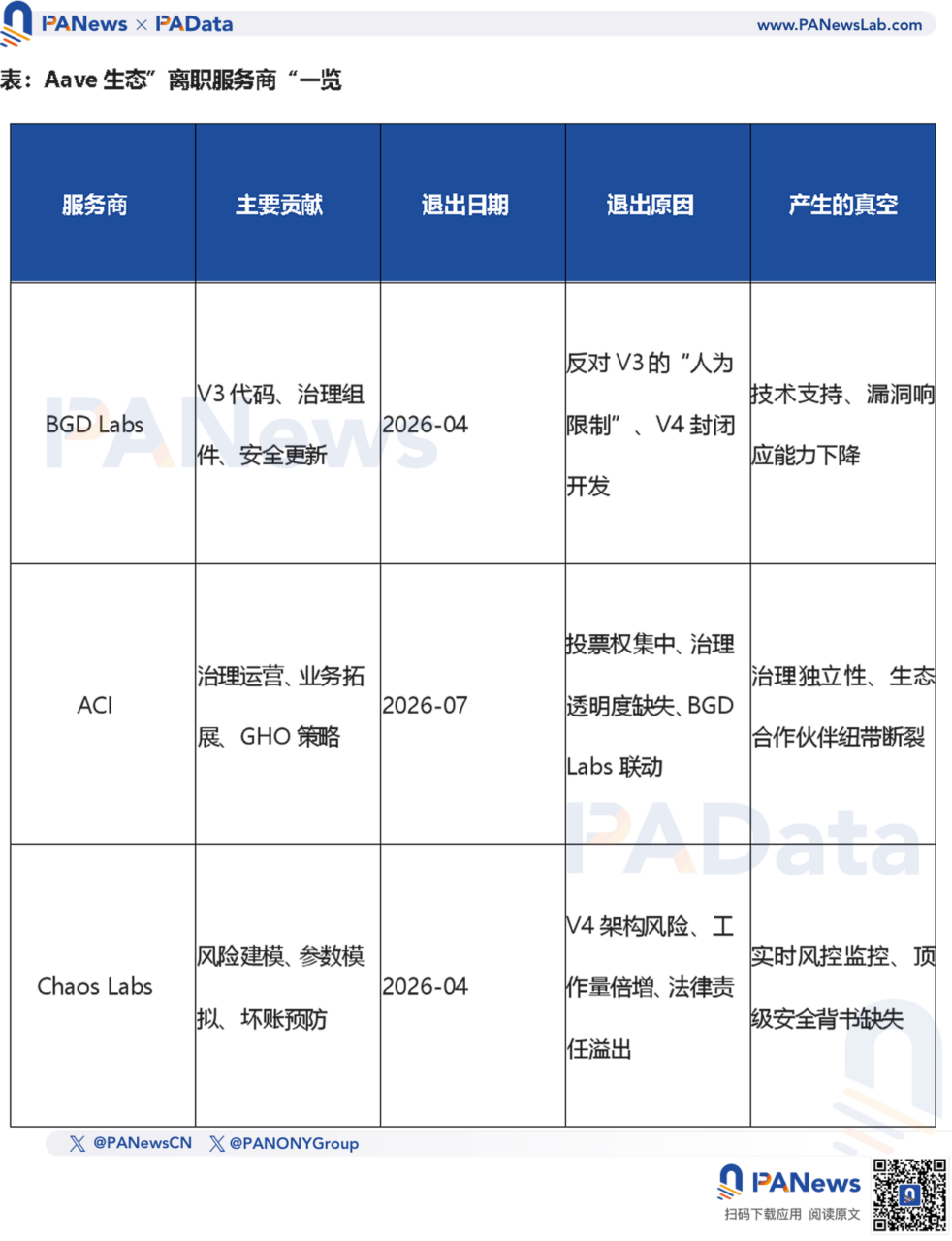
From the decisive departure of the technical pillar BGD Labs, to the public break between governance pioneer ACI (Aave Chan Initiative), and then to Chaos Labs’ official announcement to part ways—an industry “big retreat” by service providers is unfolding.
The stakes of this game go far beyond a dispute over cooperation. It triggers the ultimate paradox of a DAO (decentralized autonomous organization): the clash between founders’ will and decentralized governance, the contradiction between protocol long-termism and capital’s short-term profit chasing, and the balance between decentralized faith and centralized efficiency as blue-chip protocols scale up.
Can Aave still keep winning?
Chaos Labs has abandoned the risk-control gate—what’s really behind it?
On April 7, Chaos Labs, which has been deeply involved in Aave V2/V3 for three years and achieved “zero major bad debts,” announced its “breakup” with Aave. The departure of this top-tier risk-control firm directly hit Aave’s security red line.
Chaos Labs gave three reasons: it has been in a long-term loss state; its main contributor BGD Labs and ACI have left in succession; and there are fundamental disagreements with Aave Labs on risk-management philosophy in the context of Aave V4’s launch.
Among these, the focal point of the conflict mainly targets V4’s “hub-and-spoke” architecture. Chaos Labs said that while this design improves capital efficiency, it also exponentially amplifies risk. In an environment where legal responsibility is not clearly defined, the risk-control team has to carry double the workload to simultaneously maintain two massive systems: V3 and V4.
Aave Labs said it respects this, and thanks it for its years of contributions. The protocol’s smart contracts and network deployment are not affected. But this split between the two sides has other hidden context.
Aave Labs disclosed that it held many rounds of negotiations with Chaos Labs regarding the renewal proposal. It would support raising Chaos Labs’ risk-management fees from the current level to $5 million, but would not support increasing it directly to $8 million without setting follow-up additional terms. It also explicitly opposed the following three exclusive clauses: making Chaos Labs the sole risk manager, and setting up the Chaos Lalink, with Chaos Labs) Labs treasury as the default treasury for all B2B integrations, and using un-audited auditors to audit Labs treasury for all B2B integrations.
Simply put, Chaos Labs wants to expand control rights and commercial benefits. But for a DeFi protocol, once risk management relies excessively on a single vendor, systemic risk rises significantly and the protocol’s governance independence is weakened. For Aave, the potential risk is simply too big.
What’s more, in March this year, the Aave CAPO oracle handled by Chaos Labs suffered an on-chain configuration mistake, which caused wstETH to be undervalued by about 2.85%, and erroneously triggered the forced liquidation of a healthy position worth about $27 million.
Aave Labs emphasized that it will continue to adhere to a dual-layer risk-management model and introduce a third-layer technical risk-management mechanism led by Aave Labs. During the transition period, LlamaRisk will take over more risk coverage responsibilities from Chaos Labs. Aave Labs will support its expansion team and budget, and provide engineering and analytical resources to ensure a smooth handover.
As for Aave V4, its architecture introduces isolated risk markets through Spokes, new liquidation logic, and a parameter mechanism controlled by governance—enabling the DAO to manage risk for different markets and assets more precisely. In the short term, Aave Labs will work closely with LlamaRisk to ensure risk management transitions smoothly and the protocol’s operations remain unaffected.
Both technical and governance lines have failed in tandem—risk intensifies inside Aave
In addition to the security perimeter, Aave’s technology and governance have also failed in tandem over the past nearly two months.
On April 1, Aave V3 technical service provider BGD Labs announced it would terminate all technical contributions. This is not an April Fools’ joke. As the main development team for V3, BGD accused Aave Labs of strongly pushing an immature V4—“artificially limiting” V3 feature development, “maliciously downgrading” its value, and even forcing users to migrate through parameters.
BGD said that V3 contributions account for 98% of the code of Aave, and nearly all TVL; annual revenue exceeds $100 million—“the jewel” atop the protocol’s crown. Aave Labs closed off V4 development and sidelined external teams. BGD Labs has neither a say nor reasonable compensation. It can only leave in protest against this “radical transformation,” and against the lack of responsibility toward users’ asset security.
The governance service provider ACI, led by Marc Zeller, also plans to exit in July, with BGD Labs’ departure directly serving as the fuse. Marc Zeller blasted Aave Labs for launching a “slow-motion coup”: on-chain data shows it controls 23% of the AAVE token supply, and whale voting power has bulldozed community proposals.
ACI’s exit marks Aave governance shifting from “checks and balances of power” to “centralized power.” Third-party service providers are forced to become mere decoration.
Although Aave has once been a model of distributed collaboration in the DeFi market—Aave Labs sets the direction, third-party service providers handle development, manage governance, and control risk—multiple parties complementing each other supported its position as the lending leader. But now, after years of operating this way, the system is showing more and more cracks.
 Pain or a fatal illness? Aave faces a test of capital trust
Amid this chaotic and complex melee, the two sides’ interest demands present completely different pictures.
From the perspective of Aave Labs and founder Stani Kulechov, they hope to transform the protocol from a loose multi-party collaboration into a tighter, more execution-capable closed-loop ecosystem through V4 and the “Aave Will Win” framework.
The business logic of this transformation is: DeFi has entered a scaling phase. Relying on loose collaboration alone can no longer meet institutional-level demands or global financial competition.
Aave can develop high-profit products by concentrating resources and unify brand ownership, which can improve execution efficiency, reduce fragmented decision-making, and enhance AAVE token value-capture ability.
Of course, this is also a problem that mature DeFi protocols will need to face in the scaling phase. As the lending leader, Aave’s internal turmoil is amplified, becoming a mirror image of the entire DeFi governance model.
However, this “strongman rule” efficiency improvement is seen as coming at the cost of sacrificing the DAO’s decentralized credibility.
Service providers fundamentally rely on professional skills to obtain DAO funding. When Aave Labs tries to marginalize them, or when the compensation they offer is not enough to offset the increasingly growing legal and operational risks, they will inevitably choose to exit. This also reveals that under the current DAO service-provider model, even top teams face the business-model problem of being difficult to sustain.
For Aave, is service providers’ departure a short-term period of “pain” or a long-term terminal phase?
From an optimistic angle, this wave of service provider resignations could be a kind of “pain” during Aave’s transformation process.
Pain or a fatal illness? Aave faces a test of capital trust
Amid this chaotic and complex melee, the two sides’ interest demands present completely different pictures.
From the perspective of Aave Labs and founder Stani Kulechov, they hope to transform the protocol from a loose multi-party collaboration into a tighter, more execution-capable closed-loop ecosystem through V4 and the “Aave Will Win” framework.
The business logic of this transformation is: DeFi has entered a scaling phase. Relying on loose collaboration alone can no longer meet institutional-level demands or global financial competition.
Aave can develop high-profit products by concentrating resources and unify brand ownership, which can improve execution efficiency, reduce fragmented decision-making, and enhance AAVE token value-capture ability.
Of course, this is also a problem that mature DeFi protocols will need to face in the scaling phase. As the lending leader, Aave’s internal turmoil is amplified, becoming a mirror image of the entire DeFi governance model.
However, this “strongman rule” efficiency improvement is seen as coming at the cost of sacrificing the DAO’s decentralized credibility.
Service providers fundamentally rely on professional skills to obtain DAO funding. When Aave Labs tries to marginalize them, or when the compensation they offer is not enough to offset the increasingly growing legal and operational risks, they will inevitably choose to exit. This also reveals that under the current DAO service-provider model, even top teams face the business-model problem of being difficult to sustain.
For Aave, is service providers’ departure a short-term period of “pain” or a long-term terminal phase?
From an optimistic angle, this wave of service provider resignations could be a kind of “pain” during Aave’s transformation process.
- Streamlined decision chain: As multiple external stakeholders leave, Aave Labs can push V4 forward with fewer obstacles. In the face of fierce market competition, it can shorten product launch cycles;
- Front-end revenue flows back: If the “Aave Will Win” proposal ultimately realizes 100% of front-end revenue being returned to the DAO, the AAVE token would change from a mere “governance token” into a true “revenue instrument”;
- Unified technical paradigm: V4’s “hub-and-spoke” architecture solves V3’s multi-chain fragmentation problem. Through a unified liquidity hub, Aave is expected to seize opportunities first in the RWA and institutional credit markets.
However, most positive expectations are built on the assumption that “everything goes smoothly.” In reality, the negative impacts are more urgent.
- Security downgrade: V4’s complexity requires stricter risk-control mechanisms. After losing Chaos Labs, Aave currently has only LlamaRisk as its main risk-control service provider. This kind of single-point issue greatly increases systemic risk during extreme market conditions.
- Experience vacuum: Service providers leaving takes away three years of historical maintenance and operational data and experience. Once the protocol faces sudden circumstances, newly taking-over teams such as LlamaRisk may respond more slowly due to lack of deep involvement.
- Reputation damaged: Through large-scale token-holding involvement in voting, Aave Labs is essentially overdrawning the protocol’s reputation assets. If the DAO loses its power-balancing mechanism, its appeal to new developer entrants will be significantly reduced.
These negative effects are also raising concerns among capital. Although Aave has not experienced very severe security incidents in the past, uncertainty in risk is increasing, and the community is starting to doubt its execution ability and risk-control capacity. Some have even bluntly said, “When the old sailors collectively step off and the new sailors haven’t yet familiarized themselves with the route, don’t put all your belongings on board.”
At the moment, Aave is standing at a critical crossroads.
Disclaimer: The information on this page may come from third parties and does not represent the views or opinions of Gate. The content displayed on this page is for reference only and does not constitute any financial, investment, or legal advice. Gate does not guarantee the accuracy or completeness of the information and shall not be liable for any losses arising from the use of this information. Virtual asset investments carry high risks and are subject to significant price volatility. You may lose all of your invested principal. Please fully understand the relevant risks and make prudent decisions based on your own financial situation and risk tolerance. For details, please refer to
Disclaimer.
Related Articles
Lido's LDO Token Surges 30% in Monthly Rally as DAO Approves $20M Buyback Program
Lido's governance token LDO has gained 30% in 30 days, driven by a $20 million buyback program, while major DeFi competitors declined. Despite the rally, LDO remains down 94% from its peak.
GateNews1h ago
Sky Deploys USDS and sUSDS Natively on Avalanche via Skylink Bridge
Sky, the decentralized finance protocol formerly known as MakerDAO, launched its stablecoin USDS and yield-bearing sUSDS on Avalanche via Skylink, a unique crosschain bridge. The bridge began with a 5 million daily transfer cap, expected to increase by April 27.
GateNews1h ago
World Liberty Financial Proposes Restructured Vesting for 62.28B WLFI Tokens With Up to 4.52B Burn
World Liberty Financial proposed a governance restructuring affecting 62.28 billion WLFI tokens, including a potential burn of up to 4.52 billion tokens for eligible holders. The plan aims to align governance participation over two years, amid concerns about token unlocks and governance transparency.
GateNews2h ago
South Korea Launches Blockchain Deposit Token Pilot for Government Payments Starting Q4 2026
South Korea's Ministry of Economy and Finance has approved a pilot project for blockchain-based deposit tokens to replace traditional government purchase cards, aiming to prevent misuse of funds and cut costs. The initiative aligns with the country’s digital currency strategy.
GateNews4h ago
Sahara AI Launches Investment Agent Sorin Supporting Crypto, Stocks, and Prediction Markets
Sahara AI has launched Sorin, an investment agent for trading across various assets like cryptocurrencies and stocks. It offers autonomous trading, quantitative strategy automation, and personalized risk management to all users, following testing with 20,000 participants.
GateNews6h ago
Ethereum Foundation Funds $1M Audit Program for Smart Contract Developers
The Ethereum Foundation has launched a $1 million subsidy program designed to help Ethereum mainnet builders pay for professional smart contract security audits.
Key Takeaways:
The Ethereum Foundation launched a $1 million audit subsidy program on April 14, 2026, to help builders cover security r
Coinpedia6h ago


