Alejandro Grisanti, head of Ecoanalitica, proposed issuing a national USD stablecoin as part of a series of measures to lift currency controls in Venezuela. This system would complement the current auction system, allowing the excluded sector to receive dollars via blockchain rails.
Key Takeaways:
- Ecoanalitica proposes a stablecoin to fix local dollar shortages, driving future Venezuelan bank integration.
- Surging adoption since 2025 bypasses the Central Bank, making stablecoins vital for future SME dollar access.
- In October, R&D, Conexus, processing 40% of transfers, announced work on a stablecoin settlement system.
Ecoanalítica Proposes Venezuelan Stablecoin to Solve Dollar Woes
As the Venezuelan economy faces headwinds because of the currency controls and the exclusion of small and medium enterprises from the dollar assignment system, cryptocurrencies can be part of the solution to these issues.
In a recent note, Alejandro Grisanti, founder and CEO of Ecoanalitica, an economic consulting firm, highlighted the advantages of issuing a stablecoin to help correct dollar distribution issues derived from the implementation of an auction system that allows different exchange rates for the greenback.
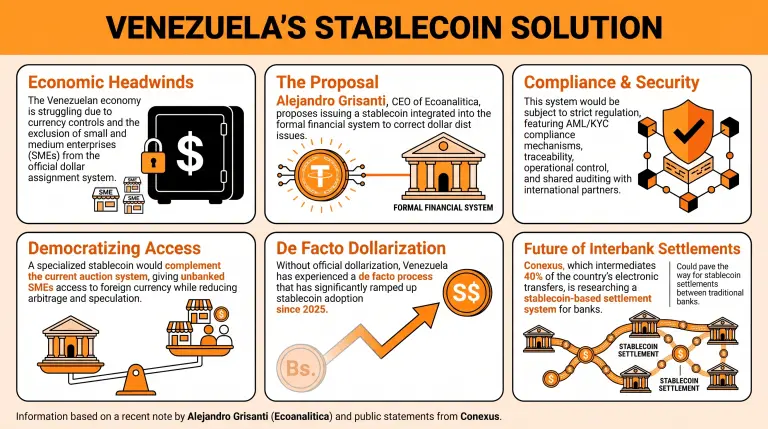
Grisanti proposes “the implementation of a system based on stablecoins integrated into the formal financial system, subject to strict regulation and featuring AML/KYC compliance mechanisms,” in addition to the controlled import of cash to allow small and medium-sized companies without banking accounts in the U.S. to operate using dollars in the local market.
Grisanti’s proposal suggests the issuance of a dollar stablecoin specially designed for the country, which would feature traceability, operational control, and shared auditing with international partners.
For him, such a system would be a good complement to the current auction system, which uses private and state banks as distributors, democratizing the assets to foreign currency to excluded systems, reducing the allure of arbitrage and speculation, and also strengthening the transparency of the foreign currency transactional system.
While there is no official dollarization, the Venezuelan economy has experienced a de facto dollarization process that ramped up stablecoin adoption since 2025, with exchange rates far higher than the official one set by the Central Bank of Venezuela. Grisanti’s proposal, if adopted, might precede the inclusion of stablecoins as part of the banking transactional system, potentially allowing for stablecoins settlements between banks.
In October, Rodolfo Gasparri, president of Conexus, which intermediates 40% of the country’s electronic transfers, stated that a stablecoin-based settlement system was in the early stages of research and development. Nonetheless, no news about this system has been shared since.
Disclaimer: The information on this page may come from third parties and does not represent the views or opinions of Gate. The content displayed on this page is for reference only and does not constitute any financial, investment, or legal advice. Gate does not guarantee the accuracy or completeness of the information and shall not be liable for any losses arising from the use of this information. Virtual asset investments carry high risks and are subject to significant price volatility. You may lose all of your invested principal. Please fully understand the relevant risks and make prudent decisions based on your own financial situation and risk tolerance. For details, please refer to
Disclaimer.
Related Articles
Fellowship PAC 獲 Cantor Fitzgerald 10M,Tether 高管任主席
Crypto Political Action Committee Fellowship PAC releases its first FEC donation disclosure, showing that Cantor Fitzgerald donated $10 million and has a business connection with Tether. Fellowship PAC supports six Republican candidates and paid $4.5 million to NXUM Group for advertising promotion.
MarketWhisper2h ago
U.S. military seizes an Iranian cargo ship in the Gulf of Oman, and Bitcoin plunges to $74k
A U.S. Navy destroyer destroyed and seized an Iranian cargo ship in the Gulf of Oman, driving up market risk-hedging sentiment, with Bitcoin down 2.5% and Brent crude soaring to $97. Iran vowed retaliation, and diplomatic negotiations face a highly uncertain situation. On Wednesday, the ceasefire deadline has become the focus of market attention.
MarketWhisper3h ago
Latam Insights: Brazil Seeks Online Gambling Ban, Venezuela's National Stablecoin Proposal
Welcome to Latam Insights, a compilation of the most relevant crypto news from Latin America over the past week. In this edition, a draft to repeal all online gambling has been introduced in Brazil, a proposal to include stablecoins to help curb currency restrictions rises in Venezuela, and Latam
Coinpedia4h ago
Bitcoin falls below 74K; U.S. former defense secretary: A U.S.-Iran agreement may be difficult to reach before the deadline
With tensions rising in the Middle East geopolitical landscape, the Strait of Hormuz has become the focal point of military conflict between the U.S. and Iran. Attacks and seizures of cargo ships have been occurring frequently, and crude oil prices have risen. The U.S.-Iran ceasefire agreement is set to expire soon; peace talks have fallen into a stalemate due to irreconcilable positions, making it difficult to reach an agreement. As a result, the price of Bitcoin has dropped below 74K.
ChainNewsAbmedia5h ago
US Equity Futures Fall as Oil Surges on Escalating Iran Tensions
Oil prices rose sharply by over 7% amid escalating US-Iran tensions, causing a drop in US equity futures and a stronger US dollar against major currencies. Risk-sensitive assets faced significant losses.
GateNews5h ago
China's Financial Law Draft Consultation Ends; Digital Currency Legal Status, Crypto Asset Regulation Largely Absent
China's Financial Law Draft aims to unify financial legislation, granting regulators expansive investigative powers. While it strengthens oversight, it lacks focus on emerging sectors like AI and digital currencies, highlighting the need for balance between regulation and innovation.
GateNews15h ago


