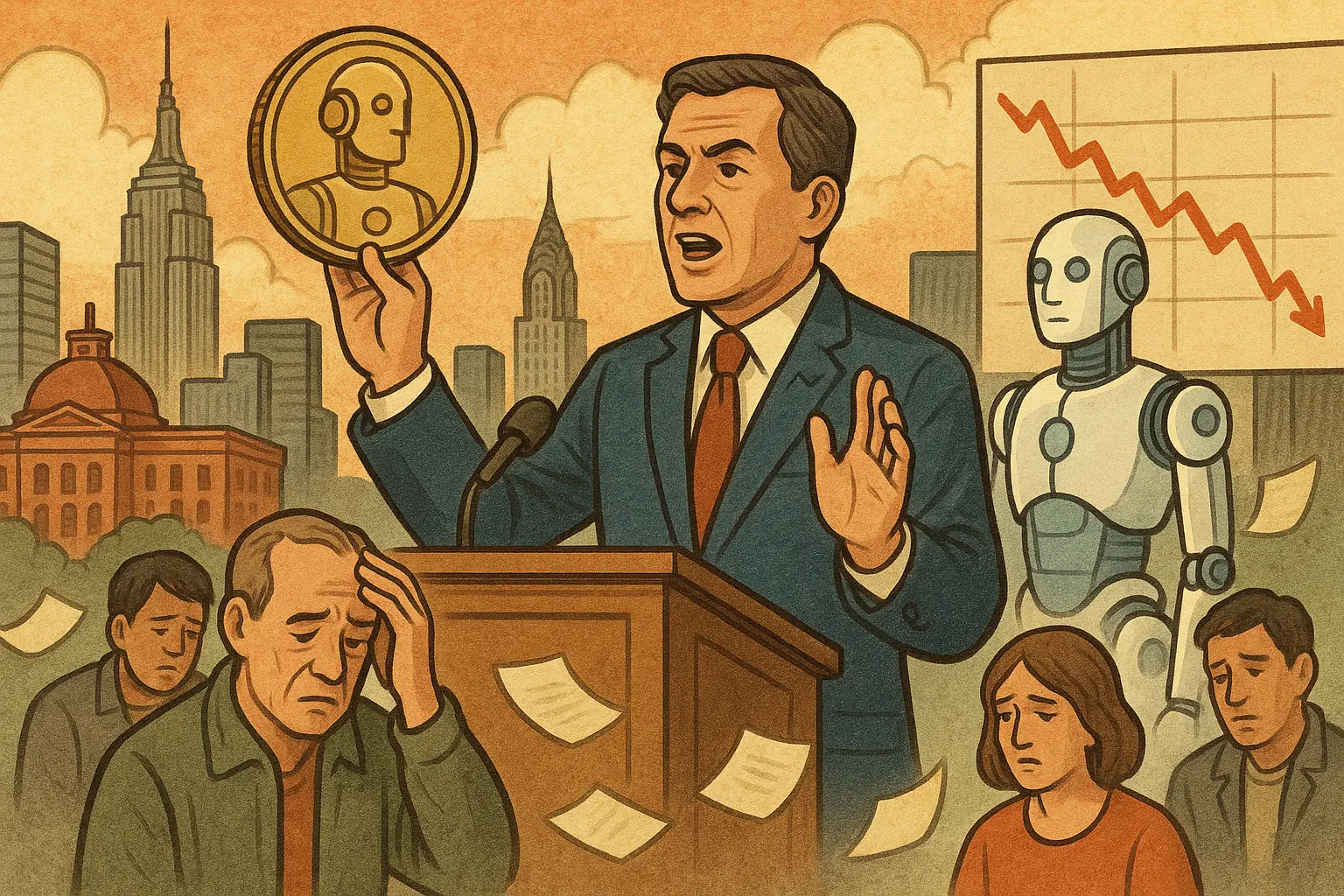
New York state legislator and congressional candidate Alex Bores announced on Sunday an “AI dividend” plan, aiming to make direct payments to U.S. citizens when artificial intelligence significantly replaces American workers. The announcement comes after a Goldman report found that AI adoption has already led to the loss of about 16k jobs per month in the United States; tech giants including Amazon, Meta, Intel, and Microsoft have all announced large-scale layoffs in succession.
Design mechanisms of the AI dividend plan: trigger conditions and how the funds are used
(Source: Alex Bores)
The AI dividend plan is not a fixed universal basic income (UBI). Instead, it sets trigger conditions—only when AI “significantly replaces American workers” will it be activated. In addition to making direct dividend payments to U.S. citizens, the funds will be used in three directions: investing in “workforce transition, training, and education”; building AI oversight and safety infrastructure; and incentivizing employers to choose hiring humans rather than AI.
The funding-raising mechanism includes: taxing the use of AI, holding equity in leading AI companies, and reforming the tax treatment of labor and capital. Bores is currently positioning this policy as a key platform for his congressional campaign, and whether it can be implemented depends on whether his campaign is successful.
Divergence between the two institutions: how severe is the AI unemployment impact, really?
A Goldman report shows that AI adoption has led to the loss of about 16k jobs per month in the United States, and the large-scale layoffs by Amazon, Meta, Intel, and Microsoft are considered to be directly related to AI efficiency-driven substitution.
However, a more cautious assessment was provided in a report published by Morgan Stanley on April 14: so far, AI’s impact on the labor market is “relatively mild,” and there is no sufficient evidence indicating that widespread unemployment is already occurring. Morgan Stanley cites historical patterns showing that waves of new technology long-term have typically also promoted job growth—while at the same time acknowledging that artificial intelligence may break this historical rule.
Policy backdrop: political responses amid the tech giants’ layoff wave
The proposal of the AI dividend plan reflects the U.S. political establishment’s growing attention to how AI is affecting the job market. How to allocate the productivity gains brought by AI is becoming a campaign issue for more and more political figures. From conception to implementation, the plan still faces several major challenges, including quantifying the trigger conditions, the legality of an AI usage tax, the enforcement mechanisms for holding equity in AI companies, and how to avoid negative impacts on AI innovation.
Frequently asked questions
What are the trigger conditions of the AI dividend plan, and does it amount to universal basic income?
The AI dividend is not a universal basic income (UBI). Its key difference lies in the setting of trigger conditions—only when AI “significantly replaces American workers” will it be activated. The plan is positioned as an “insurance mechanism,” not a fixed baseline income. The specific quantitative trigger criteria (such as an unemployment-rate threshold) have not been explained in detail in public statements.
Why do Goldman and Morgan Stanley assess the AI unemployment impact differently?
Goldman focuses on presenting substitution effects that have already occurred (16k job losses per month), while Morgan Stanley evaluates from a longer historical perspective, concluding that the impact is “mild” for now, and citing historical precedents that after technological substitution, job growth typically follows. At the same time, it also acknowledges that AI’s disruptive potential may differ from past technology revolutions.
Is this plan legislatively feasible?
The plan is currently still at the campaign-proposal stage. The premise for implementation is that Bores successfully wins a seat in Congress and secures sufficient political support in Congress. The AI usage tax and mandatory shareholding mechanisms involved in the plan may face strong resistance from the tech industry and capital markets.
Disclaimer: The information on this page may come from third parties and does not represent the views or opinions of Gate. The content displayed on this page is for reference only and does not constitute any financial, investment, or legal advice. Gate does not guarantee the accuracy or completeness of the information and shall not be liable for any losses arising from the use of this information. Virtual asset investments carry high risks and are subject to significant price volatility. You may lose all of your invested principal. Please fully understand the relevant risks and make prudent decisions based on your own financial situation and risk tolerance. For details, please refer to
Disclaimer.
Related Articles
OpenAI Codex Monthly Active Users Reach 4 Million in Under Two Weeks
OpenAI Codex hit 4 million MAUs, announced by Sottiaux and Altman; the jump came in under two weeks from 3 million, and rate limits were reset across all tiers to celebrate.
OpenAI Codex reached 4 million monthly active users in under two weeks since reaching 3 million, according to statements by OpenAI executives. To mark the milestone, rate limits across all tiers were reset.
GateNews2h ago
Two South African AI Startups Selected for Google for Startups Accelerator Africa Class 10
Two SA startups, Loop and Vambo AI, join Google's Accelerator Africa 10th cohort from 2,600 apps; Loop enhances mobility/payments, Vambo AI enables multilingual AI; program runs Apr-Jun 2026 with mentors and AI workshops.
Abstract: Two South African startups, Loop and Vambo AI, have been selected for the Google for Startups Accelerator Africa's 10th cohort, chosen from about 2,600 applications and one of 15 African participants. Loop digitizes mobility and payments, while Vambo AI provides multilingual AI infrastructure for translation, speech, and generative AI across African languages. The 2026 program runs April 13–June 19 and offers mentorship and hands-on workshops focused on AI/ML. Since 2018, the accelerator has supported 106 startups from 17 African countries, helping them raise over $263 million and create more than 2,800 jobs.
GateNews3h ago
Forbes AI 50 List Features 20 New Companies; OpenAI and Anthropic Capture 80% of Total Funding
Gate News message, April 21 — Forbes released its 2026 eighth edition AI 50 list, featuring 20 newly included companies. OpenAI and Anthropic continue to lead the rankings, attracting substantial capital from top Silicon Valley venture capitalists and major tech firms. The combined funding for all l
GateNews3h ago
Zi变量 Unveils WALL-B Embodied AI Model; Robots to Enter Real Homes in 35 Days
Gate News message, April 21 — Zibianliang (自变量), a Chinese robotics company, held a press conference on April 21 to unveil its next-generation embodied AI foundation model, WALL-B. The company announced that robots powered by WALL-B will enter real households in 35 days.
According to Zibianliang co
GateNews4h ago
OpenAI Prepares Agents Feature for ChatGPT, Codenamed Hermes
Gate News message, April 21 — OpenAI is preparing a new Agents feature for ChatGPT, codenamed "Hermes," according to Tibor Blaho, who monitors AI product updates. The feature includes a new agent builder called "studio" that allows users to create agents from templates, schedule runs, and
GateNews4h ago
SpaceX Kicks Off IPO Roadshow with Analyst Meetings at Starbase and Memphis
Gate News message, April 21 — SpaceX has begun its pre-IPO roadshow this week, hosting private meetings for top Wall Street analysts from the aerospace and tech sectors in Texas and Tennessee as it works toward a late-June stock market debut. The company is targeting a $75 billion raise, with
GateNews4h ago


